

Every summer I stand in a Raleigh living room and get asked some version of the same question: should we put in a mini-split, or just replace the central air? Homeowners usually expect a long answer full of tradeoffs. Most of the time it is a short one, and it has almost nothing to do with which system is “better.”
It comes down to a single fact about your house: whether you already have ductwork, and whether that ductwork is any good. In my experience, answer that honestly and the decision makes itself for the large majority of Triangle homes. Everything else, the efficiency ratings, the zoning, the look of the wall units, is a tiebreaker for the handful of houses that could genuinely go either way.
Here is the whole comparison the way I explain it on a sales call, with real Raleigh numbers, the manufacturer specs behind them, and the answer I give most often, which is not the either-or answer you came here expecting.
TL;DR: A mini-split and a central air conditioner both cool a Raleigh home well. The choice almost always comes down to whether your house already has ductwork in decent shape. If it does, replacing the central system is usually the cheaper, simpler move. If it does not, or your ducts are leaking into a blazing hot attic, ductless wins on both cost and efficiency. Mini-splits run $2,000 to $7,000 per zone (per Bryant) and reach about 35 SEER2 versus roughly 26 SEER2 for the best central systems (per Carrier), and they skip the 20 to 30 percent of conditioned air a typical duct system loses (per ENERGY STAR). The most common right answer in the Triangle is not either-or: keep central air for the main house and add one mini-split for the room it never cools.
Mini-Split vs. Central Air: What Is the Actual Difference?
The difference is ductwork, and that is genuinely the entire thing. Carrier puts it plainly: “The primary difference between a mini split vs central air system lies in the ductwork.” A central system conditions air in one place and pushes it through a hidden duct network to every room. A ductless mini-split skips the network entirely and puts a small indoor unit directly in each room that needs conditioning.
Mechanically, the two are closer than most people realize. Both use an outdoor unit with a compressor, both move refrigerant through a coil to pull heat and humidity out of indoor air, and both are rated on the same SEER2 efficiency scale. If you understand how one works, you understand how the other works. The delivery method is what changed.
That delivery difference drives everything else on this page. No ducts means no duct losses, but it also means visible indoor units and a separate head for every room you want to condition. Ducts mean invisible vents and one thermostat, but they also mean a lot of conditioned air moving through an unconditioned attic. Here is how the two line up side by side.
Why Raleigh Homeowners Ask This Question Every July
Interest in this comparison is almost perfectly seasonal, and the swing is bigger than most people would guess. Pulling twelve months of national search data for “mini split vs central air,” the query bottoms out at 1,000 searches in November and peaks at 5,400 in July. That is a 5.4x swing from the quietest month to the busiest.
The shape tells you something useful about the decision itself. Nobody researches cooling systems in November. They research them the week the upstairs stops keeping up, which in the Triangle is late June through early August. That is also the worst possible week to make a five-figure decision, because you are hot, annoyed, and inclined to say yes to whatever gets fixed fastest.
Notice the shoulder months in the middle of the curve, too. Demand does not sit flat through winter and then spike. It starts climbing in March, is more than double the winter low by May, and nearly doubles again by July. That March to May ramp is people who remember last August and decided to get ahead of it, and they are the ones who end up with the best outcome, because a mini-split versus central air comparison done in spring is a comparison. Done in July it is a rescue.
If your system is still limping along, the smartest thing you can do is have this conversation in April or October, when we can actually take our time with a load calculation and you can compare two real quotes side by side without sweating through the appointment.
Which Costs More to Install in a Raleigh Home?
It depends entirely on the ducts, which is why a single “mini-split versus central air” price comparison is close to meaningless. A ductless installation typically runs “between $2,000 and $7,000 per zone” (per Bryant), with single-zone systems generally landing at $2,000 to $6,000. A central air installation averaged $5,977 nationally, with most homeowners spending between $3,887 and $8,073, according to HomeAdvisor‘s 2024 cost data.
Line those up and central air looks competitive, until you notice that the central number assumes ducts already exist. If they do not, the comparison flips hard. Bryant is blunt about it: “If your home lacks existing ducts, installing central air can double your total project cost due to construction requirements.” Carrier puts a ceiling on it, noting that “Adding new ductwork can add up to $18,000 on top of the AC unit price.” HomeAdvisor’s own figure for new ductwork runs $1,000 to $5,000, with an average around $2,000, so the realistic Raleigh range sits between those two poles depending on how much of your house we have to open up.
The other direction has a trap too. A single mini-split head is cheap. Conditioning a whole four-bedroom house with ductless means four to five separate zones, and at Bryant’s per-zone range that is real money. Here is the honest spread across the four scenarios I actually quote.
Those overlapping ranges are the real finding. There is no price winner in the abstract. For a full breakdown of what drives a ductless quote specifically, we walk through every line item in our guide to mini-split installation cost in Raleigh, and the equivalent central-system math lives in our AC replacement cost guide.
Do You Already Have Ductwork? That One Answer Decides Most of This
If your Raleigh home has central ducts that are properly sized, sealed, and not falling apart, replacing the central system is almost always the better value. If it has no ducts, or the ducts are in bad shape, ductless usually wins outright. That is the fork in the road, and it is worth being honest with yourself about which side you are on.
The catch is that plenty of Triangle homes technically have ductwork that should not count as an asset. A lot of the housing stock here runs flex duct through a vented attic. In a Raleigh August that attic runs far hotter than the house it sits on, and every leak, crushed section, and loose collar up there is dumping cold air you paid for into a place nobody lives. ENERGY STAR’s figure is not a small one: “In a typical house, however, about 20 to 30 percent of the air that moves through the duct system is lost due to leaks, holes, and poorly connected ducts.”
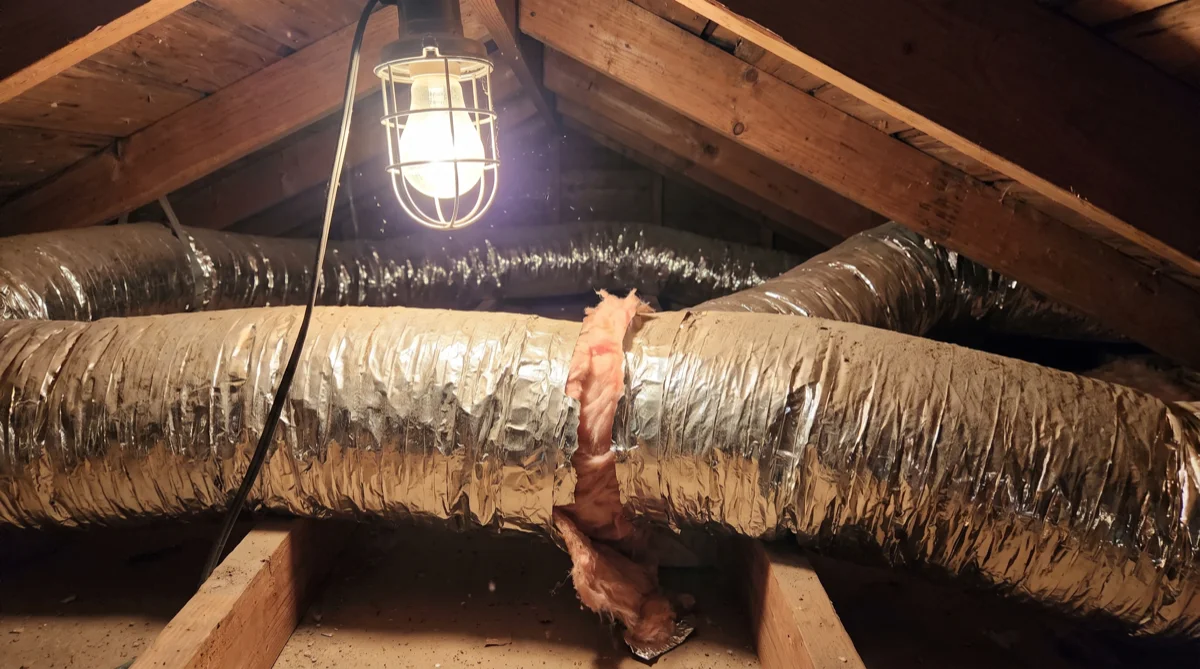
From the field (Frankie Asfari, NATE-certified, NC License #L.34356): Before I quote anybody a mini-split to fix a hot room, I go in the attic. I would guess a third of the time the room is not hot because the system is undersized. It is hot because the duct feeding it came off the plenum, or it got stepped on and pinched down to nothing, or somebody ran a 6-inch duct to a room that needed an 8. Sealing and repairing that is a fraction of what a ductless head costs, and I would rather tell you that than sell you equipment you did not need.
So the real first step is not choosing a system. It is finding out what you actually have. That is a duct inspection, a static pressure reading, and a look at whether the return side can even move the air the system is rated for. If the ducts turn out to be fixable, duct sealing plus a straight central AC replacement is frequently the cheapest path to a comfortable house. If they are not fixable, you are effectively a no-duct home, and you should price ductless accordingly.
Which System Is More Efficient?
Ductless is more efficient, and the biggest reason is not the equipment. It is that a mini-split has no ducts to lose air in. Bryant frames the efficiency case exactly this way: mini-splits “eliminate the energy loss associated with ductwork, which can account for more than 30% of energy consumption for space conditioning.”
Think about what that means in practice. A central system rated at a given SEER2 produces that efficiency at the equipment. What lands in your bedroom is whatever survives the trip. Lose a quarter of it in the attic and a very good air conditioner delivers mediocre comfort while running a very real electric bill. A ductless head, by contrast, blows conditioned air directly into the room it serves. There is no trip to survive.
The equipment gap is real too, just smaller than the delivery gap. Ductless systems reach higher peak efficiency than ducted ones, and there is a straightforward reason: a small variable-speed compressor serving one room can modulate far more finely than a large unit trying to serve a whole house. If SEER2 is new to you, we unpack the whole rating in our explainer on what counts as a good SEER rating in NC.
One honest caveat before you conclude ductless always wins the power bill. Efficiency ratings assume a correctly sized system. An oversized mini-split short-cycles and does a poor job pulling humidity out of the air, which matters enormously in a Raleigh summer. ENERGY STAR is direct about this: “Your contractor should verify the proper size system for your home using a tool called ‘Manual J.'” A properly sized central system beats a badly sized ductless one every time.
The North Carolina Efficiency Rule Nobody Mentions on a Quote
Here is something that almost never comes up on a sales call, and it is specific to living in North Carolina. Federal minimum efficiency standards for central air conditioners are not the same nationwide. Bryant explains it plainly: “For air conditioners, the Department of Energy’s new minimum efficiency standards varies by region, so your choice of AC units depends on where you live. For heat pumps, the new standard is uniform across the nation.”
North Carolina sits in DOE’s “South” region, alongside Alabama, Georgia, Florida, South Carolina, Tennessee, Texas and Virginia among others. That region carries a higher minimum efficiency requirement for split-system air conditioners than the North does, which is exactly what you would want in a climate that runs the AC from April to October.
The asymmetry is the interesting part. A ductless mini-split is a heat pump, so it is governed by the uniform national heat pump standard, not the regional AC standard. Practically, this means the two systems on your quote are not being measured against the same federal floor. It rarely changes the decision by itself, but it does explain why comparing a “builder grade” central unit in Raleigh to a “builder grade” ductless unit is not an apples-to-apples comparison. Here is where the ceilings sit.
What About Heating Through a Raleigh Winter?
A ductless mini-split heat pump heats as well as it cools, and in our climate it heats very well. A central air conditioner does not heat at all, which means a fair comparison is almost never “mini-split versus central AC.” It is “mini-split versus central AC plus whatever heats your house.”
That distinction changes the budget more than anything else on this page. If you are replacing a dead air conditioner and your gas furnace is healthy, you are only buying half a system, and central air is the cheap answer. If your furnace is also on its last legs, or you are on electric resistance heat, a ductless heat pump or a ducted heat pump replaces both jobs with one machine.
Cold weather is a fair question and the answer has changed. ENERGY STAR notes that many certified mini-split models “excel at providing space heating even in the coldest of climates” and that the certification “requires third-party verified performance for low temperatures, testing ASHPs down to 5°F.” Raleigh winters do not seriously test that. Our concern here is not capacity, it is making sure the system is sized for the cooling load first, since that is what runs eight months a year.
Where Mini-Splits Actually Win in Triangle Homes
Mini-splits win decisively in spaces the central system was never designed to reach. That is the pattern I see over and over in Raleigh, Cary and Apex: the house is fine, one room is miserable, and the miserable room is always the same handful of rooms.
The bonus room over the garage is the classic. It sits above an unconditioned space, it usually got one undersized duct run at the end of the longest branch, and it faces whatever direction the builder happened to face it. Sunrooms, converted garages, attic conversions, additions, and primary bedrooms at the far end of a ranch all have the same story. Carrier lists exactly these situations as ductless territory, including renovating an older home without ductwork, building a room addition or converting a garage.
What makes these rooms so stubborn is that the central system is not broken, so nothing looks wrong from the thermostat’s point of view. The equipment reaches its setpoint in the hallway where the thermostat lives, shuts off, and considers the job done, while the room at the end of the line never got enough airflow to catch up. You cannot fix that by turning the thermostat down, and you usually cannot fix it by buying a bigger outdoor unit. You fix it by putting conditioning directly in the room, which is exactly what a single ductless head does.
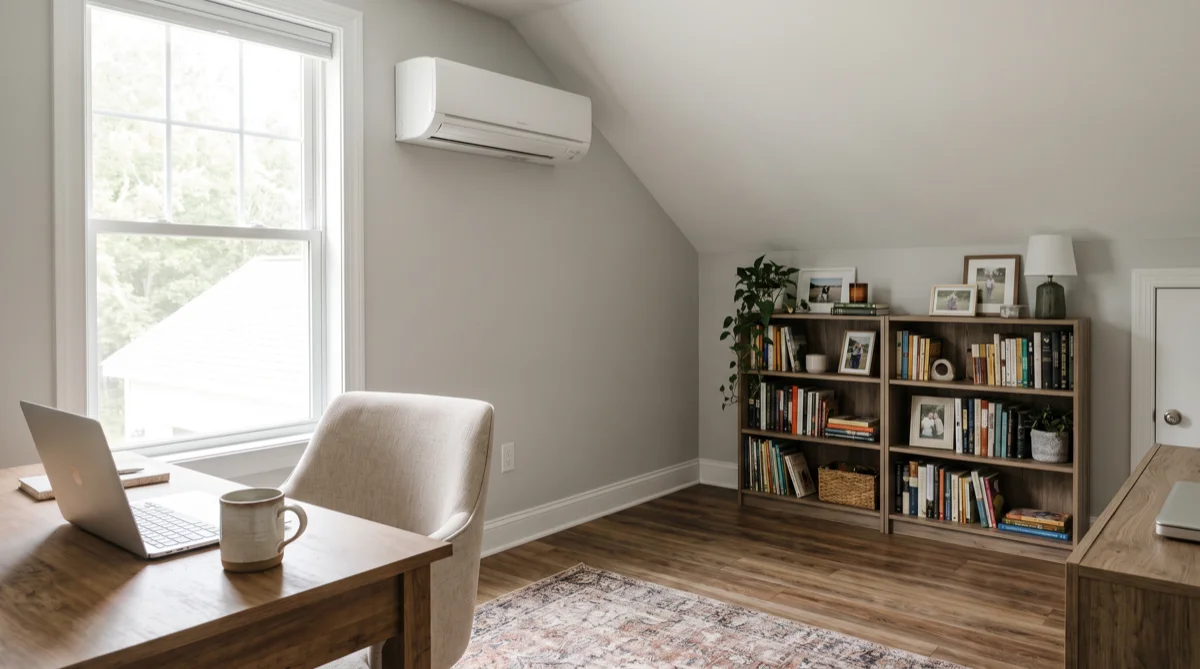
The second clear win is a home with no ducts at all. Plenty of older Raleigh houses were built with radiators, baseboard, or window units and never got central air. ENERGY STAR specifically identifies these as mini-split candidates, including “older homes with no existing ductwork (e.g., radiators or baseboard heat) that have never had central air conditioning before” and homes “with costly electric heat” that would also benefit from cooling. For those houses, ductless is not a compromise. It is the only sensible option that does not involve tearing into ceilings.
The third win is genuine zoning. A ductless system gives every zone its own setpoint by default, while Carrier notes that with central air, “Without expensive upgrades, you generally have to cool the whole house to the same temperature.” If you have a household that fights over the thermostat, that is not a small feature. Lennox notes that a single high-efficiency outdoor unit “can support up to five indoor units or comfort zones,” so whole-home ductless is realistic for most Triangle floor plans. Our mini-split installation page walks through how we lay those zones out.
Where Central Air Still Wins
Central air still wins in a big, already-ducted house, and it wins on the things nobody thinks about until after the install. Bryant is straightforward about the size advantage: central air “is highly effective for larger, multi-story homes, as it can efficiently distribute cooled air across expansive areas without needing multiple indoor units.”
The whole-home air quality argument is the one homeowners underrate. A central system pulls every cubic foot in the house across one filter, which is what makes a real media filter, a whole-home dehumidifier, a UV lamp, or a fresh-air ventilator possible at all. Carrier’s list of central advantages includes exactly this, noting central systems “can easily integrate whole-home air purifiers, humidifiers, and dehumidifiers.” A mini-split’s per-unit filters are fine at catching dust in one room, but they are not a whole-home air quality strategy. If pollen season is your real problem, that matters more than SEER2 does, and our indoor air quality guide covers why.
Then there is the wall unit itself. Some people genuinely do not care. Some people care a great deal, and there is no talking them out of it after the fact. Carrier is honest about this tradeoff too, listing aesthetics as a ductless disadvantage since “You will have visible units on your walls or ceilings, unlike the invisible vents of central air.” I would rather you look at one on a wall before you buy five of them.
Can You Have Both? This Is What We Install Most
Yes, and in the Triangle this hybrid setup is the single most common right answer. You keep the central system for the main house and add one ductless head for the room central air was never going to fix. Bryant confirms the approach outright: “Many homeowners use central air for the main living areas and install a ‘hybrid’ mini split system for hard-to-cool rooms like garages, sunrooms, or attic bedrooms.”
The economics are hard to argue with. A single-zone mini-split at $2,000 to $6,000 (per Bryant) solves the bonus room permanently, while the alternatives are worse in both directions: oversizing the central system to brute-force one room makes the whole house clammy and short-cycles the equipment, and rebuilding the duct branch to that room often costs as much as the mini-split and still fights physics.
There is a comfort argument on top of the money. Once that room has its own head, it also has its own setpoint, which means the office over the garage can sit at 70 in August without freezing out the rest of the house to get there. That is the part homeowners tell me about afterward. They expected to stop being hot. They did not expect to stop arguing about the thermostat.
It also lets you stage the money. Add the mini-split now for the room that is making your summer miserable, and let the central system finish out its life on its own schedule instead of replacing everything at once under duress. When the central unit does finally go, you already know how the ductless side performs in your house, which makes the whole-home decision a lot easier.
If you want the ducted-heat-pump version of this conversation, meaning one system that heats and cools through your existing ducts, we compare that path in detail in our guide to heat pump vs. central air, and we cover the gas-plus-heat-pump combination on our dual fuel systems page.
How Long Does Each System Last, and What Breaks?
Expect similar service life from both. Carrier’s guidance is that “air conditioners and heat pumps typically have a life expectancy of 15 to 20 years,” and a ductless mini-split is a heat pump, so it sits in that same band. Lifespan is not a tiebreaker here. How well the thing was installed and whether anybody maintains it matters far more than which type you chose.
What differs is the maintenance shape. A central system has one filter to change and one set of coils to clean, plus ductwork that eventually needs attention. A ductless system has a washable filter in every indoor head and a blower wheel in each one that will collect grime over the years. More heads means more small tasks, not harder ones. Either way, a system that runs from April through October in Raleigh wants a professional look once a year, and a heat pump running both seasons wants two.
Whichever way you go, the maintenance is what protects the number at the top of the invoice. We handle both on our mini-split maintenance and maintenance package plans, and if you want the full repair-versus-replace framework for an aging system, it is laid out in our guide to how long an AC unit lasts.
Rebates and Tax Credits: What Changed for 2026
The biggest thing to know is what is gone. The federal 25C Energy Efficient Home Improvement Credit, which paid up to $2,000 toward a qualifying heat pump, has expired. The IRS states that “The credit is allowed for qualifying property placed in service on or after Jan. 1, 2023, and before December 31, 2025.” A great many articles still ranking on this topic have not caught up, so treat any 2026 page that tells you to claim it as out of date.
What is left in North Carolina is state and utility money, and for eligible households it can be larger than the federal credit ever was. Energy Saver North Carolina supports heating and cooling upgrades for “Homeowners and renters (with landlord approval) with household incomes less than 150% of the Area Median Income (AMI).” Under its Home Electrification and Appliance Rebate track, the NC Department of Environmental Quality lists “Up to $8,000 for an ENERGY STAR-certified electric heat pump,” which is four times what the old federal credit paid.
Both a ductless heat pump and a ducted heat pump are heat pumps, so both can reach that $8,000 line, which means incentives rarely decide ductless versus central on their own. They do change the size of the check. Current amounts and eligibility rules move around during the year, so we keep a running breakdown in our NC HVAC rebates guide and we check your specific eligibility as part of any quote.
Frequently Asked Questions
Quick answer for Raleigh homes: Good ducts already in place? Replace the central system. No ducts, or ducts that are leaking into a superheated attic? Go ductless. Whole house fine except one stubborn room? Keep the central air and add a single mini-split for that room. Not sure which describes your house? That is what the attic inspection is for.
The Bottom Line for Raleigh Homeowners
Mini-split versus central air feels like a debate about technology. It is really a question about your particular house, and the answer is usually sitting in your attic. Here is what matters:
- Ductwork decides it. Good ducts favor central air, no ducts or bad ducts favor ductless.
- A typical duct system loses 20 to 30 percent of the conditioned air moving through it.
- Ductless reaches about 35 SEER2, high-end central air about 26 SEER2.
- Ductless runs $2,000 to $7,000 per zone, so whole-home ductless adds up fast.
- Central air only cools, so the fair comparison includes whatever heats your house.
- Central wins on whole-home filtration, humidity control, and having nothing on the walls.
- The most common right answer here is both: central air plus one head for the problem room.
- The federal 25C credit ended after 2025; Energy Saver NC pays up to $8,000 for a qualifying heat pump.
Still weighing ductless against a central replacement for your Raleigh home? We will run a proper Manual J load calculation, get in the attic and actually look at your ducts, check your rebate eligibility, and give you both quotes side by side so you can see the real numbers for your house instead of a national average. Call Icy Hot at (919) 673-7667 or request a free instant quote.