Raleigh AC units don’t last as long as Pittsburgh’s, and they don’t have to. Wake County had 26 nights in 2025 when the overnight low never dropped below 75°F, the most in two years and tied for the most on record (per the NC State Climate Office 2025 year in review). A system that sits idle four months a year in the Mid-Atlantic runs hot for six here.
If you’re trying to decide whether to nurse along an older AC or replace it, “how long do I have left?” is the wrong question. “How do I know it’s time?” is the right one. This guide gives you both answers, the warning signs that actually matter, the math behind the $5,000 rule, and how the January 2025 refrigerant change reshapes the 2026 repair-or-replace decision.
TL;DR: A central AC unit typically lasts 15 to 20 years with proper maintenance, per Carrier and Trane, but the realistic average in humid Southeast climates like Raleigh is closer to 12 to 17 years. Annual tune-ups can extend life by 3 to 5 years; skipped maintenance and oversized installs cut it short by 2 to 4. The simplest replace-or-repair test is the $5,000 rule: multiply the proposed repair cost by the unit’s age. Over $5,000, replace. Under, repair. As of January 1, 2025, all new AC equipment uses R-454B refrigerant, which makes any 2026 R-410A repair quote a worse deal than it would have been two years ago.
How Long Does an AC Unit Last on Average?
A well-maintained central air conditioner typically lasts 15 to 20 years, according to Carrier, with similar guidance from Trane (“about 15 years”) and Lennox (“15 to 20 years with proper maintenance”). The realistic U.S. average is closer to 10 to 15 years once you account for skipped maintenance, oversized installs, and homes that turn over before the unit gets a chance to reach the manufacturer’s stated lifespan. In humid Southeast climates like Raleigh, plan for 12 to 17 years.
Lifespan varies by equipment type more than most homeowners realize. A window AC unit averages 8 to 10 years because it’s exposed to weather and runs without the protection of a properly installed condensate drain and electrical disconnect. A ductless mini-split runs 15 to 20 years, similar to central AC. Heat pumps tend to fall in the 12 to 15 year range because they run year round, not just for cooling. And the compressor specifically, the most expensive single component in any system, typically lasts 10 to 15 years before becoming the trigger for replacement. Our guide to the signs of a bad AC compressor covers how to confirm that diagnosis and whether a swap is worth it at your system’s age.
Manufacturer claims skew toward the high end of these ranges because they assume average climate, professional installation, and a homeowner who actually changes filters and books spring tune-ups. The real-world averages from Angi and the Google AI Overview consensus (10 to 15 years for central AC) reflect homes where one or more of those assumptions doesn’t hold. Pretend Carrier’s number is the ceiling and Angi’s is the floor, and you’ll land in the right zone for planning.
Why Raleigh AC Systems Wear Out Faster Than the National Average
Raleigh AC systems work harder than the U.S. average. NC was tied for its 5th-warmest year on record in 2025, with 26 nights in Raleigh when the overnight low never dropped below 75°F (matching 2024 for the most on record) and 100°F readings as early as June. A central AC running roughly 1,500 to 1,800 cooling hours per year here ages 25 to 50 percent faster than one running 900 to 1,200 hours in a cooler climate, which is why the realistic Triangle lifespan band is 12 to 17 years instead of the 15 to 20 manufacturers quote.
Three things specifically chew through AC lifespan in Wake County, and we see them on service calls every summer:
Short-cycling from oversized installs. A lot of Raleigh subdivisions built in the 2000s and 2010s have AC systems sized by rule of thumb rather than a proper Manual J load calculation. Oversized units cool the air too fast, hit the thermostat setpoint, and shut off before they’ve removed any humidity. Then they fire up again 8 minutes later. Each start pulls peak amps through the compressor, and a system that should run 25 to 35 minute cycles ends up running 5 to 8 minute ones. That’s 3 to 5 times the wear on the compressor over the lifespan of the unit.
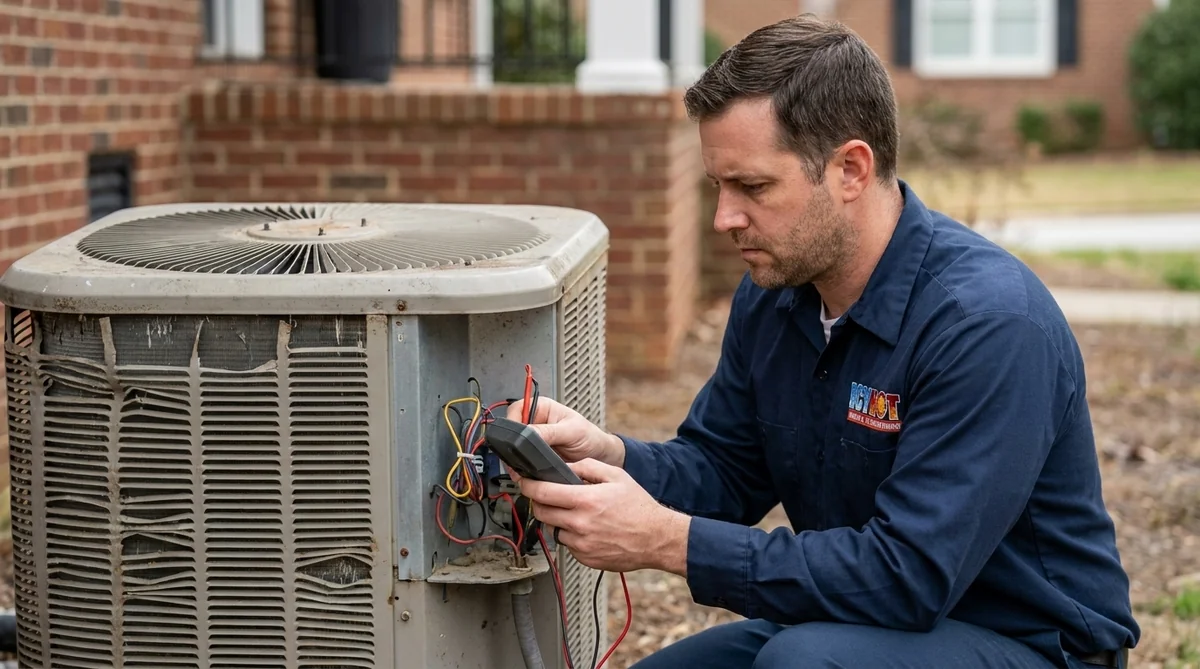
Condensate drain neglect. Raleigh’s humidity means the indoor coil pulls a lot of water out of the air, all of which has to drain away through a 3/4-inch PVC line. When that line clogs (algae, dust, debris), the water backs up, drips onto the secondary pan, and eventually onto the coil itself. Coil corrosion from sitting condensate is one of the most expensive non-compressor failures we see, and it usually shows up at year 8 to 10 on systems that never got a maintenance visit.
Standing water around outdoor pads. Low-lying yards in older Raleigh neighborhoods (Five Points, parts of North Hills, anywhere near a creek) hold water around the outdoor unit during heavy rain. The base pan, fan motor housing, and electrical connections all corrode faster when they’re sitting in 2 inches of standing water for half a day. Adding a riser pad or moving the unit a few feet on a re-pour fixes this, but most homeowners don’t know it’s a problem until the unit fails early.
7 Warning Signs Your AC Unit Is on Its Last Leg
The seven signs your AC is near end of life are: age over 12 years, compressor failure, refrigerant leaks on R-410A systems, frequent service calls, cooling bills rising while output drops, loud or uneven operation, and frost forming on the outdoor coil in summer. Any two of these together usually mean replacement is more cost-effective than another professional AC repair.
1. Age Over 12 Years
Once a central AC unit passes its 12th birthday in Raleigh, every repair decision should include a replacement quote for comparison. The 12-year mark is when compressor failures start, when SEER ratings from that era (10 to 13) look badly out of date next to today’s 16+ SEER2 units, and when manufacturer parts warranties have typically expired. You don’t have to replace at 12, but you should know what replacement would cost.
2. Compressor Failure
The compressor is the single most expensive AC component, typically $1,500 to $3,500 installed. On a unit 10+ years old running R-410A refrigerant, the compressor replacement plus a full refrigerant recharge often gets within $1,500 of a full system replacement. That math almost always favors replacement, which is why we treat compressor failures on older systems as a replacement trigger by default.
3. Refrigerant Leaks on R-410A Systems
R-410A refrigerant prices climbed from $8 to $12 per pound wholesale in 2023 to $40 to $75 per pound in 2026 as supply contracts (per industry pricing reported by HVAC trade publications). A 3-ton system holds 9 to 12 pounds of refrigerant. A slow leak that needs a 2-pound recharge every season now costs more than the same leak did 18 months ago, and the price ceiling keeps rising. We cover the refrigerant transition in detail in our R-454B refrigerant standards guide.
4. Three or More Service Calls in a Single Cooling Season
A healthy AC unit needs one tune-up per year and zero unscheduled service calls. Two service calls in a season is bad luck. Three or more in a single May-to-September window is a pattern, and the pattern almost always continues. If you’re on your third call this summer for a unit older than 10 years, every dollar going into repairs is buying you weeks of service, not years.
5. Cooling Bills Rising While Output Drops
An AC unit’s efficiency degrades gradually over its lifespan, but the curve gets noticeably steeper after year 10. If your Duke Energy bill is climbing year over year and the house feels less comfortable on the same thermostat setting, the system is losing ground. Compare June through August bills against the same months 2 to 3 years ago. A 15 to 25 percent jump on similar weather is the system telling you something.
6. Loud, Grinding, or Uneven Operation
Outdoor units that rattle, screech, or shake mid-cycle usually have a failing fan motor, dying compressor, or loose internal mount. Indoor air handlers that whistle or vibrate often have a worn blower bearing. These noises are warnings, not personality. A unit that sounds different than it did last summer needs a diagnostic visit before the noise turns into a hard failure during a July heat wave.
7. Frost or Ice on the Outdoor Coil in Summer
Frost on the outdoor condenser in 90°F heat is a clear sign of low refrigerant charge, a failing expansion valve, or a restricted indoor coil. Frost on the indoor evaporator coil is the same problem from a different angle. Either condition means the system is starving for refrigerant or airflow, and running it that way damages the compressor. See our guide to common AC problems in Raleigh for the full diagnostic walkthrough.
How to Use the $5,000 Rule
The $5,000 rule is a back-of-envelope decision tool you can run in your head: multiply the AC unit’s age in years by the cost of the proposed repair. If the result is above $5,000, replacement is usually the smarter long-term call. If the result is below $5,000, the repair likely makes financial sense. The rule is widely cited by HVAC companies, and the threshold reflects the typical cost ceiling for repairs that make sense on equipment that’s already past 60 percent of its useful life.
The fastest way to see it work is on real numbers. The table below shows six common repair scenarios we run into on Raleigh service calls, and what the $5,000 rule says about each.
The rule isn’t perfect, and the source acknowledges this: it doesn’t factor in rebates, refrigerant pricing, efficiency gains, or warranty coverage on new equipment. A 12-year-old R-410A unit with a $500 leak repair calculates to $6,000 (replace per the rule), and that’s actually the right answer once you fold in rising refrigerant costs and the thousands of dollars in NC rebates available on replacement. The rule gets you a starting point. You adjust from there based on what’s available to you specifically.
How R-454B Refrigerant Changes the 2026 Decision
As of January 1, 2025, the EPA’s AIM Act prohibited manufacturers from producing new HVAC equipment using R-410A refrigerant. All 2025+ residential AC systems use R-454B (or R-32). Existing R-410A systems remain legal to service, but the economics shifted hard against keeping one in 2026 and beyond. R-410A wholesale prices climbed from $8 to $12 per pound in 2023 to $40 to $75 per pound in 2026 (industry pricing data), and the price ceiling keeps moving up as new R-410A production has ended.
There’s no retrofit path. R-454B requires equipment specifically designed for it, including different lubricant oils, different system design pressures in some respects, and A2L-rated safety sensors built into the indoor coil cabinet. You can’t pour R-454B into an old R-410A system and have it work. When an aging R-410A unit needs a refrigerant-related repair (compressor, leak repair, recharge, evaporator coil), the cost of that repair is now measured against the rising baseline of what every future recharge will cost on that same system. A 12-year-old R-410A unit with a slow leak is a worse repair candidate today than it was in 2024.
The flip side is that new R-454B systems cost 10 to 15 percent more than the legacy R-410A units they replaced (industry data). The federal 25C tax credit that used to cover heat pumps expired December 31, 2025, but North Carolina’s incentives are larger anyway. Energy Saver NC rebates pay up to $8,000 for income-qualified households on heat pump conversions, and Duke Energy Smart Saver instant rebates run $300 to $500 for qualifying SEER2 tiers. Those programs can offset thousands of dollars of the upgrade cost depending on which ones you qualify for.
How to Get the Maximum Life Out of Your AC
Three habits add 3 to 5 years to AC lifespan: annual professional tune-ups in the spring, air filter changes every 1 to 3 months, and keeping the outdoor unit clear of debris with 24 inches of clearance on all sides. Systems on a maintenance plan average 17 years of service life in our experience, versus 12 years for systems serviced only when they break. The math is straightforward: one $150 spring tune-up that prevents one $400 capacitor failure pays for itself nearly 3x over.
Tune-ups deliver the biggest single bump because a thorough spring service catches small problems while they’re still small. A capacitor reading 6 percent below spec in April will fail under July load. A condenser coil with light dirt loses 5 to 10 percent efficiency; with heavy dirt, 25 percent. A thermostat 2°F out of calibration runs the system longer than it needs to. None of those issues stop a unit from cooling on a 70°F May day, which is why homeowners who skip the spring tune-up almost never realize how marginal their system has gotten until it actually fails.
Filter changes look trivial but matter more than most homeowners give them credit for. A clogged 1-inch filter restricts airflow across the evaporator coil, which causes the coil to run colder than it should and eventually ice up. Iced coils starve the compressor of refrigerant return, which is one of the most common compressor-damage paths we see in the field. Change 1-inch MERV 8 filters every 1 to 3 months. Change 4-inch media filters every 6 to 12 months. Set a phone reminder on the same day every month and never miss one.
If you don’t want to track all of this, our Comfort Club maintenance plan handles the tune-up scheduling and filter reminders for you. Members average 5+ extra years of service life on their AC systems compared to break-fix-only customers. For the detailed maintenance checklist, see our homeowner’s AC maintenance guide and the spring AC tune-up checklist.
How Much Does a Replacement Cost in 2026?
A new central AC system installed in Raleigh costs $5,000 to $12,000 in 2026, depending on tonnage (size), SEER2 efficiency rating, and whether ductwork or refrigerant lines need replacement. The new R-454B systems run 10 to 15 percent more than the R-410A units they replaced, because of integrated A2L safety sensors and A2L-rated components throughout the indoor coil cabinet (industry data). A heat pump replacement typically runs $6,500 to $14,000 because of the additional hardware needed for both heating and cooling modes. For a full breakdown by system size and what drives your quote, see our guide to AC replacement cost in Raleigh.
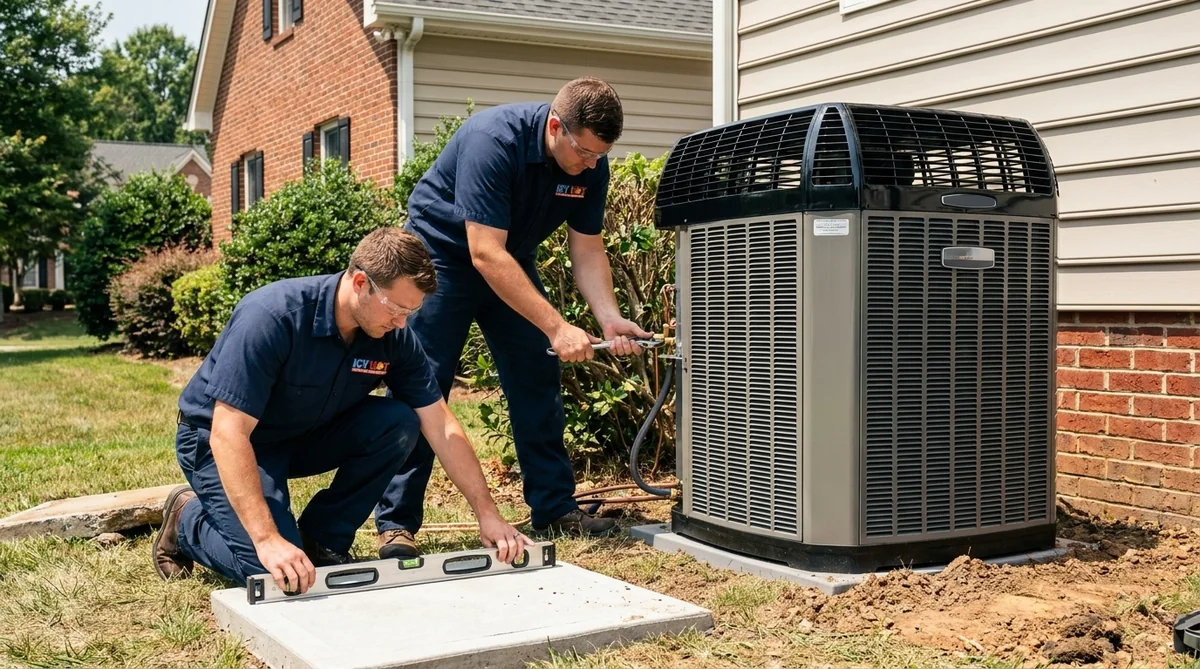
State and utility rebates can offset thousands of dollars of the replacement cost for qualifying households. The federal 25C tax credit, which used to pay up to $2,000 on ENERGY STAR-certified heat pumps, expired December 31, 2025 and does not apply to systems installed in 2026 (IRS). The Energy Saver NC program (NC DEQ, $208 million in funding) pays up to $8,000 for income-qualified households converting to heat pumps. Duke Energy Smart Saver pays $300 to $500 instant rebates on qualifying high-efficiency AC and heat pump systems. We walk through the current programs in detail in our NC HVAC rebates 2026 guide.
For a side-by-side cost-of-ownership view, our AC repair cost guide breaks down what a series of repairs on an aging unit typically adds up to versus a one-time replacement. Most homeowners are surprised at how quickly $400 here and $700 there closes the gap to a new system. For full installation details and our process, see AC replacement and AC installation.
Should You Replace Before It Breaks?
Replacing an AC unit proactively, before it dies on a 95°F July afternoon, has two real advantages. You avoid the 20 to 30 percent emergency-premium pricing that the entire HVAC industry charges during heat-wave breakdowns (industry data), and you control the timing. Most Raleigh homeowners who replace proactively schedule the install for March, April, or October, when contractor calendars are open and the rebate programs are still active. Wait until July, and you pay the premium, you take whatever’s in stock instead of what’s best for your home, and you spend 2 to 5 days of August heat without cooling while the install gets scheduled.
From the field: The July emergency installs we do are almost always replacements that should have happened the previous March. The pattern is the same every summer: a 13-year-old unit struggles through June, then quits on a Saturday afternoon when it’s 96°F outside. The homeowner’s been thinking about replacement for a year, but kept putting it off because the unit was “still working.” They end up paying 20 percent more for equipment, getting a same-day-availability model instead of the one they wanted, and sleeping in the basement for three nights. If you’re over 12 years and you’ve had two service calls this season, do it now in May or October, not in July.
The Bottom Line for Raleigh Homeowners
An AC unit’s lifespan isn’t a fixed number. It’s a window that maintenance habits, climate, refrigerant type, and installation quality each push around by 2 to 5 years. Here’s what to take away:
- Plan for 12 to 17 years in Raleigh, not the 15 to 20 manufacturers quote.
- Two warning signs together (especially age + compressor failure, or age + rising bills) means start getting replacement quotes.
- The $5,000 rule (age × repair cost) gives you a fast first answer; adjust for rebates and refrigerant.
- R-454B refrigerant (January 2025 mandate) makes R-410A repairs worse than they used to be.
- Annual tune-ups add 3 to 5 years; skipping them shortens lifespan by 2 to 4.
- Replace proactively in spring or fall to dodge the 20 to 30 percent summer emergency premium.
If your AC is over 12 years old or you’ve already had a couple of service calls this season, get a real assessment before peak season hits. We’ll run a Manual J load calculation, check refrigerant type and pressures, walk you through the Energy Saver NC and Duke Energy rebates you qualify for, and tell you honestly whether a repair gets you another 2 to 3 years or whether replacement is the right call now. Call Icy Hot at (919) 673-7667, schedule a system health check, or request a free instant replacement quote.
Frequently Asked Questions