
Every summer I walk into a Raleigh bonus room over the garage that runs ten degrees hotter than the rest of the house, or a 1950s bungalow near Five Points with radiators and window units and no ductwork anywhere. Both of those homeowners ask the same question within about ninety seconds: what is a mini-split going to cost me?
The honest answer is that mini-split installation cost in Raleigh depends almost entirely on how many rooms you want to condition, and that the useful number is not the project total, it is the price per zone. This guide gives you the per-zone number first, then the ranges by system size, by indoor unit style, and by everything that shows up on the invoice after the equipment. It also covers what changed for 2026, because the federal tax credit that every cost article on this topic still tells you to claim is gone.
TL;DR: Ductless mini-split installation runs roughly $2,000 to $7,000 per zone installed, according to Bryant, with a single-zone system landing around $2,000 to $6,000. Carrier puts a full project at $2,500 to $15,000 or more depending on how many indoor heads you need. The number of indoor units is the single biggest cost driver, indoor unit style is second, and a real quote should already include the line set, electrical connections, refrigerant charge, and startup. Budget separately for a permit and old-equipment removal. The 30% federal tax credit no longer applies to anything placed in service after December 31, 2025. In North Carolina what is left is Energy Saver NC for income-qualified households and Duke Energy’s Smart $aver rebate.
How Much Does Mini-Split Installation Cost in Raleigh?
Plan on $2,000 to $7,000 per zone installed. That is Bryant’s published range, and it matches what quotes look like in the Triangle: “A ductless mini split installation typically costs between $2,000 and $7,000 per zone.” Bryant puts a single-zone system at $2,000 to $6,000 and multi-zone systems at $2,000 to $7,000 per zone.
Zoom out to the whole project and Carrier states it plainly: “Ductless mini split installation cost typically ranges from $2,500 to $15,000 or more.” HVAC.com’s ductless guide, published in 2023, lands in the middle of that at “between $3000 to $5000,” which is still close to what a typical one-zone or two-zone Raleigh job invoices at today.
HomeAdvisor, updated June 19, 2026, reports an average of $3,000 with a normal range of $2,000 to $14,500, and breaks the spread out by how many indoor heads you install. Its low ends run below what a licensed installation in Wake County actually costs, because those figures include equipment-only and bare-bones scenarios. Treat the HomeAdvisor bottom of each range as the floor of the market, not a quote you should expect.
Mini-Split Cost by Size: Matching BTUs to the Room
Capacity is measured in BTUs, and Carrier gives you the conversion you need to talk to a contractor: “One ton equals 12,000 BTUs.” A single 12,000 BTU head is a one-ton system. That is the size that handles a typical Raleigh bonus room or a large primary bedroom, and it is the most common single-zone job we quote.
The table below pairs HomeAdvisor’s reported cost ranges by capacity with what each size usually covers in the homes we work in around Wake County. The room-size column is our field experience, not a substitute for a load calculation. ENERGY STAR is blunt about why that matters: “A system that is either too large or too small for its intended space will struggle to meet your home comfort needs,” and your contractor “should verify the proper size system for your home using a tool called ‘Manual J.'”
Notice how flat the price curve is across capacities. Going from 9,000 to 24,000 BTUs does not quadruple the cost, because the labor to hang one head, drill one wall penetration, and run one line set is roughly the same either way. Capacity mostly changes the price of the box, and the box is the smaller half of the job. That is why the zone count moves your quote far more than the tonnage does, and why a homeowner who adds a second head to a one-zone plan should expect a bigger jump than one who steps the same single head up two sizes.
It also explains a mistake I see on other people’s quotes every summer: sizing up “just to be safe.” Oversizing costs you twice, once at purchase and again every month, because a unit that overshoots the room satisfies the thermostat before it has run long enough to pull moisture out of the air. In a Raleigh August that produces a room that is cold and clammy at the same time.
| Capacity | Reported cost range | What we typically see it cover in a Raleigh home |
|---|---|---|
| 6,000 BTU | $450 to $1,600 | A small office, nursery, or converted closet workspace |
| 9,000 BTU | $600 to $2,300 | A standard bedroom or a modest home office |
| 12,000 BTU (1 ton) | $700 to $3,200 | A bonus room over the garage, a primary bedroom, or a sunroom |
| 18,000 BTU (1.5 ton) | $1,000 to $4,000 | An open living and dining area, or a finished basement |
| 24,000 BTU (2 ton) | $1,100 to $5,200 | A large great room, a garage conversion, or a small ADU |
| 36,000 BTU (3 ton) | $1,800 to $6,000 | A multi-zone outdoor unit feeding three or four indoor heads |
The Five Things That Actually Move the Price
Carrier lists the variables that matter, and after two decades of installs in the Triangle I would rank them in this order.
1. Number of zones. Every indoor head is another piece of equipment, another line set, another wall penetration, and another few hours of labor. Carrier notes that a multi-zone system uses “one outdoor unit that can support 2-5 indoor units,” which is why the second head costs less than the first: the condenser is already paid for.
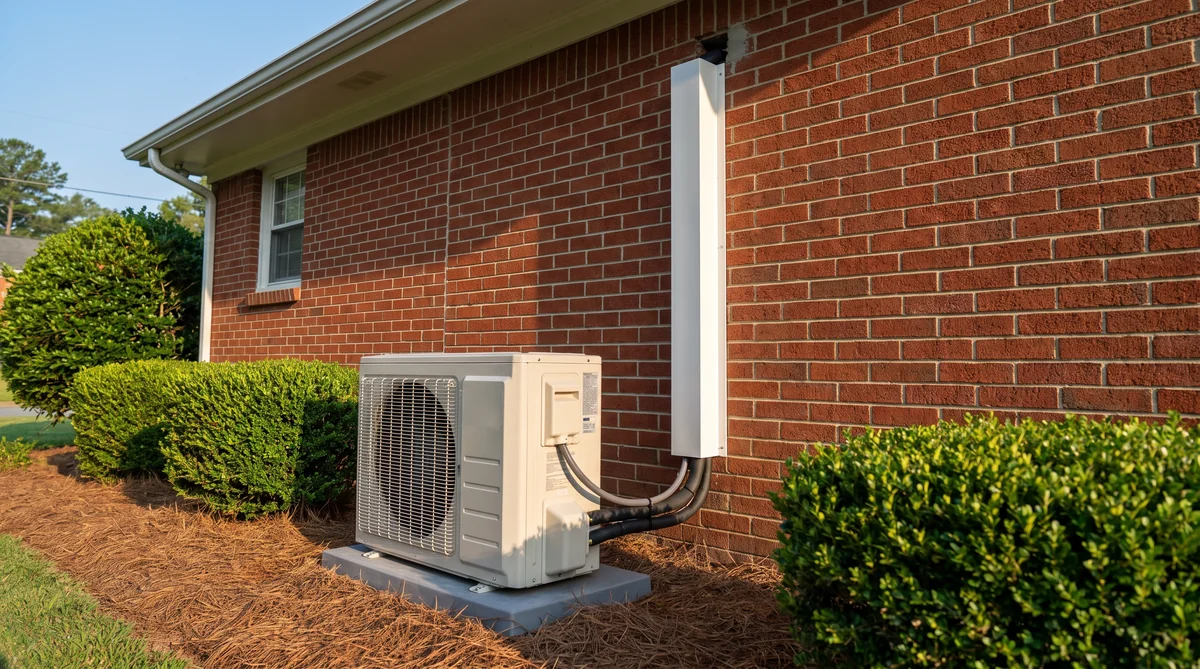
2. Line set length and routing. Carrier’s phrasing is exact: “Longer distances between indoor and outdoor units require more refrigerant lines and labor.” A head on the far gable of a two-story Cary house with the condenser at the opposite corner is a different job from a bonus room directly above the pad.
3. Indoor unit style. Carrier again: “Standard wall-mounted units are usually the most affordable. Ceiling cassettes or concealed ducted mini split units require more complex installation and hardware.” That gap is worth hundreds to thousands per head, and it gets its own section below.
4. Efficiency tier. “High-efficiency units with a higher SEER2 rating cost more upfront but reduce monthly electric bills,” per Carrier. In our climate the payback math is real, because the equipment runs most of the year.
5. What is already there. Carrier points out that “replacing an existing unit may be cheaper if electrical work and holes are already prepped.” A swap of a failed mini-split on an existing pad with an existing circuit is the cheapest version of this job. Cutting a new 240-volt circuit into a 1960s panel is the most expensive.
Wall, Floor, or Ceiling Cassette: Cost by Indoor Unit Style
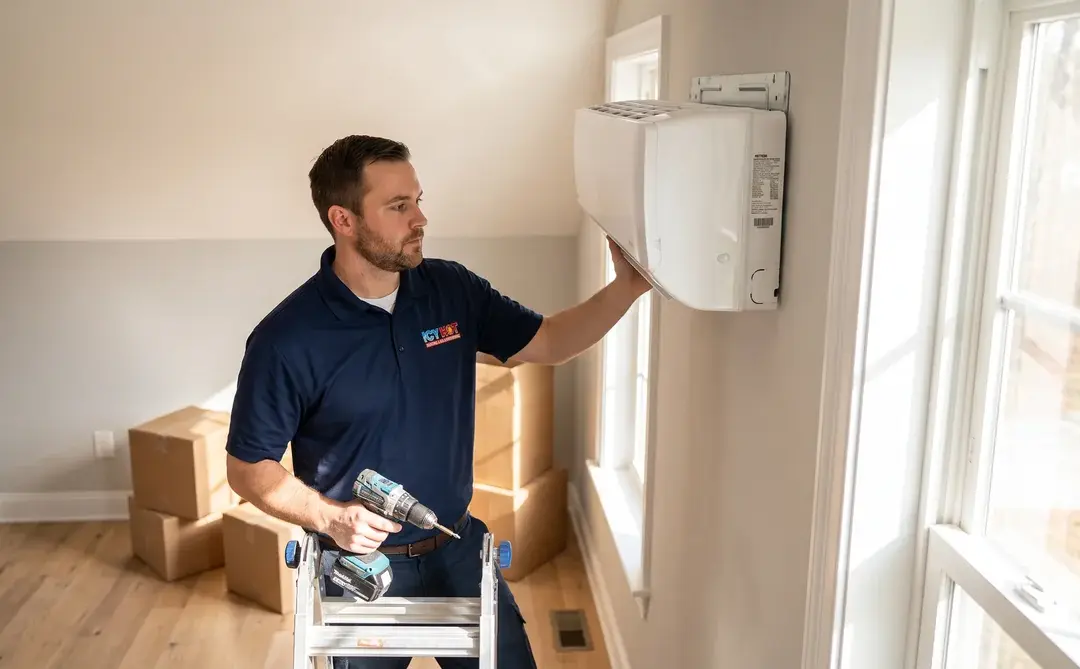
The indoor head is the part you look at every day, so this is where homeowners spend money on preference rather than performance. HomeAdvisor’s per-head ranges show the spread clearly, and it is wide enough to change a multi-zone budget on its own.
My practical advice: use wall-mounted heads everywhere you can live with them, and spend the cassette premium only in the one room where the unit would otherwise be staring at you from above the sofa. On a four-zone job, choosing ceiling cassettes in all four rooms instead of one can add more to the bill than upgrading the entire system to a higher efficiency tier would have, and the efficiency upgrade is the one that pays you back every month.
There is a service angle too. A wall head is the easiest style to clean, because the filters slide out from behind a front panel you can reach from a step stool. A recessed cassette or a concealed unit above a soffit needs a ladder and a little more patience every time, which in practice means it gets cleaned less often. Factor that into the choice for a room you rarely think about, like a guest suite or a finished attic.
| Indoor unit style | Reported cost per head | When it makes sense |
|---|---|---|
| Wall-mounted | $500 to $9,200 | The default. Cheapest to hang, easiest to service, best airflow throw for a bonus room |
| Floor-mounted | $1,300 to $3,800 | Rooms with knee walls, dormers, or full-height windows that leave no wall space up high |
| Ceiling cassette | $1,300 to $9,100 | Open rooms where four-way airflow beats one direction, and where you want the unit out of sight |
| Ceiling-mounted or concealed | $1,200 to $12,000 | Renovations where the head hides above a soffit or in a dropped ceiling and only a grille shows |
What a Mini-Split Quote Should Include, and What It Will Not
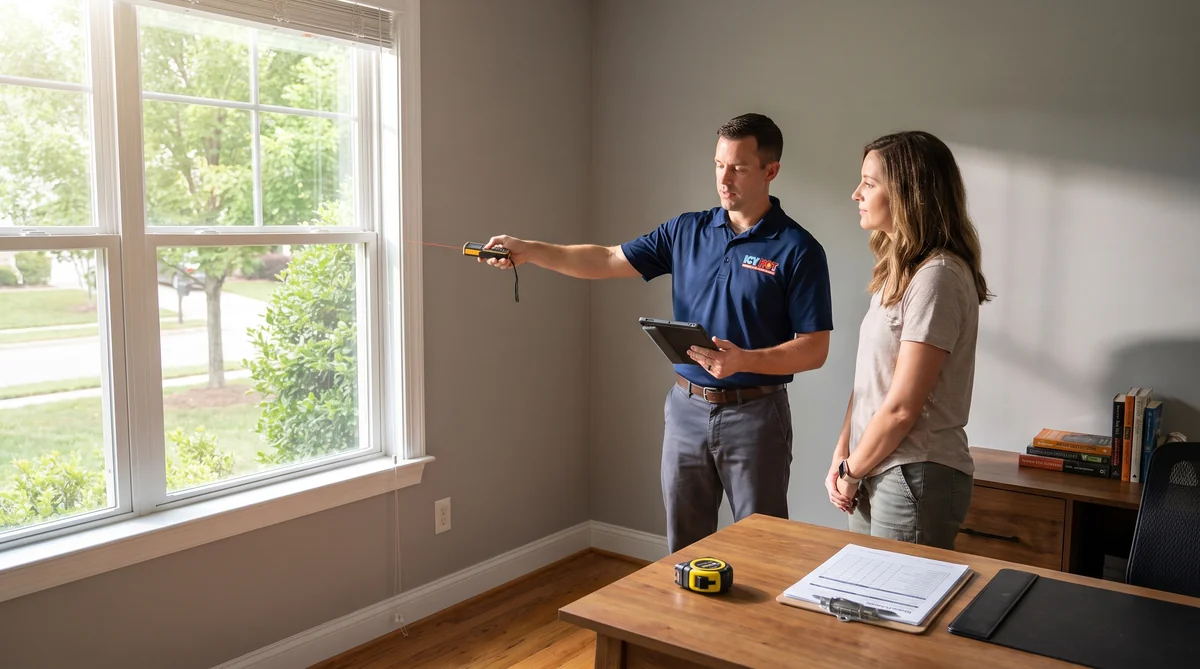
A complete quote is not just a box price. Bryant’s list of what a ductless quote typically covers is a good yardstick: equipment, labor, refrigerant lines, electrical connections, hardware, startup and testing, drainage setup, equipment removal, and warranties. Bryant also names the exclusions: a quote “typically excludes major electrical upgrades and complex structural modifications.” If your panel is full, or the wall you want the head on backs up to a chase that has to be opened, those are separate conversations and they should be separate line items.
Labor is the biggest single line inside that total. HomeAdvisor puts labor at “$300 to $2,000” for a single-zone system and “$700 to $3,000” for multi-zone systems, at hourly rates “between $50 and $100 per hour.” Around it sit three smaller items that homeowners routinely forget to budget for: a permit at $250 to $400, hauling away the old equipment at $80 to $150, and annual maintenance at $75 to $200 once the system is running.
Add those together and you get the difference between the number you remember and the number you pay. A quote that reads $4,500 for a two-zone system, plus a $300 permit and $120 to haul off the old window units, is a $4,920 project before anyone has discussed an electrical upgrade. None of that is padding. It is the part of the job that a low bid usually leaves off the page so the headline number looks better than the competing one.
One Zone or the Whole House? How Raleigh Homeowners Actually Buy
Most of our mini-split installations start as one-zone problems. A room got finished, a porch got enclosed, a garage became a gym, and the existing ducted system was never sized to carry it. Adding a single head solves that for a few thousand dollars without touching the central system at all.
ENERGY STAR’s own list of where ductless fits reads like a map of Triangle housing stock. It names “homes with costly electric heat…that will also benefit from cooling,” “older homes with no existing ductwork…that have never had central air conditioning,” “additions or outbuildings (e.g., shed, barn, garage) where extending ductwork…is difficult,” and spaces with “hot or cold spots.” That is the bonus room, the 1950s bungalow, the detached studio, and the room at the end of the longest duct run.
The whole-home conversation is different math. If you are replacing a failing system anyway, compare a multi-zone ductless project against a ducted AC replacement or a heat pump installation, because at three or four zones the two numbers converge. Our Raleigh AC replacement cost guide has the ducted side of that comparison in detail, and the heat pump versus central air comparison covers how the two behave differently through a Triangle winter.
There is a hybrid answer that gets overlooked. Plenty of Raleigh homes are best served by keeping a healthy ducted system for the main body of the house and adding one ductless head for the room that system was never going to reach. That is cheaper than replacing a working system, it does not require touching the ductwork, and it fixes the actual complaint. When we run the load calculation, that split solution is what the numbers point to more often than people expect.
Mini-Split vs. Central Air vs. Window Units
For the full side-by-side on which system actually fits your house, see our guide to mini-split vs. central air.
The right comparison depends on what you already have. If your house has good ductwork and a dying condenser, central air is almost always the cheaper path back to comfort: HVAC.com reported that “on average, a new AC unit cost will fall between $3,300 and $7,800,” with the 2025 average at “$5,750 for a 3-ton unit in a 2,000-square-foot home.” If you have no ducts, or one problem room, ductless wins before you even open a spreadsheet, because the cost of adding ductwork to a finished house is the hidden line item nobody quotes cheerfully.
One thing a cost table cannot show you: the window unit you buy this July is the window unit you pull out and store every October, and it is the one that will be running in the background of every phone call you take in that room. Ductless heads are dramatically quieter because the compressor and the fan that make the noise are outside on a pad. That is the reason most of the home-office installs we do never seriously considered a window unit twice, even when the window unit was a quarter of the price.
Security and appearance matter to some homeowners too. A window unit occupies a window, blocks the light and the view, and leaves an opening that is easier to force than a locked sash. A mini-split head sits high on an interior wall and needs only a three-inch hole through the exterior. For a ground-floor bedroom or a rental unit, that difference alone often decides it.
| Ductless mini-split | Central air | Window units | |
|---|---|---|---|
| Typical installed cost | $2,000 to $7,000 per zone (Bryant) | $3,300 to $7,800, averaging $5,750 for a 3-ton system in a 2,000 sq ft home in 2025 (HVAC.com) | Lowest upfront cost of the three |
| Ductwork required | None | Yes, and adding it to a finished house is a major project | None |
| Room-by-room control | Yes, each head has its own setpoint | Only with a zoning system added | Yes, per unit |
| Heats as well as cools | Yes, it is a heat pump | Only if paired with a furnace or heat pump | Cooling only on most models |
| Best fit in Raleigh | Bonus rooms, sunrooms, additions, garage conversions, homes with no ducts | Whole-house comfort where ductwork already exists and is in decent shape | Short-term or seasonal fixes, rentals, single small rooms |
What SEER2 and HSPF2 Mean for Your Duke Energy Bill
Efficiency is where a higher price tag can pay you back, because a mini-split in Raleigh runs a lot of hours. ENERGY STAR explains the physics: “Because heat pumps move heat rather than converting it from fuel, as combustion heating systems do, an ASHP is so efficient that it can deliver up to three times more heat energy to a home than the electrical energy it consumes.”
For the rooms where mini-splits usually go, the comparison is even more lopsided. ENERGY STAR reports that “ENERGY STAR certified mini splits use up to 60% less energy than standard home electric radiators,” and that certified systems in a whole-house setting “avoid more than 4,500lbs of greenhouse gas emissions, on average, over the course of their lifespan compared to standard systems.” If your bonus room is currently heated by baseboard resistance heat or a space heater, that 60% figure is the number to hold onto.
When you compare quotes, the two ratings to read are SEER2 for cooling and HSPF2 for heating. To carry the ENERGY STAR label, split-system heat pumps must hit “≥ 7.8 HSPF2/ ≥15.2 SEER2/ ≥11.0 EER2 for split systems.” The cold climate designation asks more of ductless equipment specifically, at “≥ 8.5 HSPF2/ ≥15.2 SEER2” for non-ducted split systems, and requires third-party verified performance “testing ASHPs down to 5°F.” Raleigh does not need cold-climate certification to get through a normal winter, but the models that carry it tend to hold their heating capacity better on the coldest mornings of a Triangle January. Our guide to what counts as a good SEER rating in NC goes deeper on how to read those numbers.
| Certification | Requirement | What it means for a Raleigh home |
|---|---|---|
| ENERGY STAR, split-system heat pump | “≥ 7.8 HSPF2/ ≥15.2 SEER2/ ≥11.0 EER2 for split systems” | The baseline to ask for. Most quality mini-splits clear it comfortably |
| Cold climate, non-ducted (ductless) | “≥ 8.5 HSPF2/ ≥15.2 SEER2” | Optional here, but useful if the head is the only heat in the room |
| Cold climate, ducted split | “≥ 8.1 HSPF2/ ≥15.2 SEER2” | Relevant if you are comparing a ducted heat pump at the same time |
| Low-temperature verification | Third-party “testing ASHPs down to 5°F” | Covers the coldest mornings the Triangle sees in a normal January |
Rebates and Tax Credits in 2026: What Is Actually Left
This is where most cost guides on this topic are now wrong, and it matters by thousands of dollars. The 30% federal Energy Efficient Home Improvement Credit, the one worth up to $2,000 on a qualifying heat pump, has ended. The IRS states that the credit “is allowed for qualifying property placed in service on or after Jan. 1, 2023, and before December 31, 2025,” and its guidance on the 2025 tax law is explicit: “The credit will not be allowed for any property placed in service after December 31, 2025.”
Energy Saver NC is the big one if you qualify. Per NC DEQ, households under 80% of Area Median Income can have “up to 100% of project costs covered by the rebate up to a certain amount,” households between 80% and 150% of AMI can have up to 50% covered, and above 150% of AMI there is no eligibility. Two rules catch people: DEQ says “self-installation projects do not qualify,” and “double counting rebates from different federal grants for the same upgrade is not allowed.” You can stack a state rebate with a utility incentive, though, as long as “the combined rebates cannot exceed the purchase-price of the product.” Check your own eligibility at energysavernc.org, and see our NC HVAC rebates guide for the full picture.
| Program | Status | What it is worth |
|---|---|---|
| Federal 25C tax credit | Ended for property placed in service after Dec 31, 2025 | Was up to $2,000 per year for a qualifying heat pump. Not available for a 2026 installation |
| Energy Saver NC (HEAR) | Open to income-qualified households in all 100 counties | “Up to $8,000 for an ENERGY STAR-certified electric heat pump,” with a $14,000 per-dwelling HEAR cap |
| Duke Energy Smart $aver | Active residential program | Duke Energy announced in January 2025 that HVAC and heat pump incentives increased “from $350 to $500.” Confirm your specific equipment qualifies before you buy |
How to Avoid Overpaying on a Mini-Split Quote
Mini-split pricing has more spread than almost any other residential HVAC job, which means the same house can get quotes $3,000 apart for functionally identical equipment. Five questions close that gap fast.
One of those questions is about the permit, and it is worth knowing why. Wake County issues trade permits for “mechanical and water heater installations and change-outs,” so a ductless installation here is permitted and inspected work, not an under-the-radar job. Ask all five of the questions below on every quote, and ask them the same way each time so the answers are comparable. The point is not to catch anyone out. It is that ductless quotes vary in what they silently assume, and two contractors can bid the same house honestly and still be $3,000 apart because one assumed a 15-foot line set and a shared circuit while the other priced a 40-foot run and a new breaker.
The system also only holds its efficiency if the filters and coils stay clean. ENERGY STAR’s maintenance checklist warns that “a dirty filter can increase energy costs and damage your equipment, leading to early failure,” and mini-split filters sit right behind the front panel where you can rinse them yourself in about five minutes. Everything past that, refrigerant charge included, belongs to a technician. A maintenance plan or a scheduled mini-split maintenance visit keeps the equipment efficient and the parts warranty intact.
| Ask this | Why it moves the price | What a good answer sounds like |
|---|---|---|
| “What load calculation did you run?” | Guessing by square foot leads to oversizing, which costs more and dehumidifies worse | A room-by-room Manual J, the tool ENERGY STAR names by name |
| “Is the permit in this number?” | A permit runs $250 to $400 and is the most common quiet omission from a bid | Yes, itemized, with the inspection included |
| “How long is the line set?” | Line-set length is the number one change order on ductless jobs | A specific footage written on the quote, not “whatever it takes” |
| “Does the panel need work?” | Bryant excludes “major electrical upgrades” from a base quote | The panel was opened and checked, with any upgrade priced separately |
| “Wall head or cassette in each room?” | Head style swings the per-room cost by hundreds to thousands | Both priced, so you can spend the premium only where it shows |
Frequently Asked Questions
Quick answer for Raleigh homes: Price a mini-split by the zone, not by the house. One head in a bonus room or sunroom is a few thousand dollars and solves the problem for good. Three or four heads is a whole-home project that deserves to be compared against a ducted system. Ask for the Manual J, the line-set footage, and whether the permit is in the number, and you will have already filtered out most of the quotes that would have surprised you later.
The Bottom Line for Raleigh Homeowners
| Scenario | Indoor heads | Where these land |
|---|---|---|
| Bonus room over the garage | 1 (usually 12,000 BTU) | Bryant’s single-zone range of $2,000 to $6,000 |
| Enclosed porch or sunroom | 1 (12,000 to 18,000 BTU) | Same single-zone range, toward the top if the room is glassy and west-facing |
| Primary bedroom plus home office | 2 | HomeAdvisor’s two-zone span of $1,400 to $7,700, or roughly $2,000 to $7,000 per zone on Bryant’s basis |
| Small home with no ductwork | 3 to 4 | HomeAdvisor’s $1,800 to $10,700 band, and worth comparing against a ducted system |
Here is what to hold onto when the quotes come in:
- Price by the zone. Bryant’s $2,000 to $7,000 per zone is the number that travels between houses; total-project ranges are not comparable without the zone count.
- The second head costs less than the first, because both share one outdoor unit.
- Wall-mounted heads are the value choice. Save the cassette premium for the one room where it matters visually.
- Labor is $300 to $2,000 single-zone and $700 to $3,000 multi-zone, and the permit, removal, and first-year maintenance are separate line items.
- The federal 25C credit does not apply to anything placed in service after December 31, 2025. Energy Saver NC and Duke Energy’s Smart $aver are what remain.
- Insist on a Manual J. An oversized mini-split leaves a Raleigh room cold and damp instead of cool and dry.
If you are weighing a bonus room head against a whole-home system, we will walk the space, run the load calculation, and give you both numbers in writing so you can compare them honestly. Call Icy Hot at (919) 673-7667 or request a free instant quote, and see our ductless mini-split services for what installation, repair, and maintenance look like once the system is in.