If you’re shopping for a new air conditioner in Raleigh, the first thing you’ll run into is a number: SEER rating. The second thing you’ll run into is confusion, because the rules changed in 2023 and nobody explained it well. Your old 14 SEER unit? On the new scale, that same system would show up as 13.4 SEER2. It didn’t get worse. The test got harder.
Heating and cooling account for about 46% of residential energy use in the South Atlantic region (U.S. EIA). That makes SEER the most expensive number on the entire sticker. Here’s what it means, what the legal minimum is in North Carolina, and where the math actually stops making sense.
TL;DR: North Carolina’s legal minimum is 14.3 SEER2 (about 15 on the old SEER scale) per the U.S. Department of Energy’s 2023 Southeast region standard. A genuinely good rating for Raleigh is 15.2 SEER2 or higher, which meets ENERGY STAR and qualifies for Duke Energy Smart Saver rebates. The practical sweet spot for Triangle homes is 16–18 SEER2. Premium 20+ SEER2 systems exist but rarely pay back in our 5–6 month cooling season.
What Does SEER Actually Measure?
SEER stands for Seasonal Energy Efficiency Ratio. It measures how many BTUs of cooling your air conditioner produces per watt-hour of electricity, averaged across a full cooling season from 65°F to 104°F outdoor temperatures (per U.S. DOE). Higher number, more cooling per dollar of electricity.
Think of it like miles per gallon for your AC. A 20 SEER2 system and a 14 SEER2 system might both cool your house on a 95°F day, but one will do it for noticeably less money on your power bill. Residential central air conditioners in 2026 range from about 13 SEER2 on the bottom end to 28 SEER2 on the high end (AHRI Directory of Certified Products).
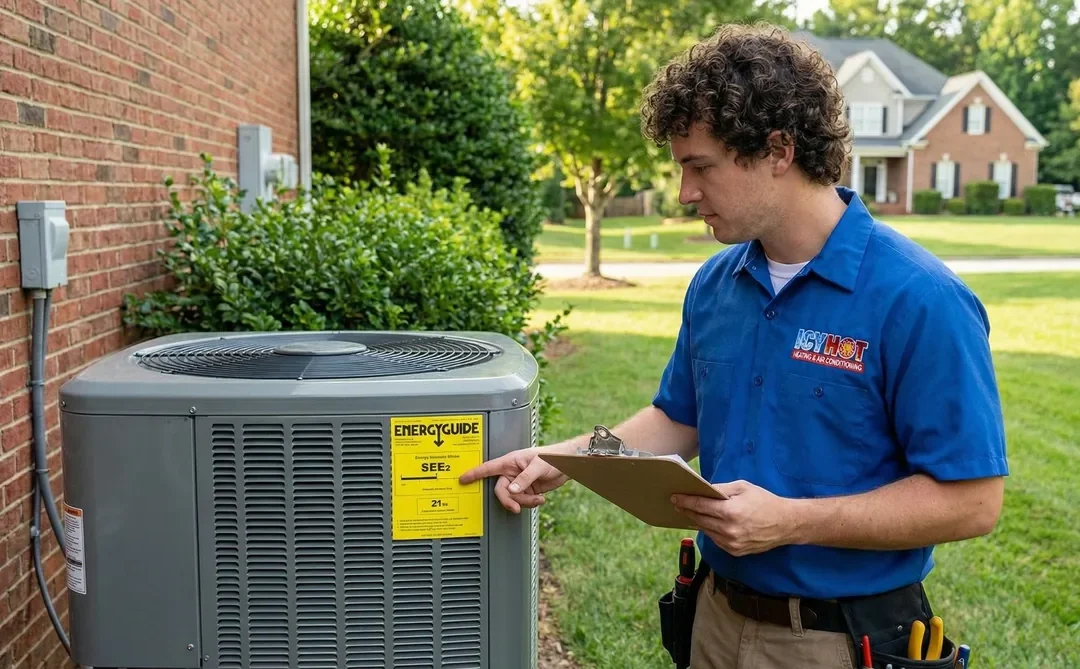
There’s a related rating called EER (or EER2 today), which measures efficiency at a single outdoor temperature, usually 95°F. SEER is the seasonal average. EER is the worst-case peak. Both matter, but SEER is what you’ll see on the yellow EnergyGuide sticker and what most people mean when they say "efficiency rating."
What’s the Difference Between SEER and SEER2?
SEER2 is the same efficiency concept as SEER, but tested with realistic duct pressure. The U.S. Department of Energy adopted it on January 1, 2023, and a SEER2 number runs about 4.5–5% lower than the old SEER number for the exact same equipment (DOE Final Rule).
Here’s the part nobody explains clearly: your old 14 SEER unit would test as 13.4 SEER2 today, not because it got less efficient, but because the test got more honest. The old SEER method used 0.1 inch of external static pressure, which is basically laboratory conditions with no ductwork resistance. SEER2 uses 0.5 inch, matching what actually happens when an AC has to push air through a real house’s ducts (AHRI Standard 210/240). The new number is closer to what you’ll actually experience in the field.
The quick conversion rule: SEER ÷ 1.05 ≈ SEER2. Here’s what that looks like for the ratings you’ll see at the showroom:
What Is the Minimum SEER Rating in North Carolina?
The legal minimum for new residential split-system air conditioners in North Carolina is 14.3 SEER2 for units under 45,000 BTU, or 13.8 SEER2 for units at 45,000 BTU and above (per DOE 10 CFR Part 430). North Carolina falls in the DOE’s Southeast region, which has a higher floor than the Northern U.S. because we run our AC far more months per year. Heat pumps have their own minimum of 14.3 SEER2 with 7.5 HSPF2 for heating season efficiency.
This is a hard line, not a guideline. Since January 1, 2023, HVAC contractors in NC cannot legally install new split or packaged systems that fall below these numbers. If a contractor tries to sell you a 13 SEER2 unit as new equipment for a typical Raleigh home, something’s wrong.
The Southeast region covers North Carolina, South Carolina, Virginia, Tennessee, Georgia, Alabama, Mississippi, Louisiana, Arkansas, Kentucky, Oklahoma, and parts of Texas. If you move here from Ohio or Michigan, you’ll notice new AC systems cost a little more up front. That’s the regional standard at work.
What Is Actually a "Good" SEER Rating for a Raleigh Home?
For most Raleigh-area homes, a good SEER rating is 15.2 SEER2 or higher, which is the ENERGY STAR minimum for central air conditioners in the Southeast region and the threshold where Duke Energy Smart Saver rebates start. The practical sweet spot for our climate is 16–18 SEER2. You get meaningful efficiency gains, rebate eligibility, and a payback period most homeowners can live with.
Here’s how the three tiers actually shake out:
- Budget tier (14.3 SEER2): Meets NC code, lowest upfront cost, no utility rebate. Good choice for a rental property or a short-term stay.
- Mid tier (15.2–18 SEER2): ENERGY STAR certified, qualifies for NC HVAC rebates and Duke Energy Smart Saver incentives, and delivers roughly 7–18% lower cooling costs than the legal minimum, and many mid-tier units step up to a two-stage compressor for better humidity control. Best payback for most Triangle homes.
- Premium tier (19–28 SEER2): Variable-speed compressors, excellent humidity control, highest efficiency, and the longest warranties. The catch is that the payback period in NC’s climate typically runs 8–12 years, which is close to the expected lifespan of the equipment itself.
Why doesn’t premium always pay back here? Because Raleigh runs AC about 5–6 months per year, roughly May through early October. Phoenix and Houston run 8–10 months. The absolute kWh savings from a jump between 16 and 20 SEER2 are smaller in our climate than they’d be in a place that runs air conditioning nearly year-round. The percentage gain looks the same on paper. The dollar savings don’t.
From the field (Frankie Asfari, NATE-certified, NC License #L.34356): In 18 years running Icy Hot, I’ve watched plenty of homeowners get talked into 20+ SEER units that never broke even. Not because the equipment was bad, but because the ductwork was leaking 25%, or the house was oversized by half a ton, or they were planning to move in six years anyway. A properly sized 16–18 SEER2 system with tight ducts almost always beats an oversized 22 SEER2 system with sloppy install work. The install matters as much as the sticker.
How Much Does SEER Rating Actually Affect Your Power Bill?
Upgrading from the legal minimum 14.3 SEER2 to a mid-tier 16 SEER2 unit cuts cooling costs by about 11% (based on DOE efficiency calculations). For a typical 2,000 square foot Raleigh home, that’s roughly $45–$60 per cooling season at Duke Energy’s current residential rate of about $0.12 per kWh. Jump from 14.3 SEER2 to 18 SEER2 and you’re looking at closer to $90 per year. Higher tiers also raise the purchase price, so see how SEER2 affects replacement cost in our 2026 pricing guide.
Here’s our estimate for a 2,000 sq ft Raleigh home with a properly sized 3-ton system running about 1,500 equivalent cooling hours per year. Your actual bill depends on your usage, insulation, thermostat habits, and whether your ducts leak:
The savings are real, but they’re smaller than most contractor blogs lead you to believe. A $125 annual difference between the minimum and a 20 SEER2 premium system sounds nice until you learn that premium system might cost $2,500–$4,500 more up front. That’s a 20–35 year payback for a system designed to last 15–20 years. The math only works if you plan to stay in the house long enough to collect the savings.
Want to know what your current system is actually costing you? The fastest check is to look at your summer power bills compared to your spring and fall bills. The difference is almost entirely cooling. If it’s more than $200 per month, an older low-SEER unit is probably part of the story, and AC replacement might pay for itself faster than you think.
Which SEER Ratings Qualify for Duke Energy Rebates?
Duke Energy’s Smart Saver program offers residential HVAC rebates for qualifying high-efficiency equipment, with the entry threshold at 15.2 SEER2 for central AC and 15.2 SEER2 / 8.5 HSPF2 for heat pumps. Higher rebates apply to higher efficiency tiers, and Duke updates the program annually, so always verify current amounts before you buy.
The rebates stack with other incentives where they apply. North Carolina’s Energy Saver NC program runs a separate Home Efficiency Rebates track (HEAR) that covers heat pumps and related upgrades for income-qualified households, with awards up to $8,000 for qualifying heat pump installations. Between Duke and Energy Saver NC, the effective cost of jumping from a budget 14.3 SEER2 unit to a rebate-eligible 15.2 or 16 SEER2 unit is often smaller than it looks on the initial quote.
One important note for 2026: the federal 25C Energy Efficient Home Improvement Tax Credit that required 16.0 SEER2 and 12.0 EER2 expired at the end of 2025. Current federal credits for HVAC equipment are limited, so the NC-specific rebate programs are doing most of the heavy lifting right now. Any contractor still advertising the 25C credit as available in 2026 is either out of date or not paying attention.
What SEER Should I Buy for My House Size?
House size doesn’t really determine the right SEER rating. It determines capacity (measured in tons). A 2,000 square foot Raleigh home usually needs a 2.5 to 3-ton system, and you can buy that in anything from 14.3 SEER2 to 24 SEER2. The SEER choice is about efficiency and payback; the tonnage choice is about proper sizing.
The real factors that should drive your SEER decision are your climate hours, electricity rate, home envelope condition, ductwork tightness, and how long you plan to stay in the house. A homeowner who runs cool at 68°F all summer in a leaky 1970s split-level will benefit more from duct sealing and insulation than from a 22 SEER2 upgrade. A homeowner in a tight 2015 build who sets the thermostat to 72°F and plans to stay 20 years might legitimately earn back an 18 or 20 SEER2 system.
Proper sizing is done with a Manual J load calculation, not a rule of thumb. A system that’s too big cycles on and off too quickly, wastes capacity, and does a lousy job pulling humidity out of your air. In our muggy Piedmont summers, bad humidity control is worse than a slightly warmer thermostat setpoint. If a contractor is eyeballing your square footage and quoting tonnage without doing a load calc, that’s a red flag.
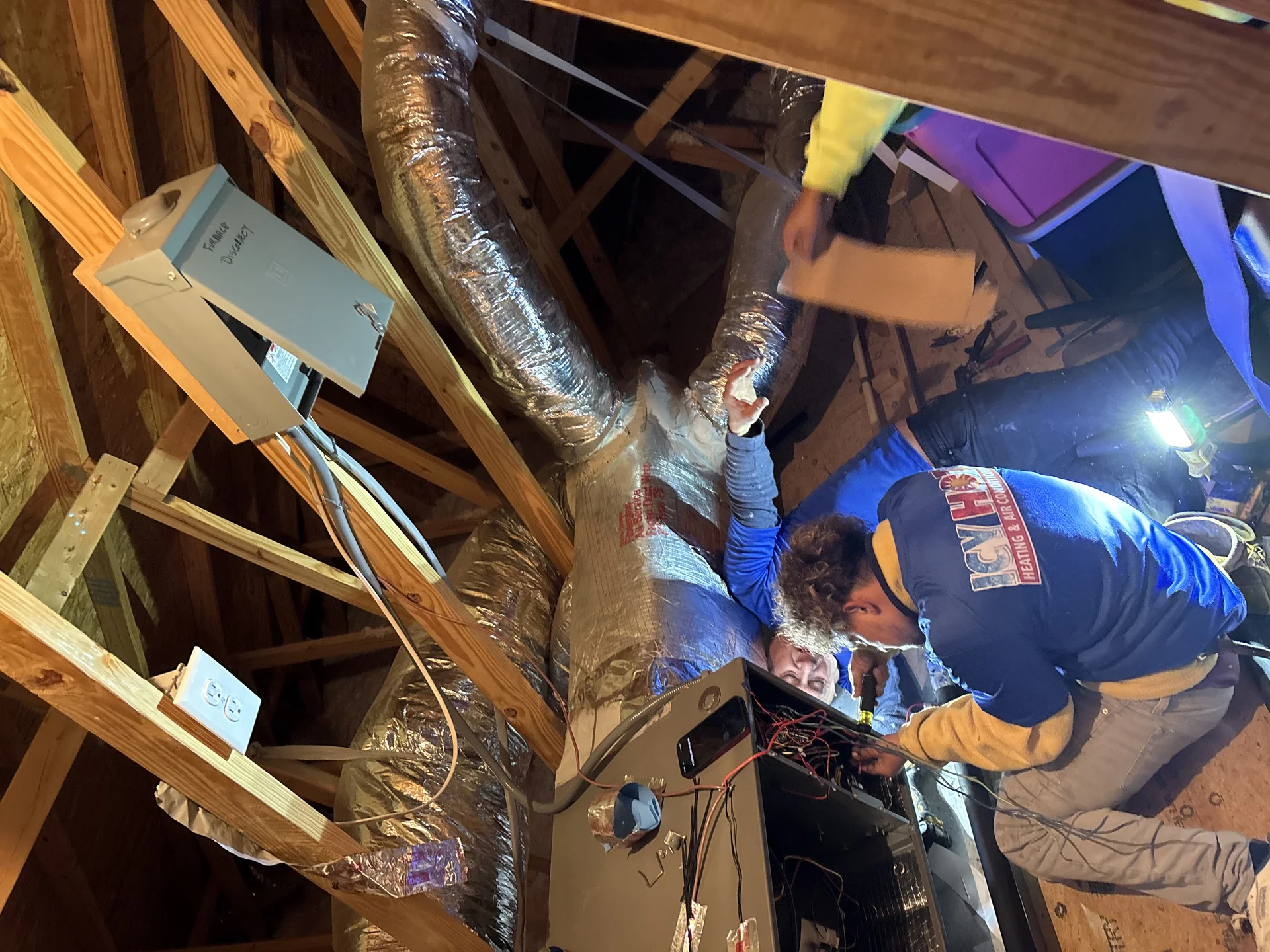
One thing almost nobody talks about: your ductwork is probably the real bottleneck, not your SEER rating. Duct leakage wastes 20–30% of heated and cooled air in typical homes (ENERGY STAR Seal & Insulate program). Fixing leaky ducts with professional duct sealing often returns more dollar savings than jumping two SEER tiers, and it’s a lot cheaper than swapping out the whole system.
When Is a Higher SEER NOT Worth It?
A premium 20+ SEER2 system rarely makes financial sense in NC if your home has leaky ducts, poor insulation, or an oversized existing system. You’ll get more savings from fixing the envelope than from chasing a higher efficiency number. If you are weighing an all-electric heat pump against a central AC paired with a furnace, see our heat pump vs. central air comparison.
Three scenarios where we tell homeowners to skip the premium tier:
- Leaky or undersized ductwork. If your ducts are losing 25% of your conditioned air to the attic, no amount of compressor efficiency fixes that. Get a duct pressure test first. HVAC inspection includes this.
- Poor home envelope. Single-pane windows, leaky rim joists, and thin attic insulation will eat premium SEER savings for breakfast. Fix the envelope first, then talk about equipment.
- Short expected ownership. If you’re planning to move in 5–7 years, the payback math rarely works on anything over 18 SEER2. A solid 16 SEER2 unit is almost always the right call.
Premium variable-speed systems also need compatible thermostats and well-commissioned airflow to actually deliver their rated efficiency. If the installer doesn’t know how to program the control board and verify static pressure, you paid for an 20 SEER2 that runs like a 16. The install is the product.
Frequently Asked Questions
The Bottom Line for Raleigh Homeowners
SEER rating matters, but it’s not the only number on the sticker, and it’s definitely not the only thing that determines your summer power bill. Here’s what actually matters for a new AC install in Raleigh:
- The legal minimum in NC is 14.3 SEER2 (about 15 old SEER).
- A good rating starts at 15.2 SEER2 (ENERGY STAR).
- The sweet spot for most Triangle homes is 16–18 SEER2.
- Premium 20+ SEER2 rarely pays back in our climate.
- Duke Energy Smart Saver rebates start at 15.2 SEER2.
- Proper sizing, tight ducts, and a careful install matter as much as the sticker rating.
Still not sure which SEER rating is right for your Raleigh home? We’ll run a proper load calculation, walk you through the rebate-eligible options, and tell you straight up when premium efficiency is worth it and when it isn’t. Call Icy Hot at (919) 673-7667 or request a free instant quote.
Shopping a ductless system instead? Our guide to mini-split installation costs in Raleigh covers the SEER2 and HSPF2 thresholds worth paying for on a mini-split quote.