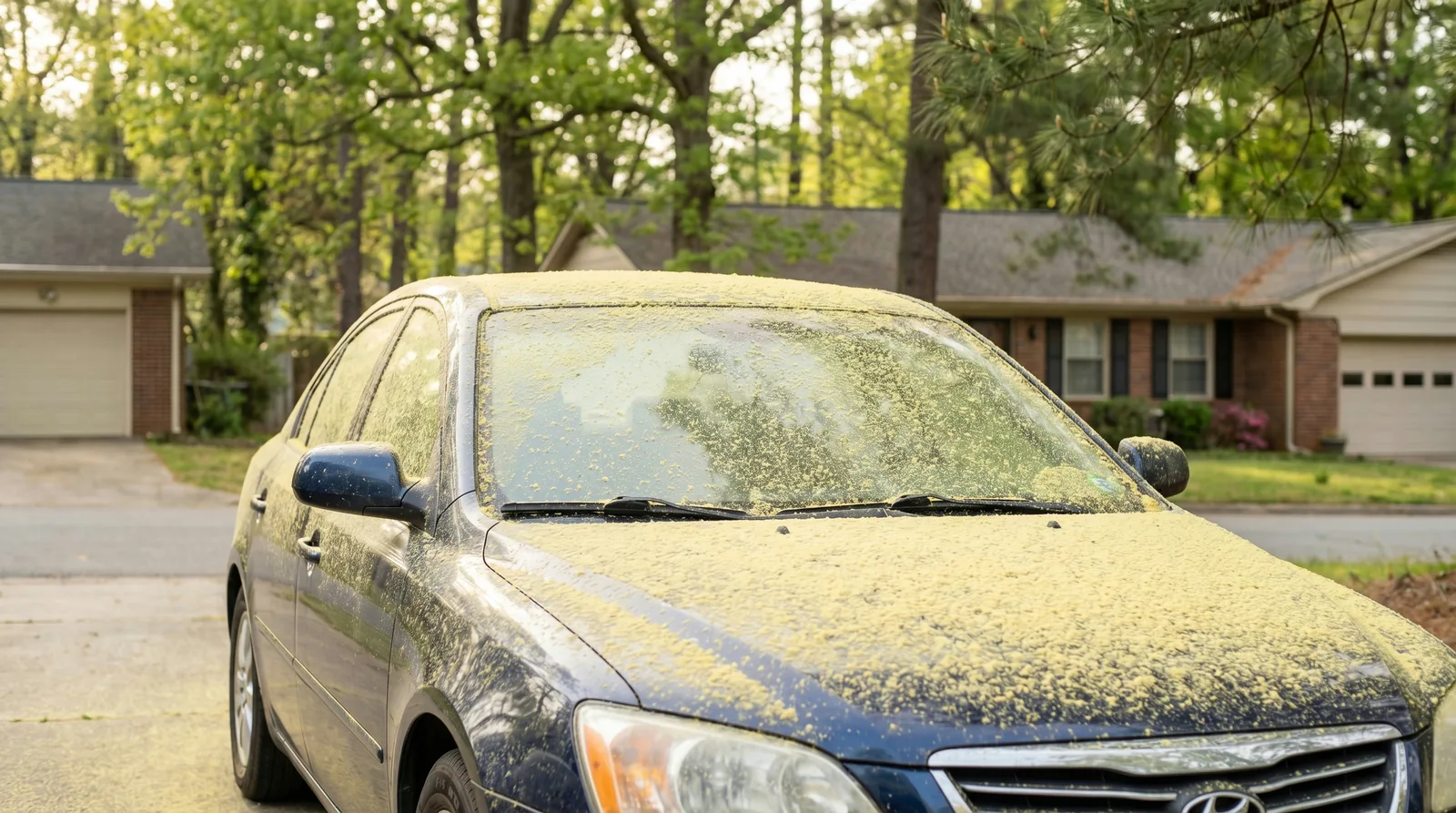
If you washed your car last Tuesday and it was coated yellow by Thursday, you already know what your HVAC system is up against right now. The Triangle’s tree pollen season runs February through May, and it peaks in late March and early April (NC State CNR). For Raleigh homeowners, that yellow dust on the deck is just the visible part. The microscopic hardwood pollen you can’t see is what actually triggers symptoms, and a lot of it ends up indoors.
Raleigh ranks among the most challenging U.S. metros for spring allergies in the 2026 Allergy Capitals report, scoring worse than average across all three categories the AAFA tracks (AAFA via WUNC). And here’s the part most homeowners miss: the EPA’s Total Exposure Assessment Methodology studies have measured indoor concentrations of common pollutants at 2 to 5 times higher than typical outdoor levels (U.S. EPA). Since Americans spend roughly 90% of their time indoors, what’s circulating through your HVAC system matters more than what’s blowing across your yard.
TL;DR: Indoor air carries 2 to 5 times the pollutant load of outdoor air (EPA), and Raleigh ranks among the worst U.S. metros for spring allergies (AAFA 2026). The fastest wins: upgrade to a MERV 11 to 13 filter, change it every 60 days during pollen season, run your HVAC fan on “On” instead of “Auto, ” and seal duct leaks that pull pollen-laden attic air into your living space.
Why Is Indoor Air Worse Than Outdoor Air?
Modern homes are built tight. Energy-efficient construction, synthetic materials, and reduced air exchange trap pollutants that older, leakier houses used to dilute naturally. According to the EPA’s Inside Story guide, indoor pollutant concentrations have climbed in recent decades for exactly this reason. Add personal care products, household cleaners, gas appliances, pet dander, and the pollen that hitchhikes in on shoes and clothing, and you’ve got a soup that the outdoor air rarely matches.
Spring makes it worse. Tree pollen season in North Carolina spans February through May, and pine, oak, and hickory pollen all release at the same time (NC State CNR). The visible yellow pine pollen rarely causes symptoms because the grains are too large to inhale deep into the lungs. The hardwood pollen, especially oak, is microscopic. It slips past door seals, rides in on your dog, and circulates through your air handler until something captures it.
Climate change is making the problem stickier. Pollen seasons in NC are starting earlier and lasting longer than they did 20 years ago (WRAL via NC State). What used to be a six-week problem is now a four-month one. That means your HVAC filter is doing a lot more work, for a lot longer, than it was designed for.
Step 1: Upgrade to a MERV 11 to 13 Filter
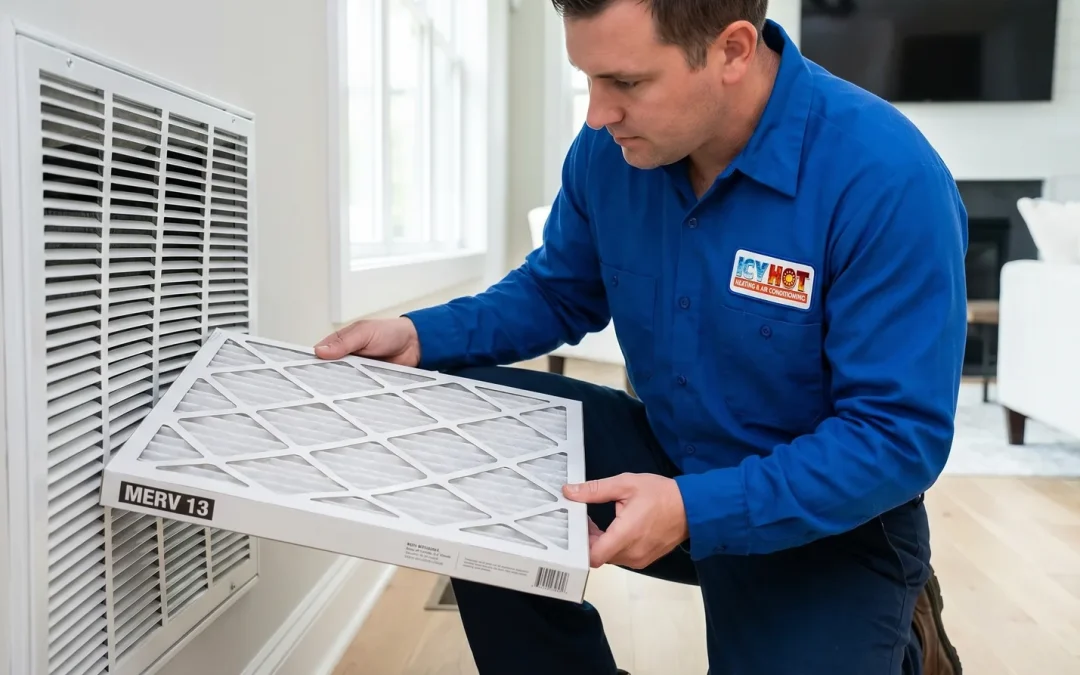
This is the single highest-impact move you can make, and it costs less than $30. The EPA’s official guidance is that homes wanting better filtration should upgrade to at least MERV 13, or as high as your system can accommodate (EPA). MERV stands for Minimum Efficiency Reporting Value, and it rates how well a filter captures particles between 0.3 and 10 microns. Pollen, mold spores, and pet dander all live in that range.
The chart below shows why the jump from MERV 8 to MERV 13 matters. A standard MERV 8 filter captures dust and large pollen grains, but it lets most of the small, lung-penetrating particles through. MERV 11 catches a meaningful share. MERV 13 is where the curve gets steep.
One caution: don’t jump straight to MERV 16 because more is better. It isn’t. Filters above MERV 13 restrict airflow enough that they can damage residential blower motors, ice up evaporator coils, and force your system to work harder for less output. For most Raleigh homes built since 2010, MERV 13 is the practical ceiling. If your home is older or your system is on the smaller side, MERV 11 is the safer upgrade. When in doubt, a quick indoor air quality inspection will tell you what your specific system can handle.
Step 2: Change Your Filter Every 60 Days During Pollen Season
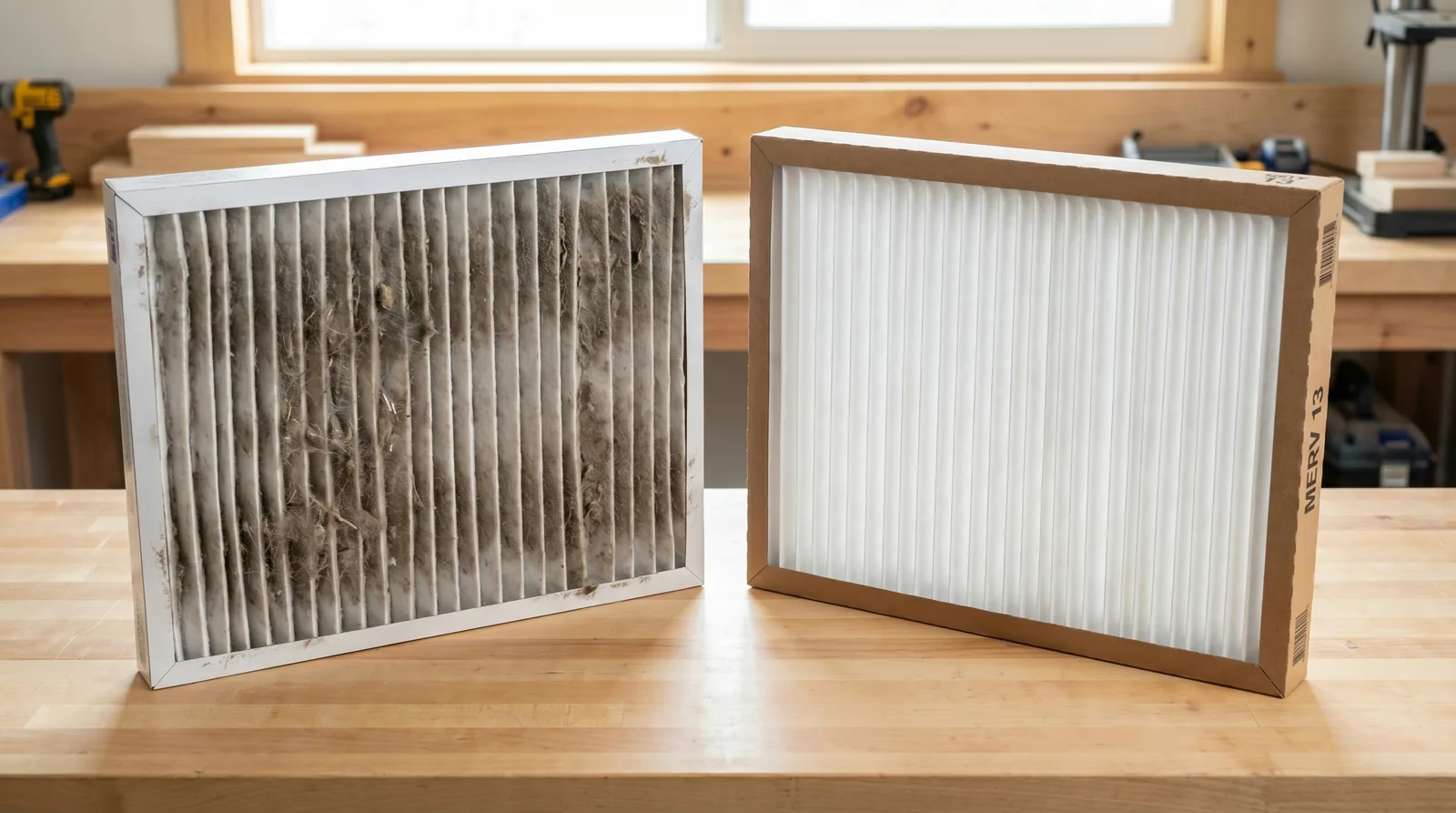
Manufacturer guidance usually says 90 days. Ignore that during March, April, and May. The pollen load on a Triangle filter in spring is two to three times what the same filter sees in October, and a clogged filter does more than just stop catching pollen. It actually worsens indoor air quality because air starts bypassing the filter through the gaps around its edges, dragging unfiltered debris straight into your ducts.
The simple test: pull the filter out and hold it up to a bright light. If you can’t see light through it, it’s done. If you have pets, drop the interval to every 30 days during pollen season. A $15 MERV 13 filter replaced six times a year still costs less than one emergency service call, and it’s the cheapest insurance against allergy symptoms you can buy.
If you keep forgetting, set a recurring reminder on your phone tied to the first of every other month, or sign up for a Comfort Club maintenance plan that includes scheduled filter changes along with seasonal tune-ups.
Step 3: Run Your HVAC Fan on “On” Instead of “Auto” During Peak Pollen Weeks
Most thermostats default to “Auto, ” which means the blower only runs when the system is actively heating or cooling. Switch it to “On” for the worst three or four weeks of pollen season, and the fan circulates air through your filter continuously. You’ve effectively turned your central HVAC into a whole-house air cleaner, without buying anything new.
The trade-off is energy use. On a modern variable-speed ECM blower, continuous operation adds roughly $5 to $15 per month to your electric bill. On an older single-speed PSC motor, it can be closer to $25 to $40. Worth it during peak pollen, probably not worth it year-round. Smart thermostats like the Nest, Ecobee, or Honeywell models let you schedule “fan on” during specific hours, so you can run it during the day when pollen is heaviest and let it cycle normally overnight.
Step 4: Seal Duct Leaks (the Hidden Pollen Highway)
This is the one most homeowners never think about. ENERGY STAR estimates that the average home loses 20 to 30% of HVAC airflow to duct leakage (ENERGY STAR). In a typical Raleigh home with attic-routed ducts, that doesn’t just waste energy. It also pulls scorching, pollen-laden attic air directly into the supply side of your system, where it bypasses the filter entirely.
From the field (Frankie Asfari, NATE-certified, NC License #L.34356): On almost every spring service call where homeowners tell me “my filter is brand new but my allergies are still terrible, ” the culprit turns out to be a return-side leak. The system is sucking pollen and dust straight from the attic or crawlspace, around the filter, and into the living space. Replacing the filter doesn’t fix it. Sealing the ductwork does.
Three telltale signs your ducts are leaking: dirty streaks on the wall or ceiling around supply registers (that’s filtered air pulling unfiltered air past the gasket), rooms that are noticeably hotter or colder than the rest of the house, and electric bills that climb faster than your neighbors’ do. Sealing is also a different job from cleaning, and a better use of the same money: we work through the evidence in whether duct cleaning is worth it. Duct tape is not the fix. It dries out and falls off within a year. Mastic sealant or aerosol duct sealing applied by a pro is what holds. Professional duct sealing typically pays for itself within two to four years through energy savings alone, with the IAQ improvement as a bonus.
Step 5: Control Indoor Humidity Between 30 and 50%
The EPA recommends keeping indoor relative humidity between 30 and 50% to minimize dust mites, mold growth, and bacterial activity (EPA Mold Course). In the Triangle’s humid summers, an uncontrolled home regularly hits 60 to 70% indoor humidity, which is dust-mite paradise. Below 30% and you swing the other direction into respiratory irritation, dry skin, and shocks from doorknobs.
Your AC dehumidifies as a side effect of cooling, but that only works when it’s actually running. The classic Raleigh problem is an oversized AC unit that cools the air to setpoint in 10 minutes flat, then shuts off before it can pull meaningful humidity out. The result: a cold, clammy house that still feels muggy. The fix is either a properly sized variable-speed AC (long, slow runtimes do more dehumidification) or a dedicated whole-house dehumidifier tied into your ductwork.
A $20 hygrometer from any hardware store will tell you where you actually stand. Drop one in the room where you spend the most time and check it for a week before deciding whether you have a humidity problem.
Step 6: Add Targeted Equipment When Filters Aren’t Enough
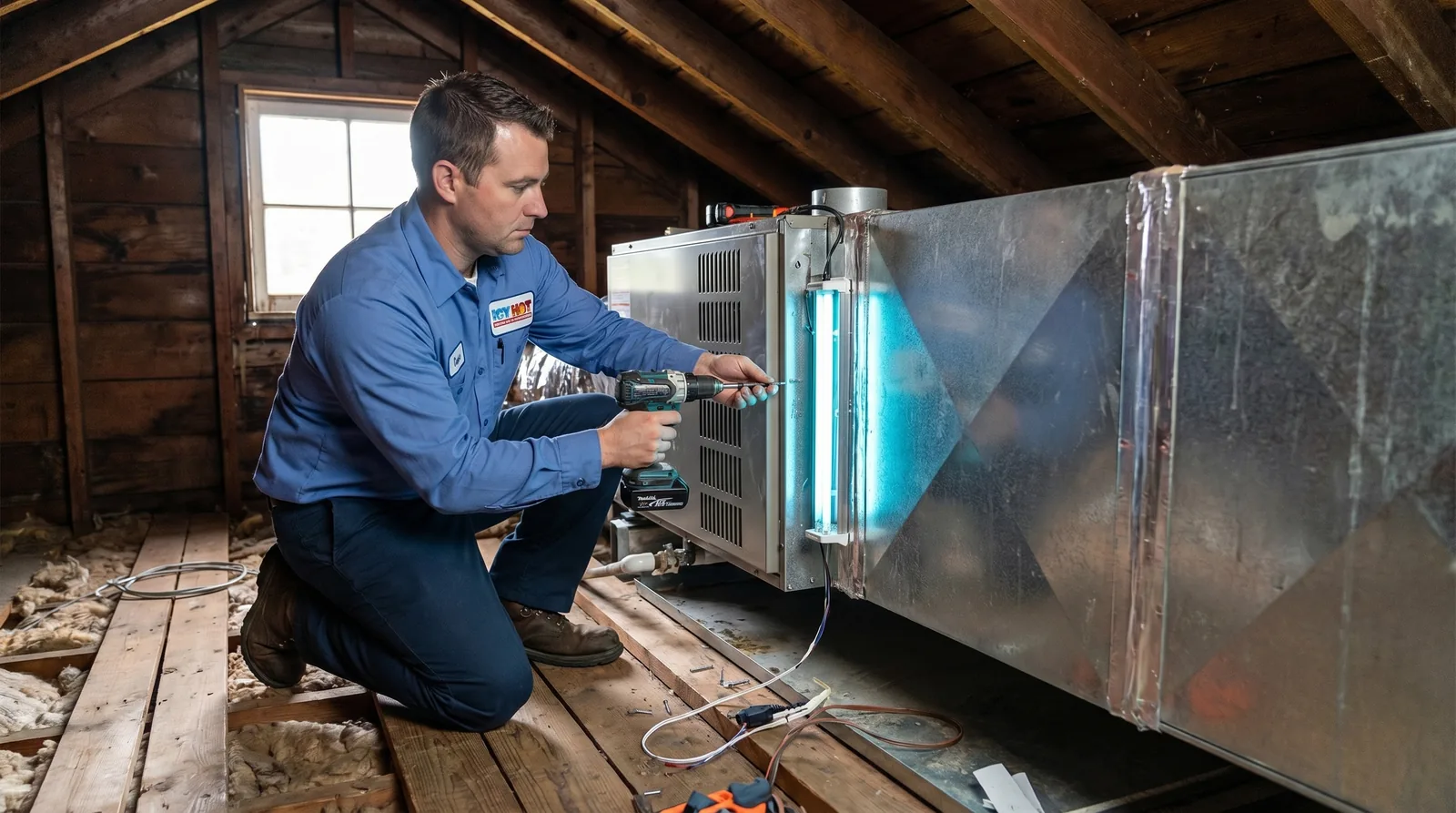
If you’ve upgraded your filter, sealed the obvious leaks, and your humidity is in range, but symptoms still aren’t budging, that’s when it makes sense to add equipment. Three options handle what filters can’t reach.
UV germicidal lights mount inside the air handler and kill mold, bacteria, and viruses on the evaporator coil and in the airstream. They’re particularly useful in humid Raleigh attics where coils stay damp for months. Expect $400 to $800 installed for a quality unit. Learn more about UV light installation.
Whole-house air purifiers with HEPA-grade or electronic filtration mount in line with your ductwork and remove sub-micron particles that even MERV 13 misses, including smoke, viruses, and the smallest pollen fragments. Installed cost typically runs $1, 000 to $2, 500. See our whole-house air purifier overview for the trade-offs between media, electronic, and HEPA-based systems.
Energy Recovery Ventilators (ERVs) bring fresh outdoor air into the home through a heat-exchange core that filters and conditions it on the way in. Unlike opening a window, an ERV doesn’t introduce pollen at outdoor concentrations. They’re the right answer for tight, modern homes that suffer from stuffy, stale air. Installed cost: $1, 500 to $3, 500. More on ventilation systems here.
Step 7: Keep Windows Closed on Peak Pollen Days
This one runs counter to the conventional advice you’ll see in most national IAQ articles. “Open windows for fresh air” works fine in February and November. From late March through mid-April in the Triangle, opening a window during the morning pollen peak can push indoor pollen counts above outdoor counts within 60 to 90 minutes. You’re filtering hard with the HVAC system, then sabotaging it through the window.
Two practical rules during peak pollen weeks. First, check the daily pollen forecast (the NC DEQ Pollen Report and Pollen.com both publish Raleigh-specific data). On High and Very High days, keep windows closed and let your HVAC do the work. Second, if you crave fresh air, ventilate at night. Pollen counts drop sharply between midnight and 6 a.m. as winds calm and tree pollen settles.
For homes that genuinely need more fresh air during pollen season, an ERV (covered above) is the long-term answer. It gives you the air exchange of an open window without the pollen invasion.
When to Call a Raleigh HVAC Pro
If you’ve worked through the steps above and your indoor air still feels off, that’s the cue to schedule a professional indoor air quality inspection. A licensed technician can measure particle counts, test for duct leakage, check the evaporator coil for mold, verify your humidity levels, and identify whether the issue is filtration, ventilation, source control, or something more involved like a cracked heat exchanger.
From the field (Frankie Asfari, NATE-certified, NC License #L.34356): The biggest red flag I look for on an IAQ visit is a difference between what the homeowner reports and what the equipment shows. If symptoms persist after a clean filter and decent humidity, the cause is almost always hidden, dirty coil, cracked plenum, or a duct leak pulling unfiltered air. None of those are visible from the thermostat. That’s what a real inspection finds.
The simplest path is to bundle the IAQ assessment with your spring AC tune-up or join the Comfort Club maintenance plan, which covers seasonal inspections, priority scheduling, and discounts on any equipment you decide to add. Annual professional review is the easiest way to catch slow-developing problems before they become symptoms you can feel.
Frequently Asked Questions
Breathe Easier This Spring in the Triangle
The 7-Step Recap
| 1. | Upgrade to MERV 11 to 13. Single highest-impact move, under $30. |
| 2. | Change every 60 days during pollen season (30 if you have pets). |
| 3. | Run the HVAC fan on “On” during peak pollen weeks. |
| 4. | Seal duct leaks so attic air stops bypassing your filter. |
| 5. | Hold humidity at 30 to 50% (per EPA). Use a $20 hygrometer to check. |
| 6. | Add UV lights, a whole-house purifier, or an ERV only if filtration alone isn’t enough. |
| 7. | Keep windows closed on High pollen days. Ventilate at night, when counts drop. |
Pollen season won’t take a break, but your home doesn’t have to feel like the inside of a pollen cloud. Run the seven steps in order, starting with the cheapest and easiest (MERV 13 filter, change every 60 days, fan on “On”), then work your way up to duct sealing and equipment if you need to. Most Raleigh homeowners can knock 70% of their indoor pollen problem out for under $50 and an hour of effort.
If you want a professional set of eyes on your system before the worst of allergy season passes, call (919) 673-7667 or schedule an appointment online. We’ll inspect your filtration, test your ducts, check your humidity, and tell you exactly which of these steps will actually move the needle for your specific home. No upsells, just a straight assessment of what’s working and what isn’t.
, Frankie Asfari, Owner & NATE-Certified Technician, Icy Hot Heating & Air Conditioning