A furnace is a big purchase most homeowners make only a few times, so it is hard to know whether the number in front of you is fair. Search for “furnace replacement cost” and you get a wall of national ranges that look slightly different and turn out to be nearly the same number, a federal tax credit that no longer exists, and permit fees that have nothing to do with Raleigh.
I am Frankie Asfari, and I have owned and run Icy Hot Heating & Air Conditioning in Raleigh since 2008. This guide does what those pages skip. It sets the published ranges next to the Department of Energy's own engineering model, prices out the high-efficiency upgrade with federal data, shows Raleigh's minimum permit fee, and gives you a way to check the payback on a 95% furnace with nothing but your own gas bills. Every published figure links to its source, and calculations are labeled as ours.
TL;DR: Angi's Raleigh calculator puts a normal furnace replacement at about $2,900 to $6,800, with a $4,834 average. Gas costs more than electric, and a condensing (90%+) furnace adds roughly $750 to $1,050 in 2026 dollars (the Department of Energy's $654 to $914, adjusted for inflation by us). That premium pays back fast only if you burn a lot of gas, so check your winter bills first. The federal tax credit ended with 2025, and Enbridge's $200 to $400 bill credit is the main incentive left for gas. Raleigh's minimum trade permit is $129 with its surcharge, far below the $400 to $1,500 some national pages quote.
How Much Does Furnace Replacement Cost in Raleigh?
Plan on about $2,900 to $6,800 for a typical Raleigh furnace replacement, with the average near $4,800. Angi's cost calculator, set to Raleigh, NC, shows a normal range of $2,879 to $6,808 and an average of $4,834, with a $450 low end and a $9,000 high end. That local range sits almost on top of the national numbers.
Nationally, HomeAdvisor reports that “the average furnace replacement cost ranges from $2,822 to $6,897, with most homeowners spending around $4,814,” and it says “this project can cost anywhere from $167 to $13,750.” Angi publishes the same $2,822 to $6,897 range and the same $4,814 average, and says that average is “based on 11,869 verified projects from Angi Pros.” Bryant, a furnace manufacturer, says “furnace installation costs generally range from $3,800 to $12,000.”
The top of every range is driven by the same handful of things: fuel type, capacity, efficiency tier, how hard the furnace is to reach, and whether the vent, drain, ducts or a shared water heater flue need work. Each of those gets its own section below. The bottom of the range tends to be a simpler job, such as a small electric furnace or a like-for-like gas unit in an open closet.
Two cautions before you hold a quote up against this table. These are averages across a lot of houses, not a price for yours, and a furnace that heats a 3,000-square-foot two-story house from a crawlspace is a different job from one that heats a 1,400-square-foot ranch from a hall closet. And the national numbers are not as independent as they look, which is the next section.
Why Do Furnace Prices Online All Look the Same?
Because two of the biggest cost sites appear to share one survey method, and an independent check, the federal government's own cost model, lands right in the middle of them. HomeAdvisor and Angi publish identical national ranges and averages, and both describe the same method: surveying “over 10,000 real” customers and pairing that with Bureau of Labor Statistics data and expert interviews.
Bryant's $3,800 to $12,000 lines up with HomeAdvisor's gas furnace figures of $3,800 to $10,000, “as much as $12,000.” Bryant does not publish a method, so the match may be a coincidence, but three pages agreeing could be one measurement, not three.
The independent number comes from the U.S. Department of Energy. To set the new furnace efficiency rule in 2023, DOE built a cost model from engineering teardowns of real furnaces, manufacturer and distributor markups, and installation costs, then averaged it over capacities and regions. Its installation model covers replacements, homes adding a furnace for the first time, and new construction, not replacements alone. In the final rule, a 95% AFUE gas furnace has an average installed cost of $3,962 in 2022 dollars. Adjusted with the Consumer Price Index to September 2026, that is about $4,560 (our calculation), about $250 under the $4,814 survey average.
That gap is not a sign that anyone is wrong. DOE says its prices “reflect an amended-standards scenario in which a given efficiency level is the new minimally compliant, baseline level,” which means a basic 95% furnace, not the premium two-stage and variable-speed models that also appear on real quotes.
DOE also notes that “the vast majority of consumer furnaces are sold through a distribution channel involving a contractor, not via a retail outlet,” which is why a furnace's price on a retail website is not what an installed furnace costs. Read together, the survey data and the federal model point, by our reading, to roughly $4,500 to $5,000 for an ordinary furnace replacement in 2026, with the range around it driven mostly by the job: fuel, capacity, efficiency and installation.
What Does Each Type of Furnace Cost?
Electric furnaces are the cheapest to install, at about $2,000 to $7,000, while gas furnaces run about $3,800 to $10,000. HomeAdvisor and Angi agree on those two ranges. Angi adds propane at $3,700 to $14,200, and both list oil at $6,750 to $10,000.
Before you price a furnace at all, check what you have. In North Carolina, a furnace is the main heating equipment in only about half of homes.
The U.S. Energy Information Administration's 2020 Residential Energy Consumption Survey counts 1.99 million of the state's 4.01 million homes heating mainly with a furnace (50%) and 1.54 million with a central heat pump (38%). With 38% of the state on heat pumps, it is worth confirming that “the furnace” in your closet is not an air handler paired with a heat pump, because that changes the whole conversation. Our air handler vs. furnace guide shows how to tell in about two minutes.
Gas costs more to install because there is more to install: a gas line connection, a combustion vent, and safety controls an electric unit does not have. An electric furnace is the cheapest box to put in, and if you have one, the better question may be whether to replace it with a heat pump instead, which our heat pump installation page covers. That is also the one swap where a state rebate is still in play, covered below. Our gas furnace and electric furnace pages walk through each option.
How Much Does Furnace Size Change the Price?
Size changes the price, but the bigger cost risk is installing the wrong size. Angi's size table runs from $1,200 to $2,000 for a 1,000-square-foot home to $6,000 to $10,000 for 5,000 square feet, with a 2,000-square-foot home at $2,400 to $4,000 installed. Those size figures run below Angi's own fuel-type ranges, so treat them as rough. Both Angi and HomeAdvisor size those examples at “30 to 60 BTUs per square foot,” and that is where I would push back.
A square-foot rule is a guess, and the code asks for more than a guess. In March 2026 the NC Office of State Fire Marshal said construction and code enforcement were “ongoing under the 2018 NC Building Code,” while the 2024 code's start date was still unsettled. Section M1401.3 of the 2018 North Carolina Residential Code says heating equipment “shall be sized in accordance with ACCA Manual S or other approved sizing methodologies based on building loads calculated in accordance with ACCA Manual J or other approved heating and cooling calculation methodologies.”
A Manual J load calculation looks at your insulation, windows, air leakage, orientation and ductwork, not just your floor area. Ask your contractor to show you the calculation behind the size on your quote. Angi itself warns that “choosing a system that's too large or too small will result in wasted energy, uneven heating, and a shorter equipment lifespan.”
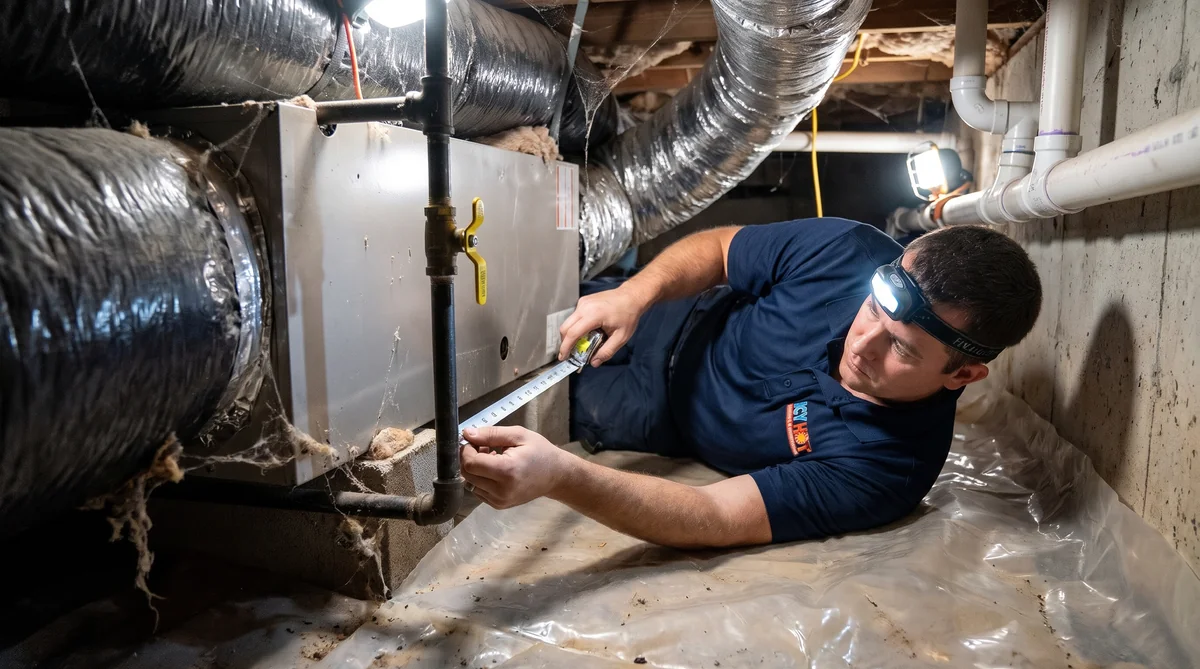
Where the furnace sits also moves the price. A furnace in an open hall closet is the easy case. A horizontal furnace in a crawlspace or an attic takes more labor to get out and get in, and a condensing model in those spaces needs a vent and drain path planned through framing or a foundation wall. That is a big part of why two quotes for “the same furnace” can differ widely.
If your furnace is 15 or more years old and you are not sure whether to replace it yet, our posts on how long a furnace lasts and the signs it needs replacing cover that decision.
How Much More Does a High-Efficiency Furnace Cost to Install?
DOE puts the extra cost of a condensing furnace in a replacement at $654 to $914 in total, about $753 to $1,052 in 2026 dollars (our inflation adjustment). In its 2023 rule, DOE says that “on average for replacement installations, the incremental installation cost is $490 for condensing NWGFs relative to non-condensing NWGFs,” and it puts the difference in total installed cost at $654 to $914. NWGF is DOE's abbreviation for the ordinary indoor gas furnace.
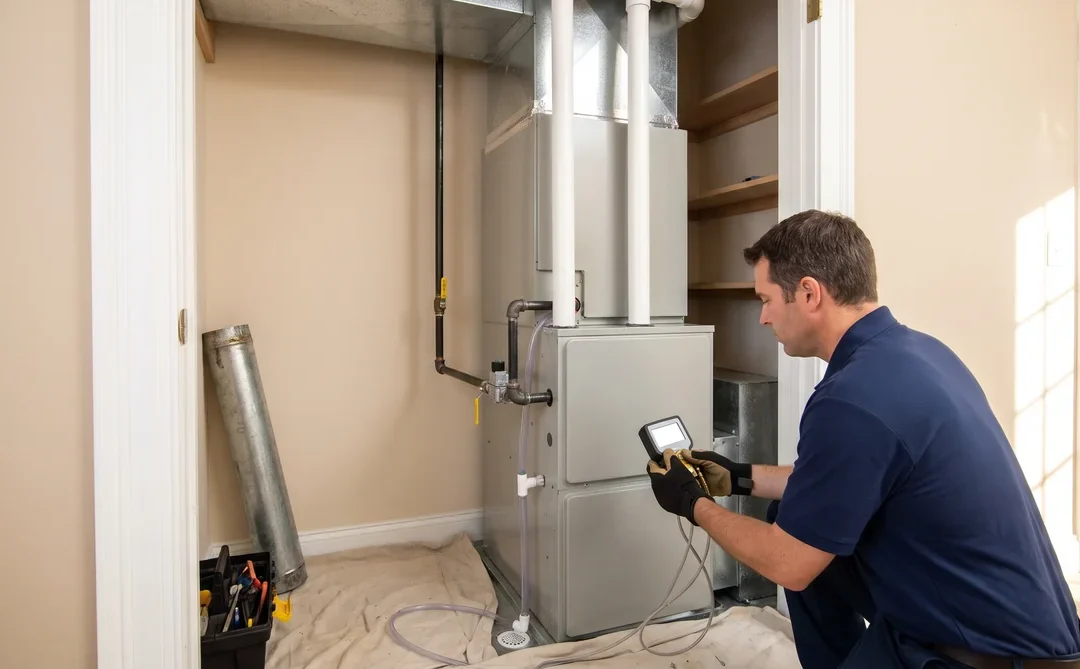
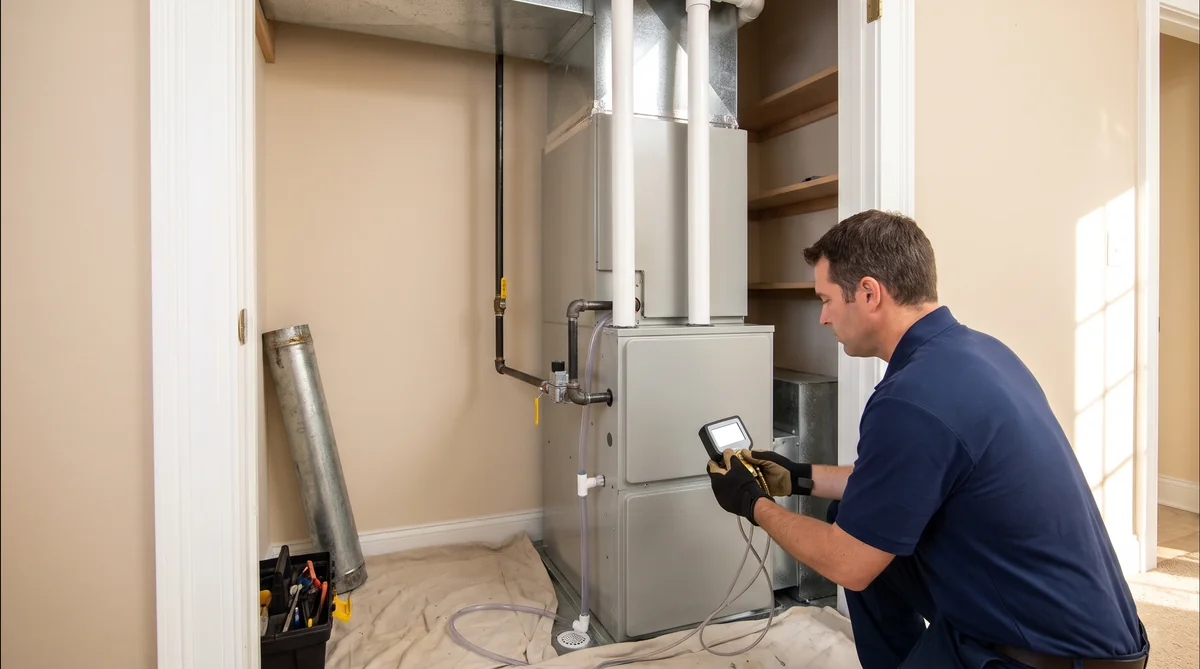
The extra money buys more than a better efficiency label. A condensing furnace, anything at roughly 90% AFUE and up, pulls so much heat out of its exhaust that the water vapor in it condenses into liquid. That changes the plumbing: the exhaust goes out through PVC pipe instead of the old metal flue, and the furnace needs a drain for the condensate. In a closet against an outside wall, that is a short run. In a crawlspace or an interior closet, it can mean a new vent route and a condensate pump.
Industry groups argued DOE's costs were too low. ACCA, the contractors' trade association, cited a 2016 survey of over 700 of its members that “showed that installing a condensing furnace costs $569 more than installing a non-condensing furnace” and argued DOE's assumptions understated the true cost. DOE replied that its $654 to $914 range was “consistent with ACCA's survey results.” The American Public Gas Association also argued the real difference is larger, pointing to a website where an 80% variable-speed furnace was $1,320 less than a 95% two-stage, variable-speed model, a comparison that also folds in a two-stage upgrade.
One more cost to ask about is the gas water heater. In homes where the water heater shares the furnace's metal flue, taking the furnace off that flue leaves the water heater “orphaned” on a vent sized for two appliances. DOE says it includes those costs “where applicable, including updating flue connectors, vent resizing, or chimney relining,” and it notes that switching to a power-vented or electric water heater is another option. Ask whether your quote accounts for it.
Does a 95% Furnace Pay for Itself in Raleigh?
Sometimes. In Raleigh's mild winters the payback depends almost entirely on how much gas your house burns, so look at your own bills before you pay for the upgrade. ENERGY STAR says certified furnaces for the southern half of the country “will be up to 16 percent more efficient than standard models and can save an average of $60 in energy costs each year.”
At $60 a year, DOE's condensing premium takes about 13 to 18 years to come back by our calculation, which is a long time against the 21.5-year average furnace lifetime in DOE's analysis. DOE's own national average simple payback at the 95% level is 7.6 years, but that is a national figure, and homes in colder states run their furnaces more.
But $60 is an average across a lot of small southern heating bills, and your house may not be average. Here is how to check.
- Pull a year of Enbridge Gas bills.
- Find the therms used in the summer months, when the gas only runs your water heater and stove. That is your baseline.
- Subtract that baseline from each winter month's therms.
- Add up the differences. That total is roughly the gas your furnace burns each winter.
Then use the table: moving from an 80% to a 96% furnace cuts that number by about one sixth (our calculation). North Carolina residential gas averaged $18.44 per thousand cubic feet from November 2025 through February 2026 in EIA's data, about $1.78 per therm.
Three honest caveats. EIA's average price includes the fixed monthly customer charge spread across every therm, so the real savings per therm saved are somewhat lower than $1.78, which stretches every payback in the table. DOE's premium is a national average, and a hard crawlspace vent can cost more. And DOE itself estimated that at the 95% level, 18.7% of affected gas furnace buyers nationwide would see a net cost over the life of the furnace.
If your furnace burns 300 therms or less a winter and the condensing vent or drain route would be difficult or costly, an 80% furnace is a defensible choice while 80% furnaces are still made, which the federal rule allows for furnaces manufactured before December 18, 2028. If you burn 500 or more, or you plan to stay put, the table favors the condensing furnace, especially with Enbridge's credit. Our single-stage vs. two-stage furnace guide covers the next decision on the list.
What Else Shows Up on a Raleigh Furnace Quote?
The permit, haul-away, venting and drain work, any duct changes, and sometimes the water heater vent. These are the lines that make two quotes for the same furnace look different. The line where national figures are furthest from Raleigh's is the permit.
North Carolina requires a permit for “the installation, extension, alteration, or general repair of any heating or cooling equipment system,” under G.S. 160D-1110, and the City of Raleigh's residential permit page lists HVAC replacement among the jobs that need one.
The same statute limits what a town can charge for it: a local government cannot “require more than one building permit for the complete installation or replacement of any natural gas, propane gas, or electrical appliance” when a licensed contractor does the work, and “the cost of the building permit for this work shall not exceed the cost of any one individual trade permit.”
Raleigh's Development Fee Guide for July 1, 2026 to June 30, 2027 does not list a separate fee for a residential furnace change-out, and it says “any fee not specifically listed as an individual fee will be charged at the minimum permit fee.” It also treats replacing equipment with new equipment that serves the same purpose as a Level 1 Alteration, where “Minimum Permit fees per trade do apply.”
Its minimum trade permit is $124 for FY27, and the guide's technology fee table shows $129 once the 4% surcharge is added. The minimum is a floor; the fee guide calculates alteration fees as a percentage of the building permit fee. The city's online fee calculator, linked from its residential permit page, can estimate it for your job, so ask to see the permit on the quote.
That is a long way from the national figure Angi gives, that “furnace installation permits cost between $400 and $1,500.” Cary, Apex, Garner, Wake Forest and unincorporated Wake County set their own fees, and the state law above limits each of them to the cost of one trade permit for a licensed contractor's complete appliance replacement.
Two smaller items are worth asking about while the old furnace is out: a thermostat that matches the new furnace's staging, and a deeper filter cabinet in place of a one-inch slot in the return. Both are simpler to add during the install than on a separate visit later.
Why Are 2026 Furnace Quotes Higher Than a Few Years Ago?
Because furnaces themselves cost a lot more at the factory than they did in 2019, and that increase has outpaced general inflation by a wide margin. A price a neighbor paid before 2021 is not a useful benchmark for a quote today.
The Bureau of Labor Statistics tracks what manufacturers charge for warm-air furnaces in its Producer Price Index. That index averaged 161.2 in 2019 and 252.1 over the first nine months of 2026, 56% higher by our calculation, with a preliminary September reading of 259.6. Over the same stretch, the Consumer Price Index went from a 2019 average of 255.7 to a January to September 2026 average of 332.2, about 30% higher (our calculation).
The biggest jump came between 2021 and 2022, when the furnace index climbed from an average of 182.6 to 215.5 in a single year. The series covers the whole category BLS calls warm air furnaces, including duct furnaces, humidifiers and electric comfort heating, so read it as a broad gauge of what furnace makers charge rather than the price of any one model.
A producer price index measures what manufacturers charge, not what you pay installed. Labor, distribution and the parts that make up the rest of the job have their own price trends, so an installed furnace has not necessarily gone up 56%. But the direction is clear. When you compare quotes, compare them with each other and with current published figures, not with a price from before 2021.
Those price changes are also why DOE's 2022-dollar figures need adjusting before they are useful. This guide adjusts them with the CPI; adjusting by the furnace index instead would raise them and lengthen the paybacks in Table 3.
What Rebates and Tax Credits Are Left for a Furnace in 2026?
For a gas furnace installed in Raleigh today, the main incentive left is Enbridge Gas North Carolina's bill credit of $200 to $400. The federal tax credit is over, and Energy Saver NC's HEAR rebates no longer pay to switch from gas to a heat pump.
The federal Energy Efficient Home Improvement Credit, often called 25C, paid up to $600 for a qualifying gas furnace. The IRS now says plainly: “You can claim the credit for improvements made through December 31, 2025.” A furnace installed in 2026 does not qualify. Some cost pages have not caught up; Angi's furnace article still says the credit runs “through December 31, 2032.”
At the state level, Energy Saver North Carolina changed its HEAR rebates to follow new federal guidance. For furnace owners, what changed is the gas-to-heat-pump path: since September 1, 2026, “rebates will no longer be allowed for the replacement of gas or any other fossil fuel appliances through the HEAR rebates pathway,” while “Electric-to-Electric Upgrades ARE allowed.”
For households with incomes under 150% of area median income, that keeps a door open for replacing an electric furnace with a heat pump, though the program notes that “insulation and air sealing upgrades may be required alongside a HEAR heat pump-related project.” Our NC HVAC rebates guide covers that program in detail.
For gas, the utility is the place to look. The Public Service Company of North Carolina, which Enbridge describes as serving “the cities of Raleigh, Durham and Asheville,” now operates as Enbridge Gas North Carolina. Its residential rebate page lists a $200 bill credit for a gas furnace rated 0.92 AFUE or better, $400 for 0.97 or better, and $50 for an ENERGY STAR smart thermostat in a gas-heated home. You submit the form within 90 days of installation with an itemized receipt, so ask your installer for the model number and AFUE on the invoice.
Then there is the 2028 rule. Under 10 CFR 430.32, the 80% minimum applies to non-weatherized gas furnaces made before December 18, 2028, and those made on and after that date must reach 95% AFUE.
In February 2026 the American Gas Association, the American Public Gas Association and the National Propane Gas Association petitioned DOE to push that date to “January 1, 2030, at a minimum,” and DOE asked for public comment in April. As of this writing, the Federal Register shows no final decision. I would not buy or skip a condensing furnace based on where that petition goes; buy the one that pays off for your house.
Should You Replace the Furnace and the AC at the Same Time?
If your air conditioner is more than about 10 years old, get a price for both, because the two halves work as one system and share the labor. ENERGY STAR suggests considering replacement when “your heat pump or air conditioner is more than 10 years old” or “your furnace or boiler is more than 15 years old.” If your AC is past 10 and your furnace past 15, both of those thresholds apply to your house.
The physical reason is simple. The air conditioner's indoor coil usually sits right on top of the furnace, and the furnace blower moves the air for both heating and cooling. Replace the furnace alone and you may be fitting a new cabinet to an old coil, then paying for a second visit, a second set of connections, and possibly a new coil transition when the AC fails a few years later. Replace both and the coil, blower and outdoor unit can be chosen and matched as a set.
It is a bigger check. Bryant's pricing guide puts a complete HVAC system replacement at $5,000 to $28,000 nationally. This Old House, using Angi pricing, puts the average HVAC system installation at about $8,138 for a 1,000-square-foot home, $8,344 for 1,800 square feet and $12,670 for 2,500 square feet, including ductwork and a thermostat. Our AC replacement cost guide breaks out the cooling side for Raleigh.
If the AC is young and healthy, replacing only the furnace is perfectly reasonable; just make sure the new furnace's blower is matched to the coil you are keeping. If you would rather have one system that heats and cools, a heat pump, or a heat pump paired with a gas furnace in a dual fuel setup, is the other path, and our dual fuel page explains how that works. Whichever way you go, ask for both options to be priced side by side.
How Do You Compare Two Furnace Quotes?
Make every quote answer the same questions in writing, then compare the answers, not just the totals. Bryant gives homeowners the same advice: “Get at least three detailed quotes from reputable dealers. Ensure they include a load calculation (sizing), breakdown of labor vs. equipment, and warranty details.” Here is the list I would bring to the kitchen table.
- Ask for the load calculation, since the North Carolina Residential Code ties furnace sizing to Manual J or an approved equivalent.
- Ask for the exact model number and its AFUE, so you can confirm the efficiency and claim Enbridge's credit.
- Ask whether the quote includes the permit, haul-away, vent and condensate work, any duct changes, and the water heater vent if it shares the flue.
- Ask for the equipment and labor warranties in writing, along with whether the manufacturer warranty needs registration or yearly service to stay in force.
- Check the license.
North Carolina licenses heating contractors under G.S. 87-21, which says “systems installed in single-family residences are included under heating group number three, regardless of size.” You can look up any contractor's license on the State Board of Examiners of Plumbing, Heating and Fire Sprinkler Contractors website.

If one quote is far below the others, find out which of those lines it left out. If one is far above, ask what it includes that the others do not, because it may be the only one that priced the vent, the water heater or the ductwork. A good quote should make the price easy to understand. Our furnace installation page lists what goes into a full replacement, and you can request a free estimate through our online quote form.
Frequently Asked Questions About Furnace Replacement Cost
The Bottom Line for Raleigh Homeowners
Angi's Raleigh normal range for a furnace replacement is about $2,900 to $6,800, and the details on the quote matter more than the brand on the box. Check whether you actually have a furnace, get the size from a load calculation, and decide on 95% efficiency with your own gas bills rather than a sales pitch.
Expect a modest permit fee in the city (Raleigh's minimum trade permit is $129 with its surcharge), ask about the vent, the drain and the water heater, and claim Enbridge's credit within 90 days. Do not count on the federal tax credit; it ended with 2025.
If your furnace is aging or already giving up, call us at (919) 673-7667 or schedule a visit online. Whoever you call, ask for a load calculation and for pricing on both an 80% and a condensing furnace, and keep a year of gas bills handy so the payback math uses your own numbers. If you are not sure the furnace is finished, start with a furnace repair visit. A maintenance plan keeps whichever furnace you choose running for the long haul.
Written by Frankie Asfari, owner of Icy Hot Heating & Air Conditioning in Raleigh, NC. NATE-certified, NC HVAC License #L.34356.