Every fall somebody in the Triangle turns the thermostat to heat for the first time, smells the dust burn off, and wonders how many more winters the box in the closet has left. Usually it is a number they half remember from a home inspection report, and the real question underneath it is money: do I keep fixing this thing, or do I start saving for a new one?
The answer most websites give is 15 to 20 years, and that is not wrong. It is just incomplete. It is the range the manufacturers publish, and it leaves out the most data-driven estimate we found, which comes from the U.S. Department of Energy. It also leaves out the thing that matters most here: a Raleigh furnace does a different job than a furnace in Chicago, and the federal data shows that this cuts both ways.
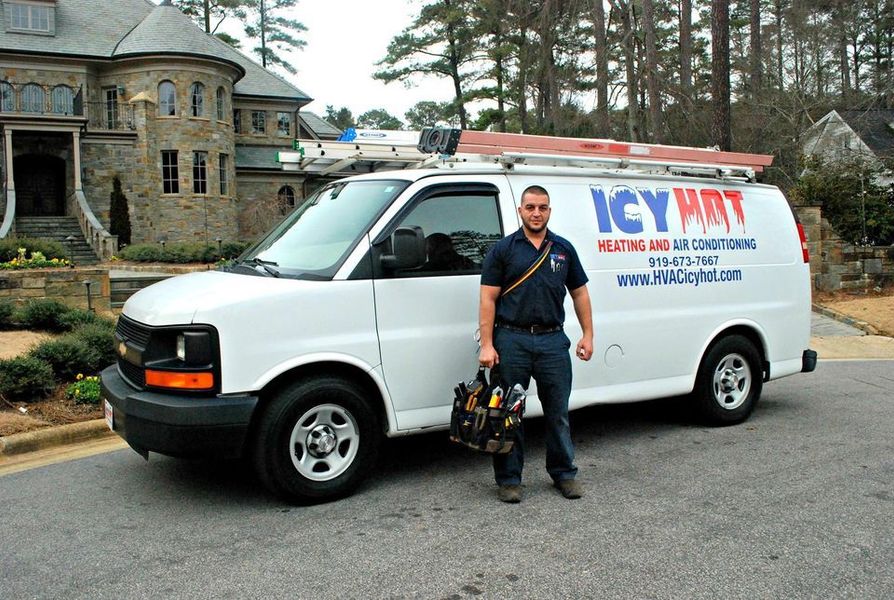
I am Frankie Asfari, and I have owned and run Icy Hot Heating & Air Conditioning in Raleigh since 2008. Below is how long a furnace actually lasts, which parts wear out first, what each repair should cost, and the point at which I tell people to stop repairing and start replacing. Every figure is linked to the federal rulemaking record, to NOAA climate normals, to the manufacturers that build these furnaces, or to HomeAdvisor cost data.
TL;DR: A maintained gas furnace lasts 15 to 20 years by the manufacturers’ numbers and about 21.5 years on average by the Department of Energy’s, which drops to 20.2 years outside the northern states. Electric furnaces last somewhat longer, 20 to 30 years. A Raleigh furnace faces about half of Chicago’s heating demand, but DOE found furnaces outside the North retire slightly sooner, in part because the blower also runs the air conditioning all summer. Start budgeting at 15, keep fixing small things at any age, and replace when a single repair passes half the cost of a new furnace, about $2,400 against HomeAdvisor’s all-fuel $4,814 average and often higher for gas furnaces, or when the heat exchanger fails. Questions about your own furnace? Call (919) 673-7667.
How Long Does a Furnace Last on Average?
A maintained gas furnace lasts 15 to 20 years by the manufacturers’ published guidance, and about 21.5 years on average by the federal government’s estimate. Those two numbers are not in conflict. They answer slightly different questions, and knowing which one you are looking at changes how you plan.
The manufacturers agree with each other to a degree that is unusual in this industry. Carrier says “a well-maintained furnace typically lasts 15 and 20 years.” Bryant says “A properly maintained gas furnace typically lasts 15 to 20 years, although actual lifespan varies based on maintenance, usage, installation quality, climate, and equipment condition.” Trane says “The average furnace will last 15-20 years.” Lennox says “The average lifespan of furnaces is 15-20 years,” and American Standard says “The average gas furnace lifespan is 15 to 20 years.”
The Department of Energy came at the question differently. When it wrote the 2023 efficiency standard for gas furnaces, it had to estimate how long a furnace stays in service, because that number drives every savings calculation in the rule. The final rule states: “DOE estimates the average product lifetime to be 21.5 years” for non-weatherized gas furnaces, the indoor kind nearly every Raleigh gas home has. It then splits that average by region: “22.5 years in the North and 20.2 years in the rest of country.”
The rule does not list which states fall in each group, but its northern region is built around high-heating-load states, so for a mild-winter state like North Carolina the 20.2-year figure is the closer match. That is my inference from the rule’s method, not a line DOE wrote about Raleigh. That sits right at the top of the manufacturers’ range, which is a useful sanity check. The two sources agree that 20 years is a normal, healthy life, and that 15 is where you should start paying attention. The chart below puts every published estimate on one axis.
Why Is the Federal Number Higher Than the Manufacturers’ Range?
Most likely because the manufacturers publish a planning range and the Department of Energy measured an average from survey data, and averages include the long-lived furnaces. Neither one is a promise. Both are useful.
DOE did not ask manufacturers how long their furnaces last. It worked from what households report. The rule explains that DOE “relied on RECS 1990, 1993, 2001, 2005, 2009, 2015, and 2020,” the Energy Information Administration’s Residential Energy Consumption Survey, and on “the U.S. Census’s biennial American Housing Survey,” covering 1974 to 2021. Combining the ages of furnaces found in real homes with historical shipment figures, it built what it calls a survival function, which “provides a lifetime range from minimum to maximum, as well as an average lifetime.”
Two details in that section are worth knowing. First, DOE checked its answer against outside studies and reported that its estimate “is consistent with the range of values identified in a literature review, which included values from 16 years to 23.6 years.” Second, it acknowledged real uncertainty by running “sensitivity analyses using a median lifetime of 16 years (low lifetime scenario) and 27 years (high lifetime scenario).” In other words, the federal analysts themselves treat typical lifetimes from the mid-teens to the late twenties as plausible for a gas furnace.
So why do manufacturers stop at 20? My read, and it is a read rather than a published explanation, is that a manufacturer’s number is a recommendation to a homeowner who wants to avoid a mid-January failure, so it leans conservative. An average from survey data includes every furnace that kept running at 24 or 27 years. If you want one sentence: the manufacturers tell you when to start planning, and DOE tells you what a typical furnace actually achieves.
Do Furnaces Last Longer in Raleigh’s Mild Climate?
Intuition says yes, but the federal data shows furnaces outside the North actually retire about two years sooner, and a big part of the reason is the air conditioner. This is the part of the question almost nobody covers, and it changes how you should think about a Raleigh furnace.
Start with the intuitive half. Trane says “The longer the winters and the harder the furnace works, in general, the shorter the lifespan.” Bryant agrees that “furnaces in colder regions typically run more frequently and for longer periods during the heating season, which can increase wear on components such as the blower motor, heat exchanger, and ignition system.” NOAA’s 1991 to 2020 climate normals put numbers on the difference: Raleigh-Durham averages 3,153 heating degree days a year against 5,974 at Chicago O’Hare, so a Raleigh furnace faces roughly 53 percent of Chicago’s heating demand. Demand is not the same as run time, though, and that is where the intuition breaks.
Now the half that surprises people. If light winters were the whole story, DOE’s rest-of-country figure would be higher than its northern one. It is lower: 20.2 years against 22.5. The gas industry made exactly the intuitive argument during the rulemaking, and the rule answered it directly. Because northern furnaces are sized much larger, DOE wrote, “burner operating hours are not necessarily higher in the North than the rest of country, due to the increased capacity.” Then the line that matters here: “furnaces in the rest of country are more likely to be paired with an air conditioner, and, thus, the air handler can have significantly higher operating hours than in the North.”
That describes Raleigh exactly. In most gas-heated homes here the furnace is also the air handler: the air conditioner’s indoor coil sits on top of it or at the end of it, and the furnace blower moves every cubic foot of cooled air all summer. Carrier makes the same point: “because the furnace often serves as the air handler for your central air conditioner or heat pump, year-round usage impacts its total lifespan.” NOAA’s normals show Raleigh-Durham at 1,805 cooling degree days against 1,003 at O’Hare, about 1.8 times the cooling demand. Degree days measure weather, not run hours, so treat both ratios as a direction rather than a measurement of your furnace. DOE adds that replacements here “are more likely to be linked to a paired central air conditioner,” which is the other half of the story.
What this means in practice: the combustion side of a Raleigh furnace, the burners, igniter and heat exchanger, only works in the heating season, while the shared side, the blower motor, its capacitor and the control board, works twelve months a year. And when the air conditioner reaches the end of its own life, which our AC lifespan guide covers, the furnace often gets replaced with it because the two are matched as a system. A Raleigh furnace that is mechanically healthy at 16 can still be retired early for that reason, and sometimes that is the right call.
Which Furnace Parts Wear Out, and Which One Ends the Furnace?
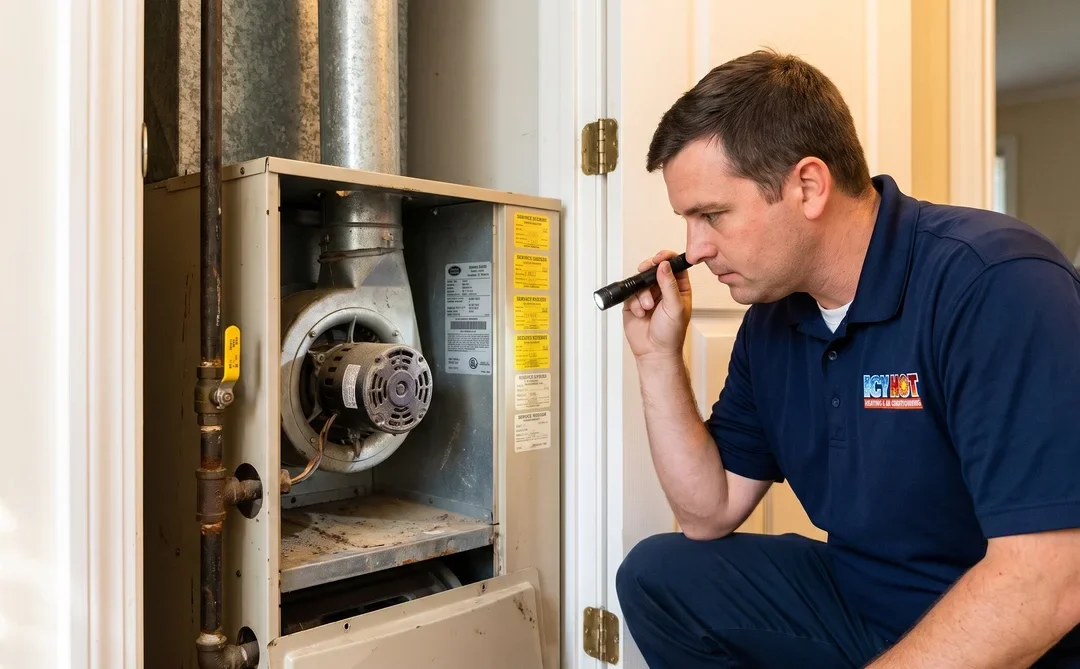
Almost every part of a furnace is replaceable, and most failures are cheap. The one that usually ends a furnace’s life is the heat exchanger. Knowing the difference keeps you from replacing a furnace over a $250 part, or pouring $1,500 into one that is finished.
HomeAdvisor puts the average furnace repair at $318, with most homeowners paying between $133 and $505 and the full range running from $64 to $1,475. Its part-by-part ranges are below, with my own note on what each failure usually means for an older furnace. HomeAdvisor does not say whether each range includes labor, so treat them as ballpark figures.
The heat exchanger is the line in that table that matters. It is the metal chamber that keeps combustion gases separate from the air you breathe, and when it cracks, the furnace is no longer safe to run. Goodman draws the line plainly: “If key parts fail, such as the heat exchanger or control module, or repair costs are more than 50% of the cost of a new product, it may be better to replace the unit.” American Standard puts a cracked heat exchanger at the top of the repair range, saying repair costs “can range between $100 on the low end to $3,000 to replace a cracked heat exchanger.” HomeAdvisor tops its heat exchanger range at $1,500 while American Standard goes to $3,000, so expect quotes from a few hundred dollars for a repair to $3,000 for a full replacement.
The manufacturers’ own warranties say the same thing in a different language. Trane notes that its “furnace warranties cover parts for 5-10 years, and warranty the heat exchanger for 20 years to the life of the furnace, depending on the unit.” A company does not put a 20-year or lifetime warranty on a part it expects to fail early. The heat exchanger is built to be the last thing standing, which is exactly why its failure is the natural end of a furnace. One practical tip: if your furnace is under 20 years old and the heat exchanger is the problem, check the warranty registration before you accept a replacement quote.
Does the Type of Furnace Change How Long It Lasts?
Electric furnaces last somewhat longer than gas, and high-efficiency gas furnaces last about as long as standard ones. The second half of that answer contradicts a lot of what homeowners hear.
On electric, the sources agree. Carrier says electric furnaces “can last slightly longer than gas furnaces,” often 20 to 30 years, “because they have fewer mechanical parts and do not require combustion.” Lennox gives electric furnaces the same 20 to 30 years. If you are not sure which you have, our electric furnace and gas furnace pages explain the difference, and our air handler vs. furnace guide covers the common Raleigh case where the indoor unit is a heat pump air handler with electric heat strips rather than a furnace at all.
On condensing furnaces, the 90-plus percent efficient models with plastic vent pipes, you will hear that the extra parts make them die sooner. The gas industry raised exactly that argument during the federal rulemaking, and DOE answered it with data: “the historical lifetime data do not show any indication that condensing furnace lifetimes are significantly different from non-condensing furnaces.” A condensing furnace does add a secondary heat exchanger and a condensate drain, so the drain needs attention at every service visit, but the federal evidence says it does not cost you years. If you are choosing between models, our single-stage vs. two-stage furnace guide covers the other big decision.
When Should You Repair a Furnace, and When Should You Replace It?
Repair when the bill is small relative to a new furnace, replace when one repair passes half the cost of a new one or the heat exchanger fails, and let age decide how much patience you extend in between. That is the whole framework. Here are the numbers that make it usable.
The half-the-cost rule comes straight from the manufacturers. Lennox puts it in one line: “It’s best to replace your furnace if a repair costs more than half the cost of a new furnace.” Goodman says the same. The second number you need comes from HomeAdvisor: furnace replacement “costs $2,823 to $6,897,” with “most homeowners spending around $4,814.” Half of $4,814, which is HomeAdvisor’s average across all fuel types, is about $2,400. Gas furnaces run $3,800 to $10,000 installed by its figures, which puts half the cost of a gas replacement anywhere from $1,900 to $5,000, and about $3,450 at the middle of that range. Use your own replacement quote if you have one.
Against that line, look again at Table 2. Nearly every common repair, an ignitor, a flame sensor, a gas valve, a control board, sits well under $1,000. Those are worth doing at 17 years old or at 22. The repairs that can cross the line are a full heat exchanger replacement, which American Standard puts as high as $3,000, or two major parts in the same season. A top-of-range blower motor gets close. Age matters because on an old furnace, the next big failure is closer. Trane advises: “If your furnace is more than 10 years old, pay closer attention to how well it is heating your home, since most furnace repairs happen during the last few years of its lifespan.” At “15+ years old” Trane says it is time to “start budgeting and looking at replacement options.”
Here is how I put the two together when a homeowner asks me across the kitchen table. This is my practice, not a published standard, and the dollar bands are rounded from HomeAdvisor’s ranges.
One thing the rule does not capture is history. A furnace with a column of service stickers and one repair in fifteen years is a different machine from one with no maintenance record and three repairs in two winters. Our eight signs your furnace needs replacing cover the warning signs that should override the calendar in either direction, and our furnace repair team will always tell you which side of the line a quote falls on.
Should the 2028 Efficiency Rule Change When You Replace?
Only if your furnace is near the end and a standard 80 percent model is what fits your house, because federal rules end the manufacture of those units on December 18, 2028, unless a pending petition changes the date. For most Raleigh homeowners with a healthy furnace, it changes nothing.
The Code of Federal Regulations currently sets an 80 percent minimum AFUE for non-weatherized gas furnaces “manufactured on or after November 19, 2015, but before December 18, 2028.” Under the 2023 rule, furnaces made on or after December 18, 2028 must reach 95 percent, which in practice means a condensing furnace with plastic venting and a condensate drain. Installing an 80 percent furnace already in a contractor’s stock after that date is a separate question from manufacturing it, and the rule’s language is about the manufacture date.
That date may move. On April 27, 2026, DOE published a petition from the American Gas Association, the American Public Gas Association and the National Propane Gas Association asking it to extend the furnace compliance date from December 18, 2028 “until January 1, 2030, at a minimum.” DOE requested comments through May 27, 2026. As of this writing the regulation still shows the 2028 date, and DOE has not published a decision on the petition.
Where it does matter is a house where a condensing furnace is genuinely awkward to install: an interior closet with no easy route for PVC venting, or a crawl space where the condensate has nowhere to drain. If that is your house and your furnace is 18 or 20, it is worth getting an installation quote on both a standard and a condensing furnace this winter. If your furnace is 9 years old, ignore all of this and change your filter.
How Can You Make Your Furnace Last Longer?
Annual maintenance, filters changed on schedule and a correctly sized replacement are the factors the manufacturers cited here tie to a longer life, and in Raleigh I add a clear condensate drain. None of it is complicated, and here two of the four are really about summer.
Get it serviced every year. Every manufacturer we cite recommends it. Carrier warns that neglect “allows dirty buildup to accumulate on vital components like heat exchangers, burners, and fan blades,” and it adds: “Dirty heat exchangers transfer heat less efficiently, which can increase run times.” HomeAdvisor puts a full tune-up at $125 to $200. That visit is also where a technician catches the cracked heat exchanger or failing inducer before it becomes a no-heat call. Our furnace maintenance visit and maintenance packages cover it, along with the cooling side.
Change the filter on schedule, all year. Bryant explains that a clogged filter “restricts airflow, causing the heat exchanger to overheat,” and Carrier adds that dirty filters force “the blower motor to strain.” In a Raleigh house the same filter serves the air conditioning, so a filter that clogs in July is shortening the furnace’s life in July.
Size the replacement properly. Bryant writes: “Oversized units turn on and off frequently,” a problem it calls short cycling, “causing excessive wear on the blower motor and heat exchanger.” Trane says a furnace that is not properly sized “can wear out early,” whether it is oversized or undersized. In a mild climate, oversizing is the common mistake, so ask for a load calculation rather than a like-for-like swap.
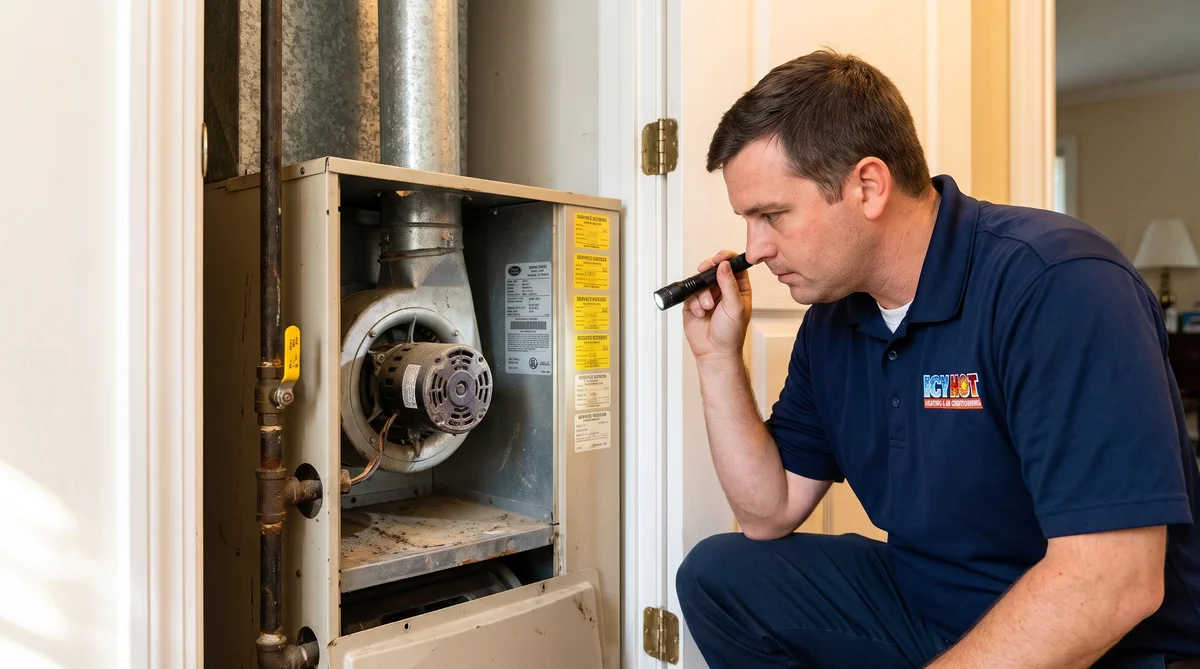
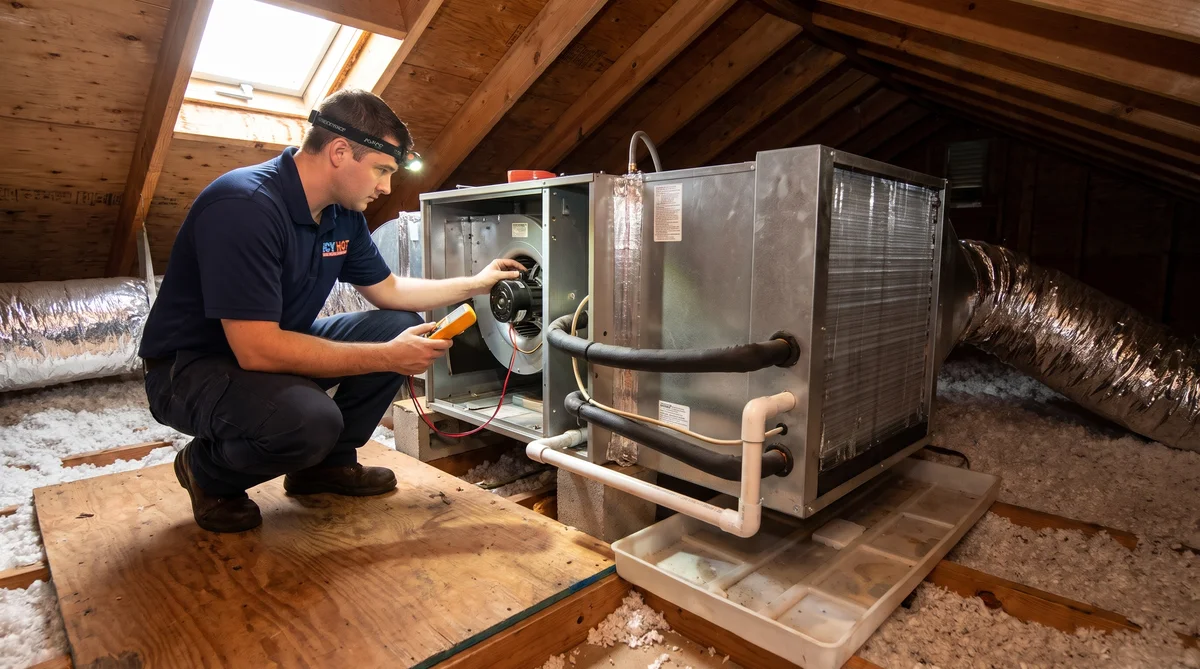
Keep the condensate path clear. In attic and closet installs like the one above, the air conditioner’s coil drains through a line and pan that sit right against the furnace cabinet, and a high-efficiency furnace adds its own condensate on top of that. A clogged line puts water where the furnace’s electronics and cabinet live. Our guide to a clogged AC drain line explains how to check and clear it, and it is a five-minute job worth doing each spring and fall.
Frequently Asked Questions About Furnace Lifespan
The Bottom Line for Raleigh Homeowners
Plan for about 20 years, start budgeting at 15, and let the size of the repair, not the birthday, decide when the furnace goes. DOE’s average outside the northern states, the closer match for North Carolina, is 20.2 years, and the manufacturers’ range is 15 to 20. A well-kept Raleigh furnace can outlast that average, though DOE found furnaces outside the North retire slightly sooner, in part because the blower also runs the cooling. Remember that the day you replace the air conditioner is the natural moment to ask whether the furnace should go with it.
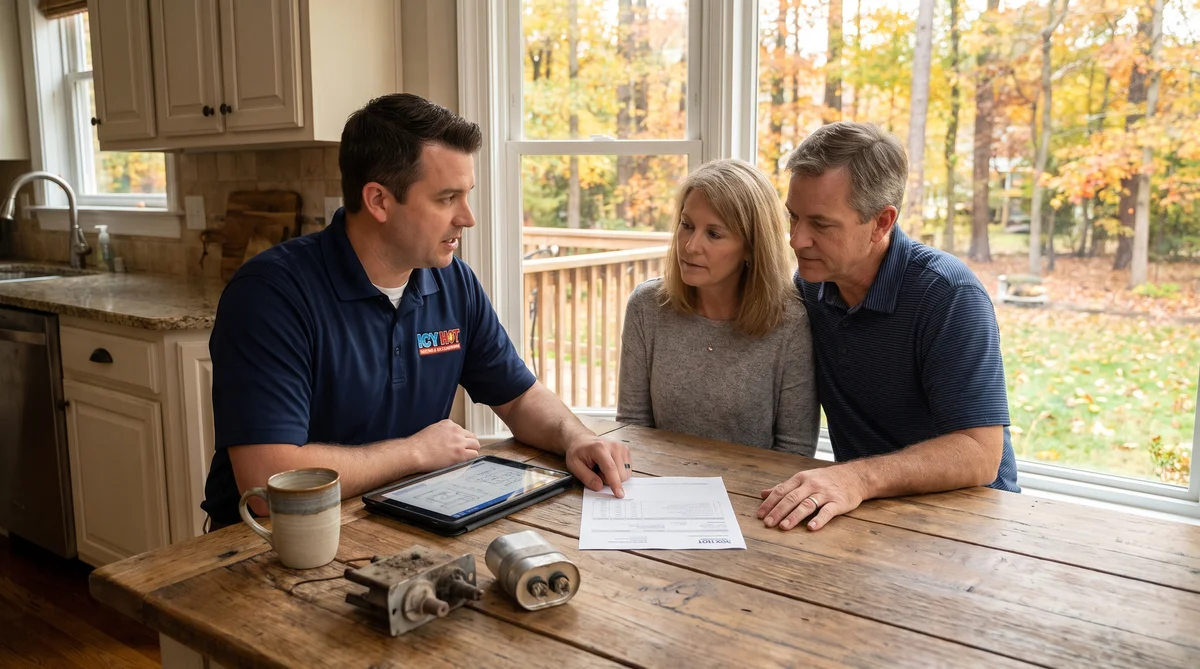
If you are weighing a repair quote right now, call us at (919) 673-7667 or schedule a visit online. We will tell you how old the furnace actually is, what the repair costs against a replacement, and which side of the line it falls on, and if the answer is to keep fixing it, we will say so. Our furnace services cover Raleigh, Cary, Apex, Garner, Durham, Wake Forest and the rest of the Triangle.
Written by Frankie Asfari, owner of Icy Hot Heating & Air Conditioning in Raleigh, NC. NATE-certified, NC HVAC License #L.34356.