
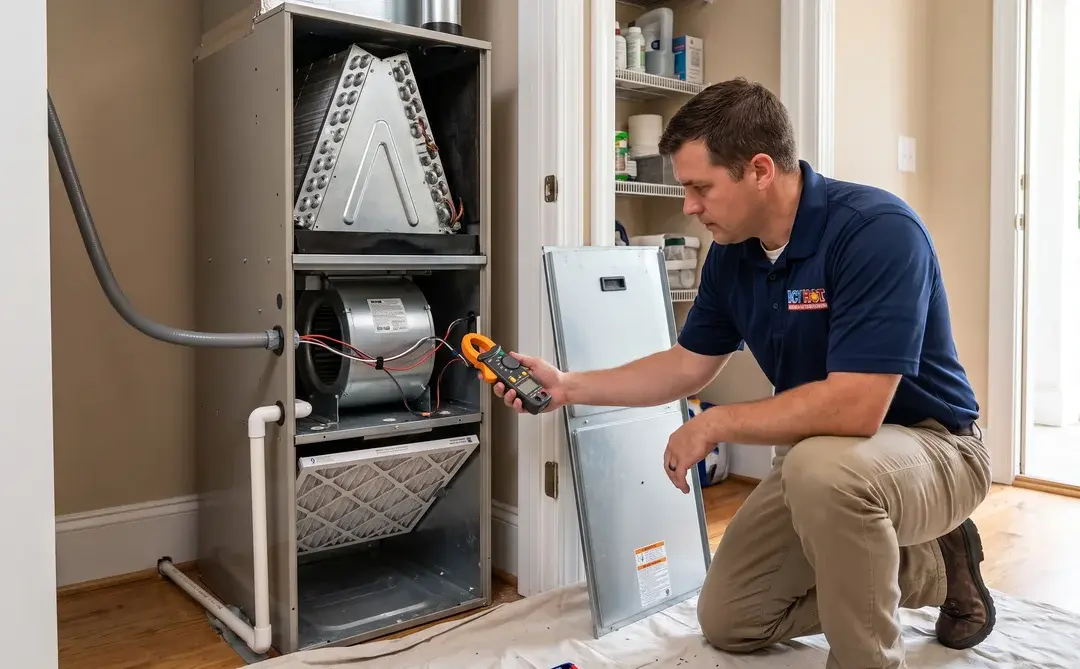
Two metal boxes. Same closet, same footprint, same beige sheet metal, and from three feet away you cannot tell them apart. One of them makes heat. The other one does not, and that single difference decides your January power bill, what you are allowed to replace when it breaks, and whether the word “auxiliary” showing up on your thermostat is going to cost you real money.
I get this question most often in October, and usually from somebody who just moved to Wake County from somewhere colder and cannot find the furnace. Quite often there is not one. What is sitting in the hall closet or the crawlspace is an air handler, and it is a completely different animal from the furnace they grew up with.
The pages currently ranking for this question will tell you that an air handler circulates air while a furnace burns fuel. That is true, and it is roughly where all of them stop. None of them tell you how cold it actually gets in the Triangle, what each one costs to run at North Carolina’s current gas and electric prices, or that the federal tax credit several of them are still pointing you toward expired at the end of last year.
So this guide answers the air handler vs furnace question with arithmetic instead. Real numbers, from the Energy Information Administration, the EPA design temperature tables and the manufacturers themselves, applied to a Raleigh house.
TL;DR: A furnace burns natural gas or propane and makes its own heat. An air handler makes no heat at all: it is a blower and a coil that moves whatever the outdoor heat pump or air conditioner produces, with electric strips as emergency backup. If your indoor unit has a gas pipe and a metal flue, it is a furnace. If it has a thick electrical whip and no flue, it is an air handler. In Wake County, where the 99% winter design temperature is 23°F, a heat pump paired with an air handler will carry the entire heating season without ever needing a burner. Questions on your own system? Call (919) 673-7667.
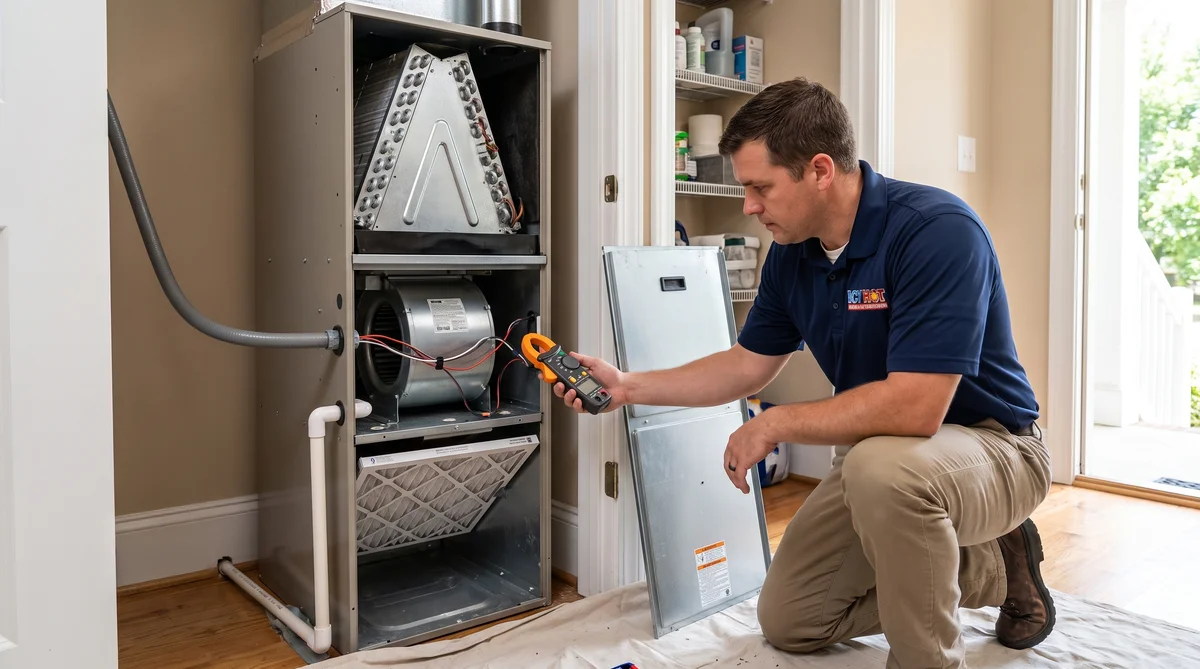
Air Handler vs. Furnace: What Is the Actual Difference?
A furnace generates heat. An air handler moves it. That is the whole distinction, and everything else follows from it. A furnace has a burner, a heat exchanger and a flue, because combustion produces exhaust that has to leave the building. An air handler has none of those things, because nothing is burning inside it.
Carrier puts it in one sentence: an air handler “is the indoor component of your HVAC system that circulates conditioned air throughout your home.” Note what is missing from that sentence. It circulates conditioned air. It does not condition it. The conditioning happens outside, at the heat pump or the air conditioner.
Trane says the same thing from the other direction: an air handler “is a device that circulates warm or cool air throughout your home,” and it is “often paired with a heat pump, which uses a process that either cools or warms the house by removing or delivering warm air.” The heat pump is the thing doing the work. The air handler is the thing distributing the result.
A furnace, by contrast, is self-contained on the heating side. It has its own blower, so it does not need an air handler. Carrier is explicit about this: “Homes with heat pumps rely on air handlers to move air through the system, while homes with furnaces often don’t need a separate air handler since the furnace already handles airflow.” That is why you almost never see both in one house. You see one or the other, sharing the same ductwork with the cooling coil.
The practical consequence shows up on your utility bill. A furnace turns one fuel into heat at some efficiency below 100%. A heat pump and air handler do not make heat at all; they relocate it, which is why they can deliver more heat energy than the electricity they consume. ENERGY STAR puts the ceiling on that at “up to three times more heat energy to a home than the electrical energy it consumes.”
How to Tell Which One You Have in About Two Minutes
You do not need a meter or a manual. You need a flashlight and two minutes. Go stand in front of the indoor unit, whether that is in a closet, the attic, the garage or the crawlspace, and look for three things.
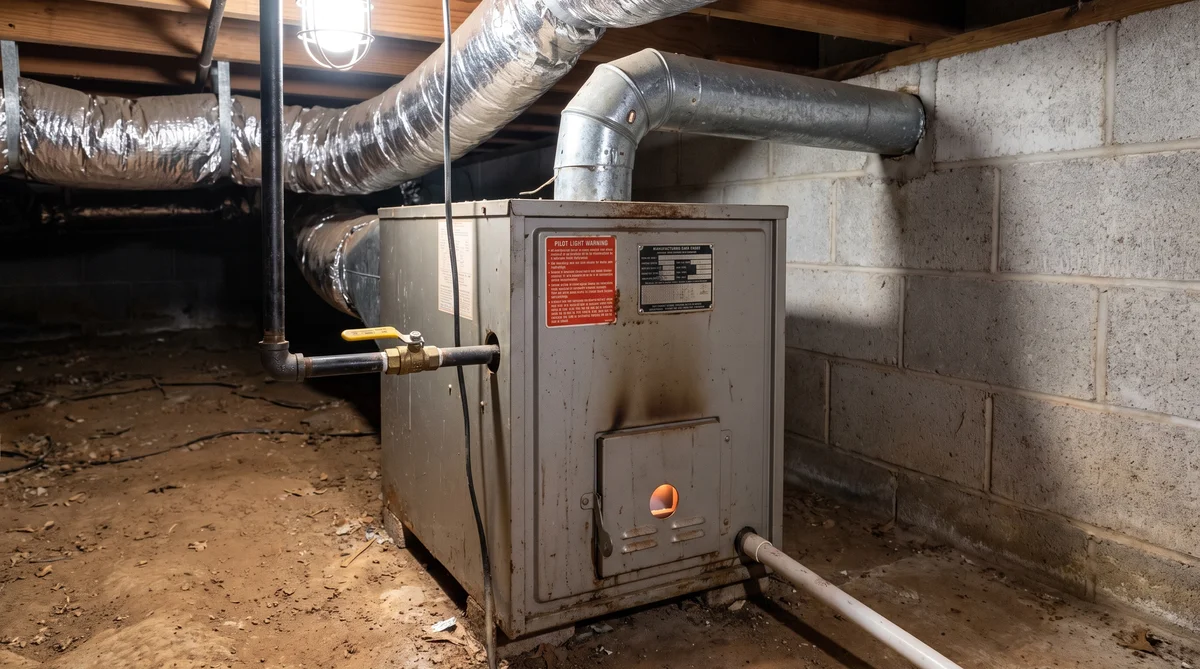
One: is there a black iron pipe running into the side of the cabinet? A gas line is almost always black iron or coated steel with a yellow shutoff handle at the union. If you see that handle, you have a furnace. Air handlers have no fuel line of any kind, because there is no fuel.
Two: is there a round metal pipe leaving the top of the cabinet and heading for a wall or roof? That is a flue, and its job is to carry combustion exhaust out of the house. Every gas furnace has one, either galvanized metal on an older 80% unit or white PVC on a modern condensing unit. An air handler has no flue, because it has no exhaust. If the only thing leaving the top of the box is ductwork, it is an air handler.
Three: how thick is the electrical feed? A furnace needs a standard 120-volt circuit to run its blower and controls, so the wire going in is small. An air handler carrying electric heat strips needs a 240-volt feed sized for the strips, which means a much heavier conduit or whip, often with its own disconnect or a double-pole breaker right on the cabinet. Thick wire and no gas pipe is an air handler every time.
A fourth tell, if you want confirmation: look for a small inspection window or sight glass on the lower access door. That is there so a technician can see the burner flame. No burner, no window.
What Is Actually Inside an Air Handler?
Open the front panel of an air handler and you are looking at four things and a drain. Carrier’s own component table names six: the blower motor or blower fan, the evaporator coil, the air filter, the drain pan and condensate drain, the electric heat strip, and the ductwork and return ducts. That list is worth reading twice, because there is no burner on it and no heat exchanger.
The blower is the squirrel-cage wheel that does all the moving. On older equipment it is a single-speed PSC motor that runs flat out or not at all. On newer equipment it is a variable-speed ECM motor that can run at 40% and stay there, which is quieter, gentler on humidity and considerably cheaper to run.
The evaporator coil is the A-shaped or N-shaped aluminum and copper assembly sitting in the airstream. In summer it gets cold and pulls heat and moisture out of your house. In winter, if you have a heat pump, the refrigerant cycle reverses and that same coil gets hot and pushes heat in. This is the part that makes an air handler fundamentally different from a furnace: the coil is inside the box, not sitting on top of it.
The filter slot sits upstream of the coil, which is the entire reason filter changes matter more on this equipment than people assume. A loaded filter starves the blower, the coil runs colder than design, and you end up with the frozen-coil call we wrote up in our guide to AC systems freezing up.
The drain pan and condensate line catch what the coil pulls out of the air. In a Raleigh August that is real volume, and when the line clogs the water has to go somewhere. That is the story behind clogged drain lines, and it is an air-handler-specific failure.
Then there are the heat strips, which get their own section below, because they are the single most misunderstood part of the whole assembly.
What Is Inside a Furnace, and Why It Needs a Flue
A gas furnace is a much simpler proposition conceptually and a much more regulated one practically. Gas enters through a valve, burners ignite it inside a sealed steel heat exchanger, and a blower pushes house air across the outside of that exchanger. The air picks up heat. The exhaust gases stay inside the exchanger and go out the flue.
That separation is the entire safety design of the appliance, and it is why the heat exchanger is the one part nobody in this trade treats casually. A cracked exchanger lets combustion products into the supply air. That is the failure mode behind every carbon monoxide warning you have ever read about furnaces.
The scale of the risk is worth stating precisely rather than dramatically. The U.S. Consumer Product Safety Commission reports that “more than 200 people in the United States die every year from accidental non-fire related CO poisoning associated with consumer products,” and that “more than 100 of those deaths are linked to portable generators.” Furnaces are a smaller share of a small number. They are not a reason to fear gas heat. They are a reason to get the heat exchanger inspected annually, which is a standard line item on any heating maintenance visit and on every furnace tune-up we run.
Efficiency on a furnace is measured in AFUE, annual fuel utilization efficiency, which is simply the fraction of the fuel’s energy that ends up in your house rather than up the flue. An 80% AFUE furnace sends one fifth of what you paid for out the roof. A 96% condensing furnace recovers so much of it that the exhaust cools enough to condense, which is why those units vent in PVC instead of metal and need their own drain.
An air handler has no AFUE, because it has no combustion. There is nothing to send up a flue. That is not a virtue by itself; where the efficiency question actually lives for an air handler is in the outdoor unit it is bolted to, and in whether the strips are running.
Which One Does a Raleigh Home Actually Need?
Here is where the national articles go vague and say “it depends on your climate.” It does, so let us put a number on the climate.
HVAC systems are sized to a design temperature, not to the coldest night on record. The convention is the 99% winter design temperature: the outdoor temperature that local weather is at or above 99% of the heating season. The EPA and ENERGY STAR County-Level Design Temperature Reference Guide publishes that number for every county in the country, and it is the figure your contractor is supposed to be running a Manual J load calculation against.
For Wake County the 99% heating design temperature is 23°F. For Durham and Orange counties it is 20°F. Chatham County is 21°F and Johnston County is 27°F. Those are the design conditions for Raleigh, Cary, Apex, Garner, Durham, Chapel Hill and Clayton respectively.
Now compare that against what modern heat pumps are verified to do. ENERGY STAR says its cold climate certification “requires third-party verified performance for low temperatures, testing ASHPs down to 5°F,” and that “your cold climate ASHP will continue working at temperatures below 5°F.” A Wake County design temperature of 23°F sits eighteen degrees above the bottom of that verified range, which is not a close call.
That is the whole answer to the Raleigh version of this question. A properly sized heat pump paired with an air handler is not a compromise here, and it is not a system that needs a gas burner standing by for the real cold. The real cold, in the statistical sense the equipment is engineered around, is 23 degrees.
What Each One Costs to Run in North Carolina
This is the part nobody does, so let us do it carefully and show the work.
To compare fuels honestly you have to convert both to the same unit: dollars per million Btu actually delivered into the house, after the equipment’s own losses. Two prices go into that, and one of them is a trap.
The electricity price is straightforward. EIA’s Electric Power Monthly puts North Carolina’s average residential price at 15.16 cents per kilowatthour in July 2026, up from 13.37 cents in July 2025. The national average that month was 18.31 cents, so we are still a cheap-power state.
The natural gas price is where people get it wrong. EIA’s North Carolina residential series shows $30.10 per thousand cubic feet in June 2026, which looks catastrophic next to electricity. It is not a real heating number. Residential gas bills carry a fixed monthly customer charge, and in June that charge is spread across almost no therms, so the per-unit price inflates. The honest figure for a heating comparison is a heating-month figure: $17.89 per thousand cubic feet in January 2026, and $17.50 in February. That is the price you actually pay to heat with gas.
The rest is arithmetic. EIA puts the heat content of delivered natural gas at about 1,037 Btu per cubic foot, so $17.89 per Mcf is $17.25 per million Btu of fuel bought. Divide by AFUE to get delivered heat. On the electric side, one million Btu is 293 kilowatthours, so $44.43 at 15.16 cents, divided by the heat pump’s seasonal coefficient of performance. ENERGY STAR defines HSPF2 as heating output in Btu divided by electricity consumed in watt-hours, so dividing HSPF2 by 3.412 converts it straight to a seasonal COP.
Electric Heat Strips: The Line Item Nobody Warns You About
Look back at that chart and find the top bar. Electric strip heat costs $44.43 per million Btu delivered, which is a little over twice what an 80% gas furnace costs and about two and a half times what a decent heat pump costs. That bar is the reason people move to Raleigh, install a heat pump, and then get a January bill that makes them think the heat pump is broken.
It usually is not broken. The strips are running.
Electric heat strips are resistance coils bolted inside the air handler, essentially a very large toaster in the airstream. Carrier lists the strip as a standard internal component and says it “delivers reliable supplemental heat when your climate or system demands it.” They are 100% efficient at turning electricity into heat, which sounds excellent until you realize the heat pump next to them is effectively 250% efficient, because it is moving heat instead of making it.
A strip kit is rated in kilowatts, and the math is unforgiving. One kilowatt produces 3,412 Btu per hour and costs whatever a kilowatthour costs. At North Carolina’s 15.16 cents, a 10 kW strip kit costs $1.52 an hour to run. The heat pump producing that same 34,120 Btu per hour at a seasonal COP of 2.5 draws about 4 kilowatthours and costs 61 cents. Same heat. Two and a half times the money.
Strips are supposed to come on only in two situations: when the outdoor temperature drops far enough that the heat pump cannot keep up, and during a defrost cycle, when the outdoor coil is temporarily running backward and the strips keep the supply air from blowing cold. What goes wrong is that a stuck sequencer, a miswired thermostat or an “Emergency Heat” switch somebody flipped in a cold snap and never flipped back leaves them energized far more than they should be. If your thermostat shows AUX or EM for hours on a 35-degree day, something is wrong, and it is worth a heating service call rather than another month of that bill.
Air Handler Replacement Cost vs. Furnace Replacement Cost
If the furnace is the half giving you trouble, our guide to the signs your furnace needs replacing walks through when a repair is worth paying for and when it is not.
The indoor box is the cheaper half of either system, and the two are not far apart once you account for what each one has to do.
Carrier’s 2026 price guide says that “new residential air handlers with professional installation typically cost between $1,500 and $4,200.” HomeAdvisor, updated June 19, 2026, reports that “air handler replacement costs between $1,800 and $3,500 with an average of $2,800.” One honest caveat that the ranking pages skip: Carrier’s own tables credit HomeAdvisor as their source, so treat these as one dataset presented twice rather than two independent confirmations.
Both break it down the same way, by capacity and by blower type. A 1.5-ton unit runs $1,500 to $2,000 and a 4 to 5-ton unit runs $2,800 to $4,200 or more. By motor, a single-speed blower is $1,500 to $2,200, a multi-speed is $2,000 to $2,800, and a variable-speed is $2,800 to $4,200. That last jump is not marketing. A variable-speed ECM is the single component that most changes how the system feels and what it draws.
Furnaces run higher. HomeAdvisor reports that “the average furnace replacement cost ranges from $2,823 to $6,897,” with most homeowners spending around $4,814. Split by fuel, an electric furnace is $2,000 to $7,000 and a natural gas furnace is $3,800 to $10,000, occasionally reaching $12,000 on a high-efficiency unit.
Two caveats before you take those numbers to a quote. First, these are national figures, not Raleigh quotes; what we bill on a specific job depends on the cabinet, the access and whether the ductwork transitions have to be rebuilt. Second, and more important, the indoor box is rarely the whole job. If the air handler failed, the outdoor unit is usually the same age, and replacing half a system is often the more expensive choice over ten years. That is the calculation behind our heat pump replacement and furnace installation pages.
Can You Replace Just the Air Handler?
Sometimes. Less often than people hope, and the reason is a rule most homeowners have never heard of.
Efficiency ratings on split systems are not a property of the outdoor unit. They are a property of the pair. AHRI, the trade body that certifies this equipment, issues a Certified Reference Number that identifies “a condenser and evaporator combination that has been certified by AHRI as properly matched system.” Not a condenser. Not a coil. The combination.
The practical effect is that a 16 SEER2 outdoor unit delivers 16 SEER2 only when it is paired with the specific indoor unit it was tested with. Bolt it to a mismatched coil and you have a system with no certified rating at all, which matters for three separate reasons: the equipment will not perform to the number on the label, most manufacturer warranties require a listed match, and rebate and incentive programs ask for the AHRI reference number as proof.
So the honest answer is that replacing only the air handler works cleanly when the outdoor unit is recent, still in warranty, and there is a certified match available for it. It works badly when the outdoor unit is fifteen years old, because you will have spent two thousand dollars on half a system that has to come back apart in two winters.
Ask for the AHRI reference number on any quote that replaces one half of a split system. A contractor who is doing it right will have it ready.
There is a second, newer wrinkle. EPA’s Technology Transitions rule set a 700 GWP limit on refrigerants in residential air conditioning and heat pumps with a January 1, 2025 compliance date, though EPA notes there is “no installation compliance date for systems where all specified components were manufactured or imported prior to January 1, 2025.” In plain terms, the industry has moved from R-410A to lower-GWP refrigerants such as R-454B, and you cannot mix an old-refrigerant coil with a new-refrigerant condenser. If your system is on R-410A, a partial replacement narrows to the inventory that still exists.
Carrier answers the question directly in its own FAQ, and the answer is a qualified no: “It is possible, but not recommended. Mixing an old outdoor unit with a new air handler can reduce efficiency and void warranties.” For context on the timeline, Carrier also puts air handler service life at “15 to 25 years,” which is usually longer than the outdoor unit it is bolted to.
Dual Fuel: When a Raleigh Home Wants Both
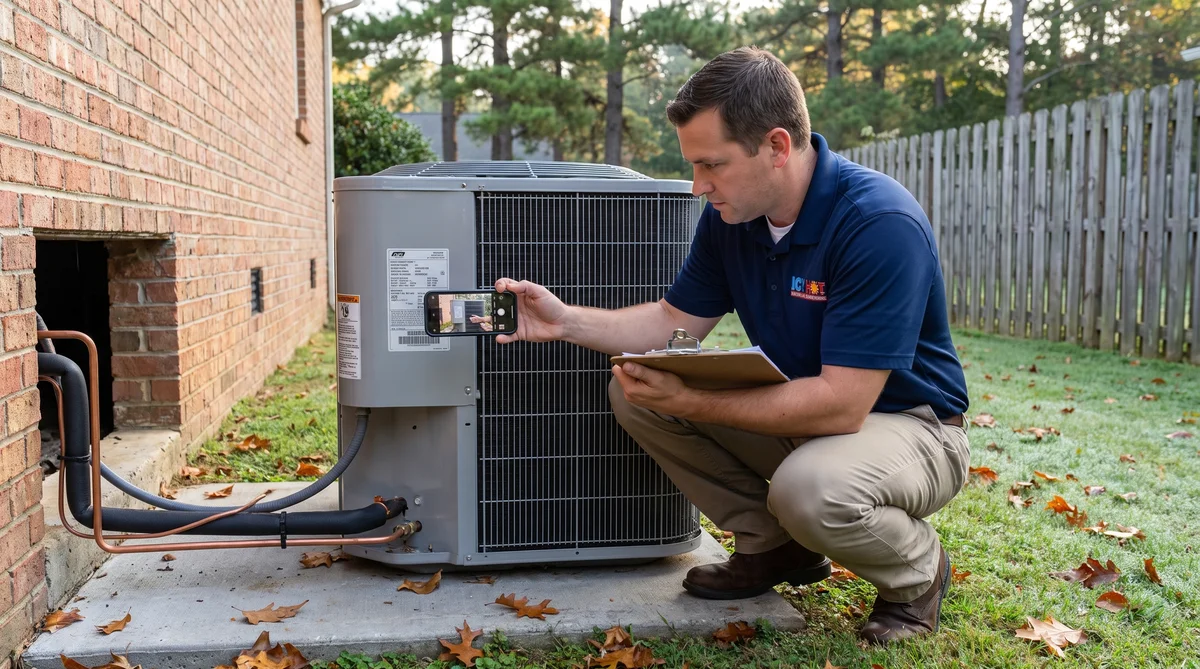
There is a third configuration, and in the Triangle it makes sense more often than you would guess: a heat pump outside, a gas furnace inside, and a control that decides which one runs. The furnace replaces the air handler entirely, since it already has its own blower and the cooling coil sits on top of it.
The logic is economic rather than mechanical. A heat pump’s efficiency falls as the outdoor temperature drops, so at some outdoor temperature the cost of a delivered Btu from the heat pump crosses above the cost of a delivered Btu from the furnace. That crossover point is called the balance point or the switchover temperature, and a dual fuel control is simply a device that watches the thermometer and picks the cheaper source.
Where that crossover actually lands depends on the two prices in the chart above, which is why it is worth setting deliberately rather than accepting a default. At North Carolina’s current prices, a heat pump at HSPF2 8.5 is cheaper per delivered Btu than even a 96% furnace under mild conditions, so the switchover belongs well down in the thirties rather than at 40°F where installers often leave it.
Dual fuel is the right call for a specific homeowner: one who already has gas service and a serviceable furnace, and who is replacing a dying air conditioner. Adding a heat pump outside instead of a straight AC costs modestly more and converts the existing furnace into a backup that only runs on the coldest mornings. It is a poor call for a home with no gas line, because running a service line to the street is its own project. We walked through the closely related choice between a heat pump and a straight air conditioner in our heat pump versus central air comparison. We break the setup down further on our dual fuel systems page.
What Changed for 2026
Three things moved recently, and two of them are still being reported wrong on pages that rank for this query.
The federal 25C tax credit is gone. The Energy Efficient Home Improvement Credit, which paid up to $2,000 toward a qualifying heat pump, applied to property “placed in service on or after Jan. 1, 2023, and before December 31, 2025,” per the IRS. Equipment installed in 2026 does not qualify. If you are reading an article that tells you to claim $2,000 on this year’s return, that article has not been updated. State and utility incentives are a separate question, and we track those in our North Carolina HVAC rebates guide.
The refrigerant changed. EPA’s 700 GWP limit for residential air conditioning and heat pumps took effect for manufacture and import on January 1, 2025. Practically, systems being installed now use R-454B or a similar low-GWP refrigerant rather than R-410A. This matters most to anyone considering a partial replacement, and it is the second reason to ask about matching.
The ENERGY STAR bar is specific. A split-system heat pump now needs SEER2 of at least 15.2, EER2 of at least 12.0 and HSPF2 of at least 7.8 to carry the label, and the Cold Climate designation requires HSPF2 of at least 8.5. Those are not abstract. HSPF2 is the number that sets your winter operating cost, and the difference between 7.8 and 9.5 is about three and a half dollars per million Btu delivered, every winter, for the life of the system.
Which One Should You Choose?
If you are building or replacing in the Triangle and you have no existing gas service, the decision is close to made for you. A heat pump and air handler cover the entire heating season at a design temperature of 23°F, they handle your cooling with the same equipment, and they avoid a gas line, a flue and an annual heat exchanger inspection.
If you already have gas and a furnace that still has years in it, keep it and put a heat pump outside when the air conditioner dies. That is dual fuel, and it gets you the heat pump’s operating cost through most of the winter without discarding a working appliance.
If your air handler has failed and the outdoor unit is under about eight years old and still in warranty, replace the air handler alone and insist on a certified match, the same logic we apply on an air conditioning replacement. If the outdoor unit is past twelve years, replace both. The in-between case, roughly eight to twelve years, is a judgment call that turns on the refrigerant, the warranty status and whether the coil has ever leaked.
And if the answer you are getting from a quote is “you need a furnace because heat pumps do not work in the cold,” ask what design temperature they sized to. In Wake County the answer should be 23 degrees.
Frequently Asked Questions About Air Handlers and Furnaces
The Bottom Line for Raleigh Homeowners
The whole air handler vs furnace question comes down to one verb. A furnace makes heat. An air handler moves it. Everything else in this comparison, the flue, the gas line, the AFUE rating, the heat strips, the matching rule, follows from that one distinction.
For the Triangle specifically, the case for an air handler and heat pump is not a compromise and it is not a green talking point. It is a design-temperature argument. Wake County bottoms out at 23°F by the EPA’s own tables, and ENERGY STAR verifies heat pump performance down to 5°F. The equipment is not being asked to do anything difficult here.
Three things I would actually do with this information. First, go find out which box you have, using the gas line and flue test above, because a surprising number of people do not know. Second, if you have an air handler, watch your thermostat for AUX or EM on mild days, because strip heat at $1.52 an hour is the single most expensive thing your system can do. Third, if anyone quotes you half a system, ask for the AHRI reference number before you sign.
And treat the fuel-cost chart in this article as what it is: a snapshot at one set of prices, fuel cost only, equipment cost excluded. Gas prices move. Electric rates move, and North Carolina’s residential rate rose more than thirteen percent in the last year. The arithmetic is the durable part; run it again with current numbers before a big purchase.
If the box in front of you turns out to be a furnace and you are shopping for a replacement, the next decision is usually how many stages the gas valve has. We worked through that one separately, with Raleigh gas prices and what each manufacturer will actually put in writing, in our guide to single-stage versus two-stage furnaces.
If you want a straight answer about your own system, whether that is a heat pump installation, a furnace repair, or just a second opinion on a quote that does not smell right, call us at (919) 673-7667. You can also schedule online or reach us through the contact page. We work across Raleigh, Cary, Apex, Garner, Durham, Wake Forest and the rest of the Triangle service area.
Written by Frankie Asfari, owner of Icy Hot Heating & Air Conditioning in Raleigh, NC. NATE-certified, NC HVAC License #L.34356.