
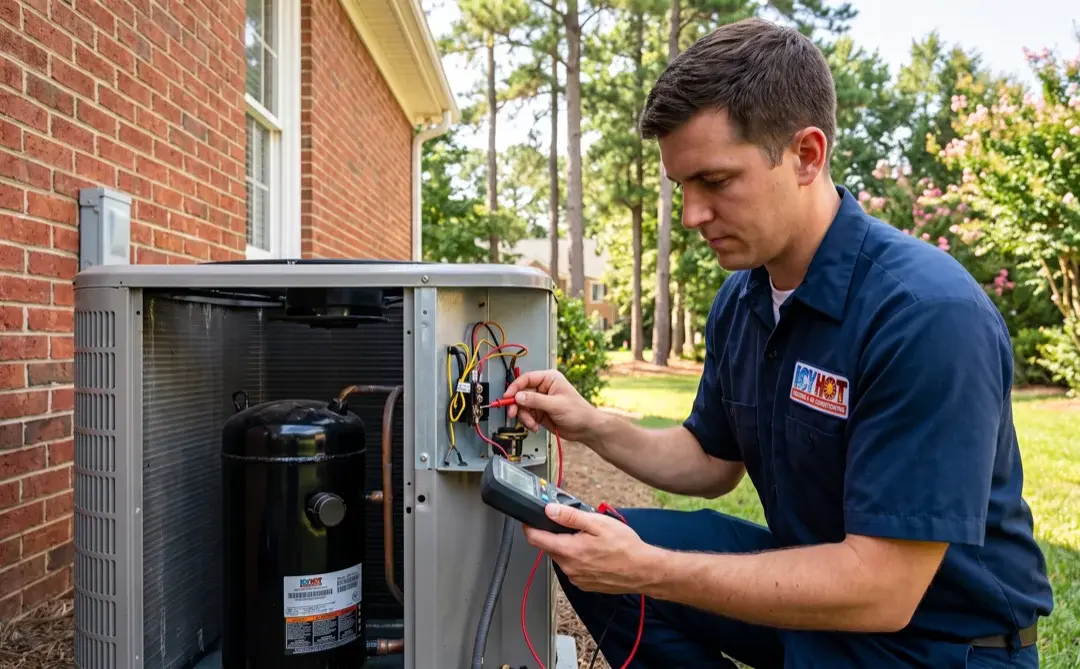
The compressor is the one part of your central air conditioner that nobody wants to hear about. It is the most expensive component in the system, it sits inside the outdoor unit where you cannot see it, and when a technician says the word out loud, most Raleigh homeowners already brace for bad news. So it is worth knowing what a genuinely bad compressor looks like, and, just as important, what it does not look like.
Here is the honest version from the field. Several cheap parts fail with almost exactly the same symptoms as a dead compressor, and I have watched homeowners approve a compressor quote when the actual problem was just the capacitor, which is a far cheaper repair. This guide covers the seven signs that point at the compressor in a home central AC system (not a car AC compressor, which is a completely different repair), the parts a good technician rules out first, the readings to ask for before you approve anything, and how to decide between a compressor swap and a whole new system.
TL;DR: A failing home AC compressor usually shows up four ways: the outdoor unit hums or clicks but never starts, the breaker trips every time cooling calls, the air never gets cold no matter how long the system runs, and the unit makes a banging, clattering, or screeching noise it never used to make. Before you approve a compressor quote, make sure the technician has ruled out the cheap parts that fake the same symptoms. A capacitor or contactor is a hundreds-of-dollars repair while a compressor replacement runs into the thousands, so that ten-minute check is worth real money. If your system is under 10 years old and the compressor is still covered by a registered parts warranty, replacing the compressor usually wins. If it is 12-plus years old and out of warranty, the money is almost always better spent on a new system.
How Do You Know If Your Home AC Compressor Is Bad?
You know the compressor is bad when the outdoor unit cannot start or cannot build pressure: it hums, clicks, or trips the breaker instead of running, or it runs continuously while the air coming out of your vents stays warm. Those two failure modes cover almost every dead residential compressor I have diagnosed. Everything else on the list below is a supporting clue, not a verdict.
| Failure mode | What you observe | What it could be |
|---|---|---|
| It cannot start | The unit hums, clicks, or trips the breaker within seconds of the cooling call. The outdoor fan may or may not spin. | A locked rotor or a shorted winding, but equally a weak capacitor, a pitted contactor, or a wiring fault |
| It cannot build pressure | The unit runs steadily and indoor air keeps moving, but the house never cools and the outdoor unit blows lukewarm. | Lost compression inside the compressor, or a refrigerant charge or metering problem |
Quick clarification, because the search results for this question are a mess: this article is about the compressor in a home central air conditioner or heat pump, the black cylindrical canister bolted inside your outdoor condenser cabinet. That is a different animal from the belt-driven compressor under the hood of your car. The symptoms overlap, the diagnosis does not, and the two repairs are not remotely comparable.
Trane describes the compressor’s job cleanly: it “is responsible for circulating and pressurizing the refrigerant in your unit, so the refrigerant can carry and release heat.” Everything else in your AC, the coils, the blower, the line set, is plumbing and airflow. The compressor is what makes the refrigerant cycle actually move. When it stops moving refrigerant, the system stops making cold air, full stop, even though the indoor blower keeps running and the thermostat keeps insisting everything is fine.
One safety note before you go outside and start poking at anything. Trane is blunt about this and so am I: “An HVAC compressor carries a high voltage so improper handling can result in serious injury or death. Therefore a licensed HVAC technician is the only person to inspect and service a broken compressor.” You can safely observe symptoms. You cannot safely test a compressor or its capacitor. The capacitor alone stores enough charge to hurt you badly after the power is off.
The 7 Signs Your AC Compressor Is Failing
Work down this list in order. The first three are the strongest indicators, the middle three are supporting evidence, and the last one is the pattern that separates a compressor problem from a refrigerant problem.
1. The outdoor unit hums or clicks but never starts. You hear the contactor click in, you hear a low hum from the cabinet, and then nothing. The fan may or may not spin. This is the classic locked-rotor symptom, where the compressor motor is trying to turn and physically cannot. It is also, critically, the exact symptom a failed start capacitor produces. Trane lists the capacitor as a distinct cause of exactly this: “A bad capacitor can cause the unit to be unable to start.” Never let this symptom alone justify a compressor quote. Our step-by-step guide to an AC that will not turn on walks the eight checks that belong before any compressor conversation.
2. The breaker trips every time the AC calls for cooling. A compressor with a shorted winding or a seized rotor pulls enormous current at startup and the breaker does its job. If you reset the breaker and it holds for a day, that may be a nuisance trip. If it trips again within seconds or minutes of the system starting, stop resetting it. Carrier is explicit: “If the breaker trips immediately after resetting, do not try again. This indicates a deeper electrical fault that requires a professional who knows how to troubleshoot an air conditioner safely.” Trane adds the reason it matters: “Flipping the circuit breaker back on without figuring out why it tripped could damage your system.”
3. The system runs and runs but the house never cools. The blower is moving air, the outdoor fan is spinning, the thermostat is calling, and yet the temperature in the house holds steady or climbs. Trane’s first listed warning sign of compressor failure is “unchanging temperature in your home,” explained as: “If your AC is on but the temperature in your home isn’t going down… the compressor might not be working properly.” A compressor that spins but has lost compression moves refrigerant without pressurizing it, which means no meaningful heat transfer and no cold air.
4. Loud mechanical noises that are new. Trane specifically flags “banging, hissing, clattering, or screeching” from the unit, and Lennox says strange sounds “for instance clanking, banging, squealing, or prolonged hissing” could “indicate a serious problem that calls for immediate attention by an HVAC professional.” The word that matters is new. Your AC has always made noise. A grinding metallic scrape or a rhythmic bang that started this season is internal mechanical damage until proven otherwise. Lennox adds the right interim step: while you wait for the technician, “it’s best to turn the system off so you can prevent what may be a small issue from turning into a bigger one.”
5. Warm air coming off the outdoor unit is not actually warm. A healthy condenser dumps a plume of genuinely hot air out the top while it runs. Trane calls out the opposite as a failure sign: “Lukewarm or cool air is being released outside during hotter months. When it’s functioning properly, it should be releasing hot air outside.” Trane even describes the test: align your hand with the fan, and “if you feel lukewarm or cold air coming from the unit in the summer, your compressor might not be working.” This is one of the few checks a homeowner can safely make on a hot Raleigh afternoon without opening anything.
6. Electric bills climbing without a change in habits. Lennox lists rising energy bills among its five warning signs, treating a jump in power consumption as an early indicator that the system is working harder than it should. A compressor that is struggling draws more amperage to deliver less cooling, and in a Raleigh July that shows up on a Duke Energy bill fast. On its own this proves nothing. Paired with sign 3 or sign 5, it is meaningful.
7. Short cycling that started recently. Lennox describes it as “a system that turns on and off for short periods of time,” a sign that “normal operation is being interrupted before it can complete a heating or cooling cycle,” and notes that “short cycling makes parts wear out earlier than they might have otherwise.” An overheating compressor trips its internal thermal overload, cools down, restarts, and trips again. That said, short cycling has plenty of cheaper causes too, including an oversized system, a dirty filter, and a failing thermostat, which is exactly why it lands last on this list rather than first.
First, Rule Out the Cheap Parts That Fake a Bad Compressor
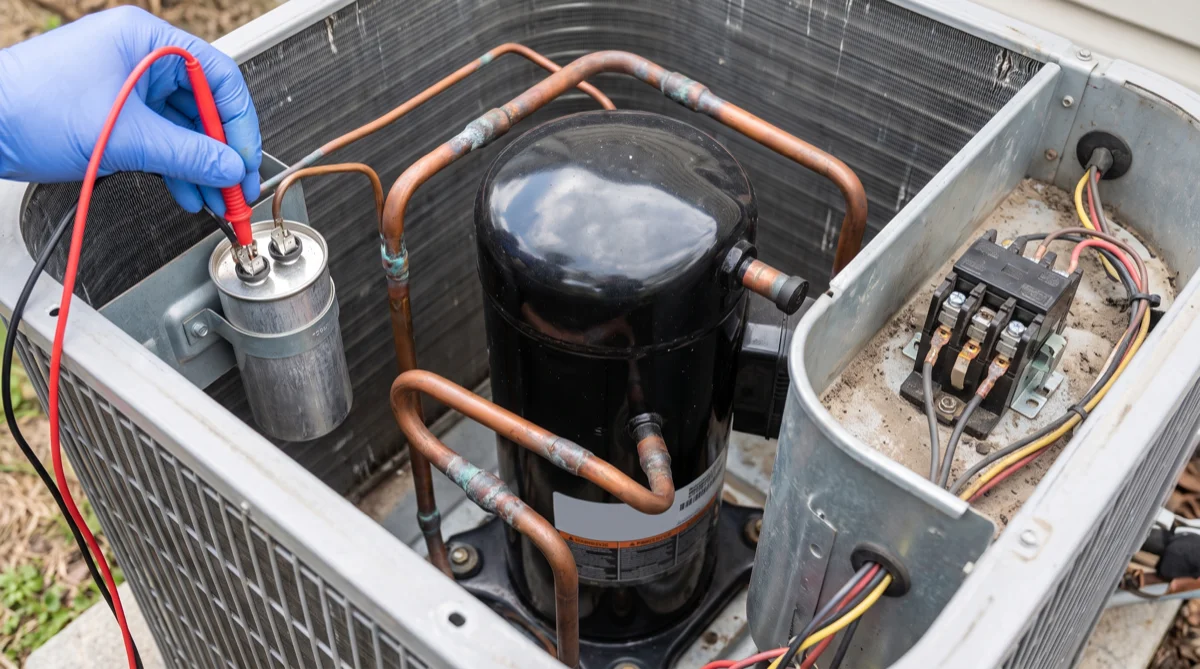
This is the section the other articles on this topic skip, and it is the one that saves Raleigh homeowners the most money. Three inexpensive components fail with symptoms nearly identical to a dead compressor, and all three can be tested in minutes with a meter.
The run or start capacitor. This is the silver cylinder mounted next to the compressor, and it is the single most common cause of a hum-but-no-start call in the Triangle. The capacitor delivers the electrical kick that gets the compressor motor turning. When it weakens, the compressor tries, fails, and hums. It is one of the least expensive parts in the entire system and one of the quickest to swap, which is exactly why it belongs at the top of the list. It is also the reason we ask for a photo of the model plate before dispatch, because we can bring the right one on the first trip.
The contactor. A relay with a coil and a set of silver contacts that closes to send high voltage to the compressor. Contacts pit, burn, and stick over the years. A pitted contactor produces a chattering click with no start, or a unit that will not shut off. Raleigh’s humidity, pollen, and the occasional ant colony are all hard on contactors.
The breaker, disconnect, and wiring. Trane’s own troubleshooting sequence puts a tripped breaker and “loose connections” ahead of “compressor motor problems” for a reason, and ENERGY STAR puts “tighten all electrical connections and measure voltage and current on motors” on every annual tune-up, warning that “faulty electrical connections can cause unsafe operation of your system and reduce the life of major components.”
Here is the question to ask when someone quotes you a compressor: what did the capacitor and contactor test at, and what were the compressor’s amp draw and winding resistance readings? A technician who has actually diagnosed a compressor can answer that in one sentence. If the answer is vague, get a second opinion before you approve the expensive repair. Our AC compressor repair visits start with those readings, not with a quote.
What Kind of Compressor Does Your System Have?
If a replacement is on the table, find out which of the three compressor types your system uses, because it changes the job in ways the symptom never reveals. Single-stage compressors run one way, full output or off. Two-stage compressors add a lower setting for milder days. Variable-speed compressors modulate continuously to match the load, which is what gives a high-efficiency system its comfort and its efficiency rating.
Three practical things follow from that. Availability is the first: a single-stage compressor for a common system is usually a stock item, while a variable-speed unit from a premium line is more often a special order, and in a Raleigh July that difference is measured in days without cooling. Matching is the second, because a replacement compressor has to suit the rest of the system it is going into, and on a modulating system the outdoor control board is part of that conversation. Warranty is the third, and it is the one worth checking before anything else. Our guide to single-stage versus two-stage AC explains which one you likely have, and the data plate on the outdoor unit will confirm it.
One thing does not change across the three types: the diagnosis. Whatever compressor is bolted inside that cabinet, the capacitor, the contactor, and the wiring get ruled out first, and the compressor’s own winding resistance and amp draw are what confirm it. Anyone skipping that sequence is guessing, no matter what badge is on the unit.
| Type | How it runs | What it means for the replacement |
|---|---|---|
| Single-stage | Full output or off, with nothing in between | Usually a stock item, so the shortest wait to get cooling back |
| Two-stage | A low setting for mild days and a high setting for peak heat | Widely available, and matched to the outdoor unit it shipped in |
| Variable-speed | Modulates continuously to match the load in the house | More often a special order, and the outdoor control board is part of the job |
Should You Replace the Compressor or the Whole System?
Replace the compressor if the system is under 10 years old and the part is still under warranty. Replace the whole system if it is 12 or more years old and out of warranty. Everything between those two poles is a judgment call, and the honest answer depends on four things: age, warranty status, refrigerant type, and how the quote compares to a new system.
Trane frames the decision the same way, listing unit age and remaining lifespan, warranty coverage, and “the cost of replacing the HVAC compressor vs. replacing the entire unit” as the three factors, and stating that “sometimes it might be more cost-effective to replace your unit entirely if your compressor doesn’t work, especially if your unit is 12+ years old and not under warranty.” Trane also puts numbers on the clock: “AC and heat pumps have an average life expectancy of 10-15 years,” and “with proper maintenance, the HVAC compressor can last up to 15 years.”
The logic that decides it is simple. A compressor swap into a 13-year-old system buys you one strong part inside tired equipment: the coils, the blower, the fan motor, and the refrigerant metering are all the same age they were yesterday, and the second failure is usually not far behind. That same money put toward a new system resets the entire clock and comes with a fresh warranty.
| Factor | Points to compressor replacement | Points to a new system |
|---|---|---|
| System age | Under 10 years, well inside the 10 to 15 year expected life | 12 years or more, at or past expected life |
| Warranty | Registered parts warranty still active, so the compressor itself is covered | Expired, so the same job on the same system costs considerably more |
| Refrigerant | Current refrigerant, easy and affordable to recharge | Older phased-down refrigerant that is costly to source |
| Quote vs. new | Repair is a small fraction of a replacement quote | Repair approaches a third or more of a new system |
One more factor that does not fit in a table: how the rest of the system has been behaving. If this is the third repair in two summers, the compressor quote is not really a compressor decision anymore. Our post on how long an AC unit lasts walks through the full repair-versus-replace decision, and a contractor worth hiring will put both options in front of you side by side instead of pushing one. If you land on replacement, our AC replacement team handles the sizing and the swap.
Check Your Warranty Before You Approve Anything
Do this before you sign a compressor quote, not after. Most major manufacturers offer a longer parts warranty if the system was registered shortly after installation, and the compressor is the part that warranty exists to cover.
Trane describes its base limited warranty as covering “parts that might fail due to manufacturer defect, but not the labor to repair them,” lasting “in most cases… five years.” Register the equipment “within 60 days of installation” and the registered limited warranty means “in most cases, this warranty lasts for 10 years.” Trane is equally clear about the limit: “The cost of labor isn’t covered under Base Limited Warranty or Registered Limited Warranty.”
So a live warranty typically covers the compressor itself and leaves you paying the labor, the refrigerant, and the incidentals. Once it has lapsed, the part lands on your invoice too, and the same job on the same system gets substantially more expensive. That single check is the difference between a manageable repair and the one that pushes you toward a new system.
To check, find the model and serial number on the data plate of the outdoor unit and run them through your manufacturer’s warranty lookup, or ask whoever installed the system. Keep in mind that a warranty covering parts does not cover a part that failed from neglect, which is one more argument for documented annual service. If you are not sure who installed your system or whether it was ever registered, we can pull the plate data during a diagnostic visit and check it for you.
How to Make an AC Compressor Last
Compressors rarely die of old age alone. They die from running hot, running dirty, or running against a restriction, and every one of those is preventable. Here is what actually protects the most expensive part in your system:
- Change the filter on schedule. ENERGY STAR says to “inspect, clean, or change air filters once a month” and warns that “a dirty filter can increase energy costs and damage your equipment, leading to early failure.” Restricted airflow starves the evaporator, floods the suction line, and puts liquid where the compressor expects gas.
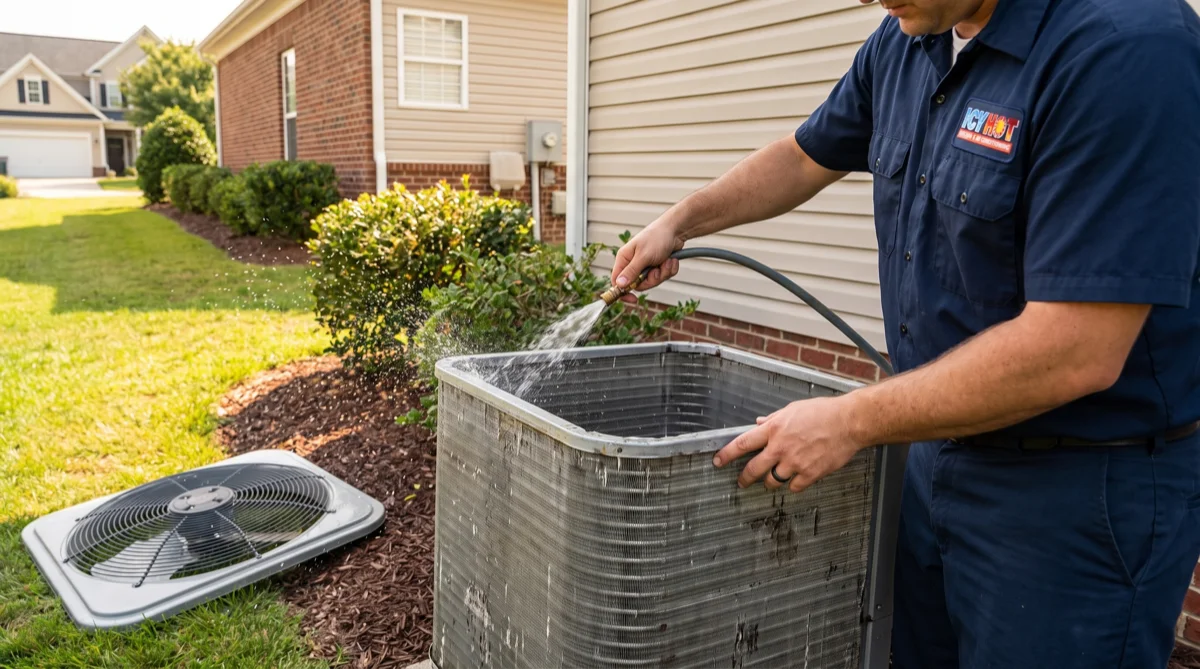
- Keep the condenser coil clean and clear. ENERGY STAR notes that dirty coils “reduce the system’s ability to cool your home and cause the system to run longer, increasing energy costs and reducing the life of the equipment.” In Raleigh that means clearing spring pollen, cottonwood, and grass clippings off the outdoor fins, and keeping shrubs about two feet back. If the fins are damaged or crushed, that is condenser repair territory.
- Never run the system when it is iced up. Carrier’s instruction is one line: “If you see ice, shut the system off immediately to prevent compressor damage.” Ice means liquid refrigerant is heading back toward a pump built only for gas. Our guide to why an AC freezes up covers the thaw-and-fix sequence.
- Fix refrigerant leaks instead of topping off. Refrigerant is not consumed, so low charge always means a leak, and running undercharged overheats the compressor. Handling it also requires an EPA Section 608 certified technician, since “technicians who maintain, service, repair, or dispose of equipment that could release refrigerants into the atmosphere must be certified.”
- Get an annual tune-up. ENERGY STAR’s checklist has a technician tighten electrical connections, measure voltage and current on motors, check the refrigerant charge, and clean the coils. Those four items are the compressor’s whole risk profile. A maintenance plan or a scheduled AC maintenance visit each spring covers them.
When to Call a Raleigh HVAC Pro
Call as soon as the breaker trips more than once, as soon as you hear a new grinding or banging noise, or as soon as the system runs for an hour without moving the thermostat reading. Those three symptoms all have the same property: continuing to run the system makes the eventual repair more expensive, not less.
What you should not do is keep resetting the breaker to squeeze one more evening out of it. Carrier’s warning applies directly here, and a compressor drawing locked-rotor current through a breaker that keeps getting reset is how a repairable problem becomes a replacement. Shut it off, put a fan in the room, and let a technician look at it. If your system is running but not cooling, that post covers the cheaper causes worth checking first.
If the house is unbearable and you are in the middle of a Triangle heat wave, that is what our emergency AC service is for. Otherwise, a standard AC repair visit gets you a real diagnosis with the meter readings to back it up.
Frequently Asked Questions
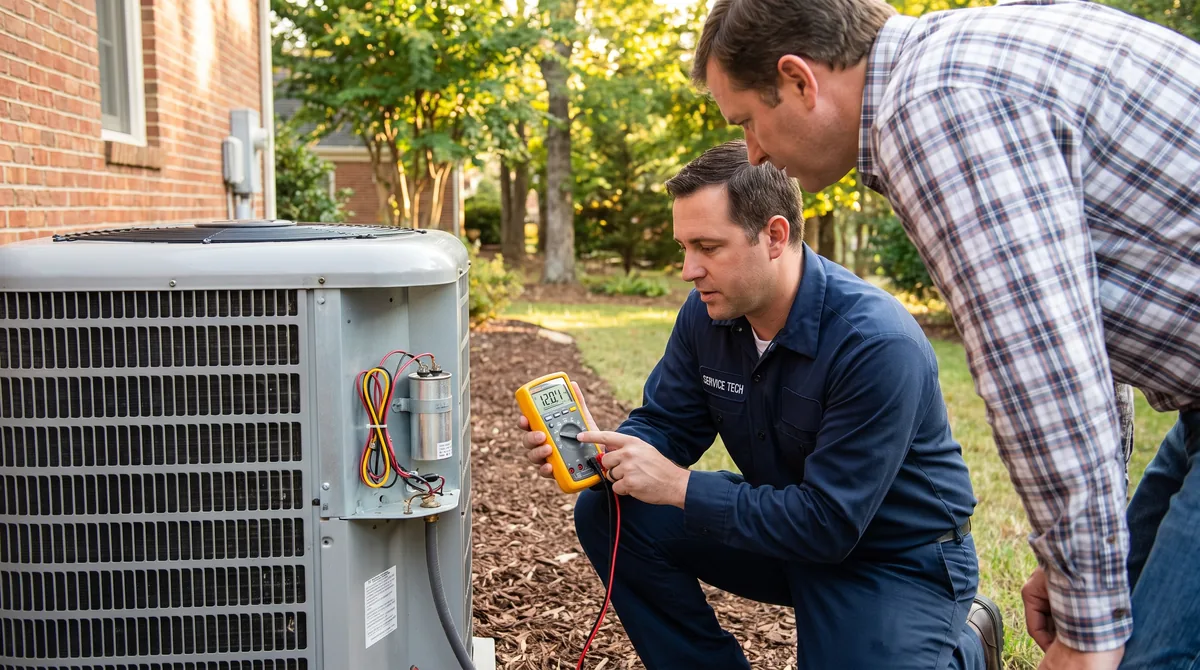
Quick answer for Raleigh homes: A bad compressor either will not start (hum, click, or breaker trip) or runs without making cold air. Both symptoms are also produced by a capacitor or contactor costing a fraction as much, so insist on capacitor, contactor, and compressor readings before you approve an expensive quote. Then check your warranty, because a live registered parts warranty covers the compressor itself and takes the largest item off the invoice.
The Bottom Line for Raleigh Homeowners
A compressor diagnosis is one of the few HVAC conversations where asking two good questions can save you a great deal of money. Here is what to hold onto:
- The strongest signs are a unit that hums or clicks without starting, a breaker that trips on every cooling call, and a system that runs without cooling.
- Supporting signs are new banging or screeching noises, lukewarm air off the outdoor unit, climbing bills, and recent short cycling.
- A capacitor or contactor produces the same no-start symptom for a small fraction of what a compressor replacement costs.
- Ask for the capacitor, contactor, and compressor readings before approving anything.
- Check your warranty first. A registered parts warranty typically runs 10 years and covers the compressor itself, which is the largest item on the invoice.
- Under 10 years and in warranty, replace the compressor. Twelve-plus years and out of warranty, put the money toward a new system.
- Never keep resetting a tripping breaker, and never run the system when it is iced up.
If your outdoor unit is humming, tripping, or running without cooling, we will get you a real diagnosis with the meter readings behind it, and we will tell you honestly when the cheap part is the answer. Call Icy Hot at (919) 673-7667 or request a free instant quote, and if it is an emergency in the heat, our Raleigh AC compressor repair team is available around the clock.