A capacitor is the cheapest part in your air conditioner that can shut the whole thing down, and it is the part Raleigh homeowners get the widest range of quotes on. I have seen the same job priced at $95 and at $485 in the same week, on the same street, for the same failure.
That spread is not fraud, at least not usually. It is the result of three or four different things getting bundled into one number, and nobody explaining which ones. Bryant publishes $100 to $400. Carrier publishes $200 to $400. Trane cites $75 to $250. The part itself, the actual metal can, costs less than a tank of gas.
So this guide does something the ranking cost articles do not. It pulls apart what each published range is actually measuring, adds what we bill here in Wake County, and then gets to the two things that move your bill more than any of it: how fast Raleigh heat eats capacitors, and whether the part is still under a warranty nobody told you to ask about.
One more thing this guide does that the others do not. It answers the DIY question honestly, which means telling you what North Carolina law actually permits and then telling you why I still would not do it.
TL;DR: An AC capacitor replacement in Raleigh runs $150 to $350 during regular business hours, and the part itself is only $8 to $100 of that. The published national ranges disagree ($75 to $250 from Trane, $100 to $400 from Bryant, $200 to $400 from Carrier) because each one draws the line around the service call differently, not because the job differs. Two things move your bill more than the quote does: Raleigh heat puts Triangle capacitors at the five to ten year end of every manufacturer lifespan range, and if your system is under ten years old the part may still be under a parts warranty nobody told you to claim. North Carolina law does permit a homeowner to swap a capacitor. All four major manufacturers tell you not to, because it holds a lethal charge after the power is off. Humming outdoor unit with a still fan? Shut it off and call (919) 673-7667.
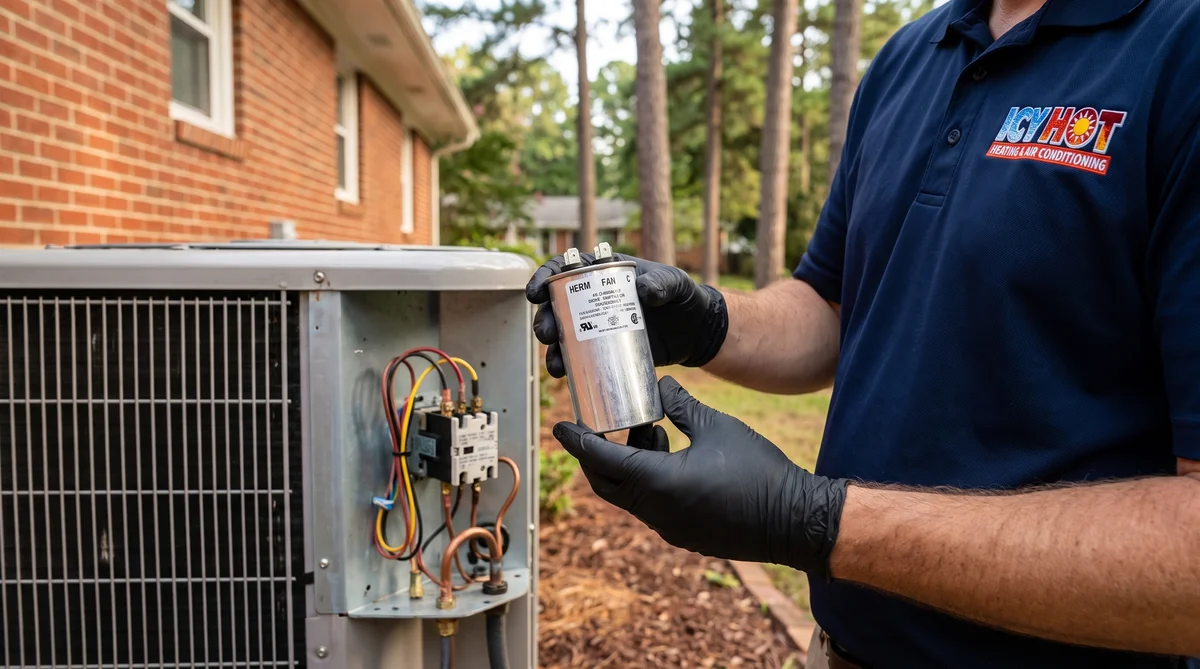
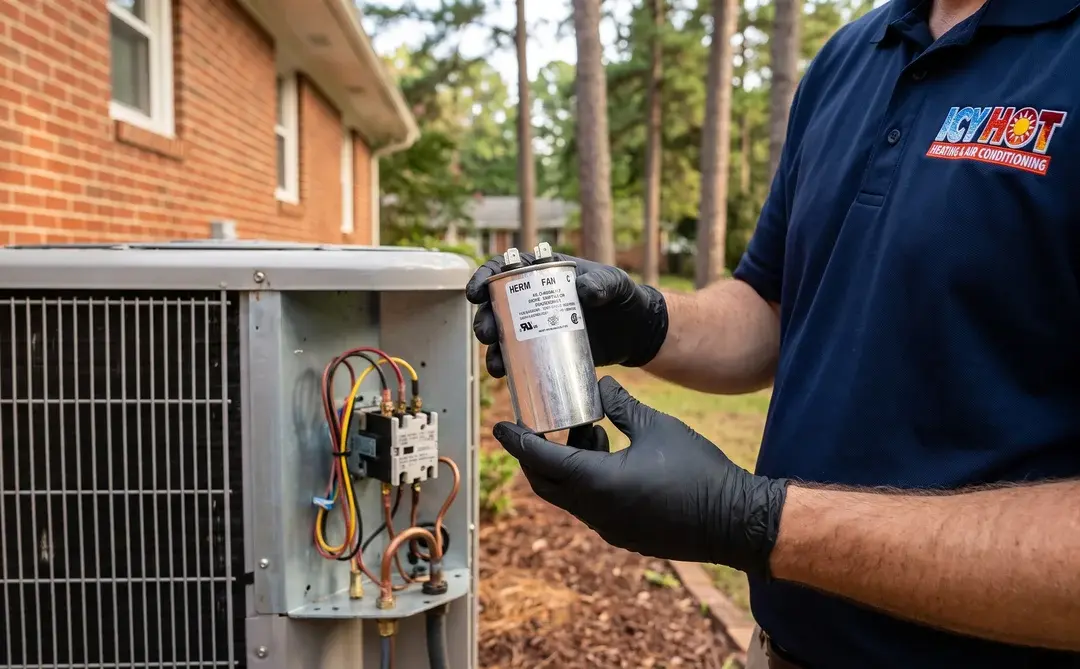
The part at the center of this entire guide. A dual-run capacitor costs $8 to $100 depending on type and brand. Everything else on the invoice is the visit.
How Much Does AC Capacitor Replacement Cost in Raleigh?
Most Raleigh homeowners pay $150 to $350 to have a failed AC capacitor diagnosed and replaced during regular business hours. That figure covers the trip, the diagnostic, the part and the labor to install and test it. Evenings, weekends and holidays run higher. A capacitor still covered by a manufacturer parts warranty runs lower, sometimes a lot lower.
That range sits comfortably inside what the manufacturers and the national cost guides publish, which is the first useful thing to know. If a quote lands well outside it in either direction, that is worth a question. A $95 quote usually means the diagnostic fee is about to appear separately. A $485 quote usually means something else is on the invoice, or it is 9 p.m. on a Saturday in July.
Bryant calls this out plainly: “A failing capacitor is the most common air conditioner repair.” American Standard agrees, calling capacitor replacement “one of the most common air conditioning repair tasks.” When a part fails this often, the pricing conventions around it get sloppy. Here is how to read them.
Why Published Capacitor Prices Range From $75 to $400
They disagree because they are counting different things. Once you separate the part from the labor from the trip charge, the published numbers stop conflicting and start agreeing.
Start with the part. This Old House, in a guide updated April 7, 2026, puts the bare capacitor at “$8 and $45” depending on type. Bryant’s own breakdown is a little higher at $20 to $100, which tracks, because a manufacturer-branded part with a stocking markup costs more than a generic one off a supply house shelf. Either way, the part is not what you are paying for.
Then the labor. This is where the guides split hard. This Old House puts HVAC labor at $60 to $150 per hour and notes that contractors “typically charge between $90 and $200, with some companies adding a flat service call fee.” HomeAdvisor, updated June 20, 2026, says something quite different: “HVAC technicians charge between $200 and $400 for labor alone.”
Both are true, and the difference is flat-rate pricing versus hourly. Bryant notes that “A trained technician can usually replace an AC capacitor in 30 to 60 minutes, including testing and system” restart. At $60 to $150 an hour that is a small number. But almost nobody in this trade bills a capacitor by the hour, because the hour is not the cost. The truck, the stocked part, the diagnostic equipment and the drive to your house are the cost. So the industry flat-rates it, and the flat rate looks like an expensive hour.
Then the trip. This Old House puts the average HVAC service call at “around $129.” Some companies waive it when you approve the repair. Some do not. A shop that waives it will quote you a higher repair number, and a shop that keeps it will quote a lower one, and the two invoices land within $30 of each other. This single convention explains most of the apparent disagreement in the chart below.
HomeAdvisor also publishes an “all-inclusive rate between $300 and $600, which includes the capacitor’s cost,” which is a different package again: that number generally reflects after-hours or emergency work, or a job where the capacitor was not the only thing replaced. If you are quoted in that band on a Tuesday morning for a capacitor alone, ask what else is on the ticket.
Our $150 to $350 sits where it does because we flat-rate the repair, stock the common microfarad values on the truck, and roll the diagnostic into the repair when you approve it. You can see the same logic on our AC repair page, where capacitor work is listed among the routine same-visit fixes.
What an AC Capacitor Actually Does, and the Three Types
A capacitor stores electrical energy and releases it in a burst to get a motor turning, then keeps feeding that motor a stabilized current once it is running. Without one, the motors in your air conditioner will not start at all.
Lennox puts it in one sentence: “Much like a battery, a capacitor is designed to store energy.” They also give you the best physical description of the part, which matters when you go looking for it: “Generally, AC capacitors look like small soda cans with two leads extending from one end.”
Trane explains the division of labor: “The start capacitor is designed to deliver the energy your AC’s compressor motor requires to start the cooling cycle. That’s it. Once your unit gets that initial jolt, the run capacitor steps in.”
Most systems installed in the Triangle in the last twenty years use a single dual-run capacitor instead of two separate cans. Carrier describes these as “space-saving powerhouses that combine two capacitors into a single physical unit,” one side feeding the compressor and one side feeding the condenser fan. Lennox calls the dual the “more modern” design, “capable of handling both jobs” in one can.
Why this matters for your invoice: a dual-run capacitor costs more than a single. This Old House prices the dual-run part at $15 to $45 against $8 to $30 for a plain run capacitor. It is a real difference on the part line and an invisible one on the total.
The numbers printed on the side of the can are the microfarad rating and the voltage rating. Ferguson, the trade supply house, notes that “HVAC capacitors can have an mfd as low as 3 or as high as 1,200, but most are in the range of 5 to 80 mfd.” American Standard puts the residential window at “5-80 MFD” and adds a useful rule of thumb: “Capacitors with an MFD above 70 are starting capacitors.” Hold onto those numbers, because they come back later in the most expensive way possible.
Seven Signs Your AC Capacitor Is Failing
A dying capacitor announces itself before it quits, usually with a hum. If your outdoor unit is humming while the fan sits still, stop reading and go shut the system off at the thermostat. That specific symptom means a motor is energized and stalled, and letting it sit there cooks the windings.
Carrier describes it precisely: “A distinct humming sound from the outdoor unit usually indicates a motor trying to start but lacking the necessary torque.” Bryant lists the same thing first among its warning signs: “Humming Noises: The outdoor unit hums but the fan isn’t spinning.”
The rest of the symptom list is less dramatic and easier to ignore, which is why capacitors so often take something else with them.
Two of those deserve a closer look. The breaker trip is the one homeowners misread most often. Bryant explains the mechanism: “A weakening capacitor forces the motor to draw excess amperage, repeatedly tripping the breaker.” People assume a tripping breaker is an electrical problem and call an electrician. Often it is a $30 part in the condenser. We cover the wider version of that triage in our guide to an AC that will not turn on.
The short cycling is the other. Carrier: “A failing capacitor often struggles to keep the compressor running, causing the unit to shut off and restart rapidly.” That pattern, cooling for four minutes and shutting down, is frequently blamed on the thermostat. Before you replace a thermostat, have somebody read the capacitor.
The last one on the list is the only one that is genuinely an emergency. Trane includes among its failure symptoms that “You notice smoke or detect a burning smell coming from your unit,” and Lennox lists the same pair, “You detect a burning smell or see smoke.” That is not a capacitor about to fail, that is a capacitor already failing with current still moving through it. Kill the breaker to the outdoor unit before you do anything else, including calling us.
The rest of the list is deceptively mild, and that is the trap. A system that takes ten seconds longer to start than it did last summer is not going to get your attention in June. It is the same fault as the humming one, just earlier, and it is the version that costs $250 instead of $2,000.
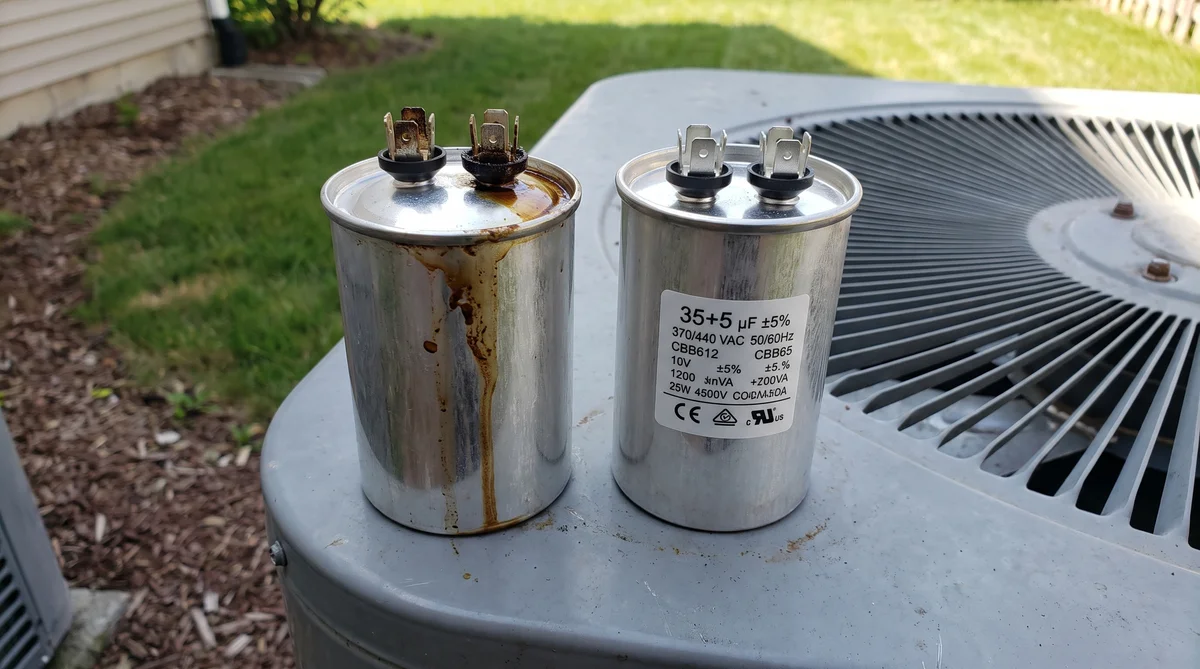
Left: a failed capacitor venting dielectric oil, with one terminal scorched. Right: its replacement, rated 35 plus 5 microfarads at 370/440 volts. Match those numbers exactly.
If you see what that photo shows, oil weeping down the side of the can or a scorched terminal, there is nothing left to diagnose. Ferguson lists the visual tells as “Leaks, bulges, scorch marks, or discoloration on the capacitor.” A capacitor that is venting its dielectric fluid has already failed, and the only question left is what else it damaged on the way out.
And do not try to run the system in the meantime. Bryant is blunt on this: “No, running an AC with a bad capacitor can cause serious damage to the compressor or fan motors and may lead to complete system failure.” Carrier’s version is that the system “physically cannot start the high-torque motors without the energy stored in the capacitor.” A few hot days of forcing it is how a $250 repair becomes a compressor conversation.
How Long Should a Capacitor Last in a Raleigh Summer?
Between five and ten years here, which is the short end of every published range. The manufacturers are not wrong about the longer numbers. They are describing a different climate than ours.
Look at what the four major manufacturers actually publish. Bryant says an AC capacitor “generally lasts 5 to 10 years, but heat exposure and frequent cycling can shorten its life.” American Standard says “The average lifespan of an AC capacitor is 15 years, but it can be shorter if you run your AC more.” Carrier says “Most AC capacitors last between 10 to 20 years, depending on usage patterns and heat exposure.” Lennox says “Generally, an AC capacitor will last around 20 years.”
That is a four-to-one spread between the shortest and the longest published lifespan for the same component. It looks like a contradiction. It is not. Read the qualifiers: heat exposure, frequent cycling, usage patterns. Every one of those manufacturers is telling you the same thing in a different order, which is that the number depends entirely on how many hours the part spends hot.
HomeAdvisor, which pulls from actual homeowner-reported jobs rather than an engineering spec, lands in between: “AC capacitors last between five and 15 years, with an average lifespan of ten years.” That is probably the most honest national figure, and it is still generous for the Triangle.
In our own work the number that keeps coming up is eight. Eight years is roughly when a Raleigh system starts producing capacitor calls at a rate you notice, and it is well before the 15 or 20 year marks that a homeowner reading a manufacturer page would plan around. If your system was installed around 2018 and has never had a capacitor, you are due.
What Actually Kills Capacitors Here
Heat, almost always. Every manufacturer that publishes a failure-cause list puts heat at the top, and Raleigh supplies it in quantity.
Bryant’s three causes are “Heat Exposure: Prolonged operation in high temperatures can degrade the capacitor’s ability to hold a charge,” “Voltage Fluctuations: Power surges or lightning strikes can overload and damage the internal components,” and “Age: Like batteries, capacitors have a finite lifespan and naturally lose their ability to store energy over time.” American Standard’s list is the same three with the heat item phrased as “An extreme heat wave that keeps it running continuously,” plus “Short circuit in the wiring” and “Lightning strike.”
Now the local part, from primary data rather than feel. The National Weather Service office in Raleigh publishes a monthly climate report for Raleigh-Durham International. The August 2026 edition, issued September 1, recorded 1,861 cooling degree days since January 1 against a 1991 to 2020 normal of 1,496. That is roughly 24 percent more cooling load than a normal year, accumulated by the end of August.
The single-month numbers are starker. August 2026 logged 509 cooling degree days against a 428 normal, with a monthly mean temperature of 81.2 degrees against a 78.8 normal. And the number that matters most for a part sitting in a metal box in direct sun: RDU recorded 18 days at or above 90 degrees in August 2026. The prior August recorded one.
A capacitor does not care about the average. It cares about hours spent above its rated operating temperature with current flowing through it. Eighteen days of 90-plus heat in a single month is not an average, it is a sustained load, and it is why the Bryant number rather than the Lennox number describes systems in Wake County.
Voltage is the quieter second cause. Summer thunderstorms are routine here, and a nearby strike does not have to hit your house to push a surge down the service drop. American Standard lists both “Short circuit in the wiring” and “Lightning strike” among its failure causes, and Bryant groups them as “Power surges or lightning strikes can overload and damage the internal components.” A surge event does not usually kill a capacitor outright. It takes a bite out of it, and the part fails three weeks later on an ordinary afternoon with no apparent trigger.
That is one of several reasons we look at electrical connections on every tune-up visit rather than only when something has already failed.
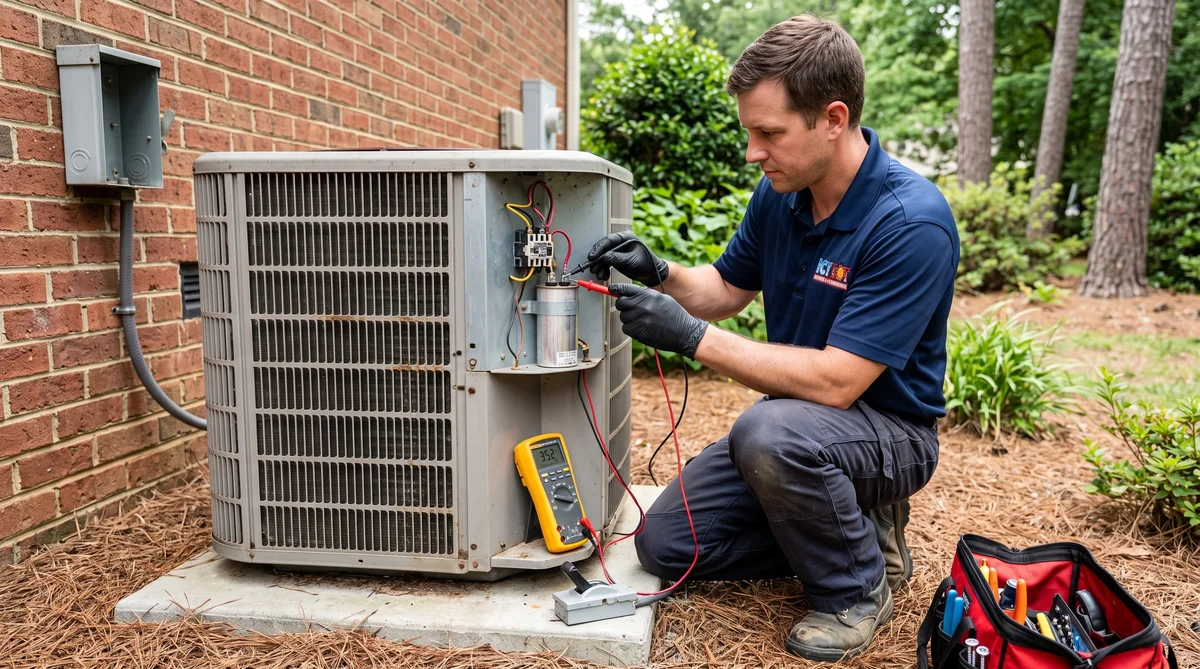
The only reliable capacitor diagnosis is a measured one. Note the pulled disconnect on the pad: cutting power is step one, and it still does not discharge the part.
Can You Replace an AC Capacitor Yourself in North Carolina?
Legally, yes. North Carolina law specifically names the capacitor as a part a homeowner may replace without a contractor license. Practically, every manufacturer that builds one tells you not to, and after twenty-some years in this trade I agree with them. Both of those things are true at once, and most articles on this topic only tell you one of them.
Here is the law. N.C. General Statutes section 87-21(c) sets out who the plumbing, heating and fire sprinkler contracting article applies to, and then carves out an exemption: “The provisions of this Article shall not apply to those who clean plumbing drains or those who make minor repairs or minor replacements to an already installed system of plumbing, heating or air conditioning.”
The statute then defines that term, and the definition is unusually specific: “Minor repairs or minor replacements within the meaning of this subsection shall include the replacement of parts in an installed system which do not require any change in energy source, fuel type, or routing or sizing of venting or piping. Parts shall include a compressor, coil, contactor, motor, or capacitor.”
The capacitor is named in the statute. So nobody can tell you it is illegal in North Carolina, and if a contractor tries, that is a reason to get another quote.
Now the other half. Here is what the four manufacturers say, verbatim, and notice that they do not hedge:
The reason they all say the same thing is that a capacitor holds its charge after the power is off. Bryant: “Capacitors store lethal amounts of electrical energy even when the power is off.” Carrier: “AC capacitors store high-voltage electricity that can cause serious injury or death, even when the power is disconnected.” Trane: “Air conditioning capacitors are dangerous, high-voltage devices. Touching or mishandling one could lead to serious injury or death.” Lennox notes they “can carry a residual charge that could seriously hurt you.”
That is four independent manufacturers using the words “death” or “seriously hurt you” about a part This Old House prices at “$8 and $45.” Pulling the disconnect does not discharge it. Flipping the breaker does not discharge it. Setting the thermostat to off does not even de-energize the unit.
So my honest answer, as somebody who is allowed to say either thing: the law permits it, the risk is real and not theoretical, and the money you save is smaller than you think once you account for the second half of this guide. If you are going to do it anyway, at minimum discharge the terminals deliberately before touching them and photograph the wiring before you pull a single lead.
The Microfarad Mistake That Turns a $25 Part Into a $2,000 Repair
The expensive DIY failure is not electrocution. It is buying the wrong capacitor, installing it successfully, and slowly destroying the compressor over the following two summers.
Ferguson, who sells these parts to the trade, spells out the trap. A capacitor rated too high, and specifically “more than 10% higher” than the unit calls for, is the dangerous one, because “it will still run but can wear out the compressor faster.” It works. The AC cools. Nothing looks wrong. The failure is invisible until it is enormous.
The opposite error is at least self-announcing. Ferguson again: “If you use a capacitor with an mfd rating that’s too low, the air conditioner may not start at all, or at minimum have long starting times.” An undersized capacitor tells you immediately that something is wrong. An oversized one does not.
Voltage has its own rule, and it runs one direction only. Ferguson notes that you may replace a capacitor with one carrying a higher voltage rating but “never a lower rating,” and gives the example that swapping a 370 volt part for a 440 volt part is fine while the reverse is not. Run capacitors, they note, come in “250, 370, and 440 volts.” HomeAdvisor describes the same residential window as “voltage ratings between 250V and 440V.”
Look at the gap in that chart. The part is $8 to $45. The parts that sit downstream of it, the ones a mismatched capacitor quietly grinds down, run into four figures. HomeAdvisor puts a burnt-out motor at $200 to $700, a damaged compressor at $750 to $2,000, and a condenser replacement at $1,050 to $5,000.
There is also a serviceability angle. Trane makes a point most homeowners never consider: “Labor and installation by a licensed HVAC professional may make up the bulk of your costs, and a dealer might not be motivated to install a part you’ve purchased yourself.” If you buy the part and it turns out to be wrong, you have not saved $30, you have bought a second service call.
The right way to verify a capacitor without guessing is to measure it. Ferguson’s threshold: put a meter on the terminals and “The reading should be close to the mfds listed on the capacitor itself. If the readings are significantly lower (roughly 6% or more), the capacitor should be replaced.” That 6 percent figure is the one that separates a real diagnosis from an eyeball.
Check Your Warranty Before You Pay for the Part
If your system is under ten years old, the capacitor may still be covered, and almost nobody asks. This is the single largest avoidable line item in this entire guide.
Bryant’s warranty page states the standard terms: “Typically, Bryant products, if registered within 90 days, come with a 10-year standard parts limited warranty; otherwise 5 years.” Most major manufacturers run a comparable structure, a long parts warranty conditioned on prompt registration, dropping to a shorter one if nobody registered the equipment.
A capacitor is a part. On a registered five-year-old system, the can itself should cost you nothing.
The catch, and it is an important one, is that labor is a separate animal. Bryant says so directly: “Even with the standard parts warranty, repair labor bills can range from $100 to $1000 or more.” A parts warranty removes the part from your invoice, not the visit.
Two practical notes. First, registration is the hinge. If the installing contractor did not register your equipment within 90 days, you are on the five-year clock instead of the ten-year one, and a nine-year-old system that should have been covered is not. Go look up your model and serial number on the manufacturer’s owner portal before you approve anything.
Second, warranties generally follow the original owner. If you bought your Raleigh house in 2023 and the system went in during 2019, the coverage you inherit is usually the shorter term. Worth checking anyway. Fifteen minutes on a website against $40 of part cost is a reasonable hourly rate.
If you are close to the end of coverage and looking at repeated repairs, that is a different conversation, and we walk through it in our guide to how long an AC unit lasts and on our AC replacement page.
What Drives Your Raleigh Capacitor Bill Up
Five things, in rough order of how much they move the number: when you call, whether a diagnostic is separate, whether the part is under warranty, what type of capacitor your system takes, and whether the capacitor was the only casualty.
Timing is the largest single lever and the one most under your control. A capacitor that fails at 4 p.m. on a Friday in July and gets called in Friday night costs materially more than the same capacitor called in Monday morning. This Old House states the general principle plainly: “HVAC repairs are often more expensive in peak summer months when demand for technicians is high.” The same guide adds that “In hotter climates where AC units run more frequently, capacitors tend to wear out faster,” which is the Raleigh problem in one sentence. The after-hours premium is a real line item at every shop in this market including ours. If the house is tolerable overnight and nobody in it is medically vulnerable, Monday is cheaper. If it is not tolerable, call us and we will come; that is what emergency AC service is for.
The second lever is the diagnostic convention, which we covered above. Ask one question when you book: “Is the diagnostic fee waived if I approve the repair?” The answer tells you how to compare that quote against the next one.
The third is warranty status, which you now know to check. The fourth is capacitor type, which you do not control; a dual-run part costs $15 to $45 against $8 to $30 for a single run capacitor, per This Old House, and heat pumps land at $15 to $25. On a $250 invoice those differences are noise.
The fifth is the one that actually produces the $485 quotes. A capacitor that failed hard sometimes takes the contactor with it, and a contactor is a similar-cost part sitting six inches away. Replacing both on one visit is not an upsell, it is the right call, because the second visit costs you another trip charge. But you should be shown the burned contactor, not just told about it. A technician who cannot point at the damage should not be adding the part.
When the Capacitor Is Not the Real Problem
A capacitor that fails twice in three years is not a capacitor problem. Something upstream is killing it, and replacing the can again just resets the clock.
The usual culprits, in the order we check them: a condenser fan motor drawing high amps because its bearings are going, which loads the capacitor every single cycle; a failing contactor chattering and pitting, which hammers the capacitor with repeated inrush; a dirty condenser coil forcing longer run times and higher head pressure, which is the coil cleaning conversation; and low refrigerant charge making the compressor work against conditions it was not designed for.
There is also the simplest one. A unit installed in full afternoon sun against a west-facing brick wall with no shade runs hotter than the identical unit twenty feet away under a pine. Same equipment, same house, different lifespan. We see this on condenser calls constantly.
The diagnostic that distinguishes these is not complicated, it is just not visual. It involves reading amp draw on the motors under load and comparing to the nameplate. ENERGY STAR builds it into its recommended maintenance: the agency’s checklist says a proper visit should “Tighten all electrical connections and measure voltage and current on motors,” and explains why: “Faulty electrical connections can cause unsafe operation of your system and reduce the life of major components.”
That last clause is the whole argument for maintenance in one line. A loose lug on a capacitor terminal does not announce itself. It just quietly shortens the life of everything downstream.
When Capacitor Calls Spike in the Triangle
July and August, by a wide margin, and the pattern is visible in national search data long before it shows up in our dispatch board.
We pulled twelve months of US search volume for the phrase homeowners actually type when this happens. The shape is extreme. Demand floors at 4,400 searches in January 2026 and peaks at 27,100 in both July and August 2026. That is a 6.2 times swing across a single year, steeper than almost any other HVAC repair term we track.
The interesting part is not the peak, it is the ramp. Volume nearly triples between February and March, from 6,600 to 18,100, well before Raleigh gets genuinely hot. That is systems coming out of winter, being asked to start for the first time in months, and discovering that a marginal capacitor which limped through last September does not have enough left to turn a compressor over.
Which is the practical takeaway: the failure usually happens on a start, not during a run. First hot week of spring and first sustained heat wave of summer are both start-heavy periods. That is exactly why a spring tune-up catches capacitors, because a technician measuring microfarads in April finds the weak one before June finds it for you.
The secondary spike, the one that catches Raleigh homeowners off guard, is September. National demand in September 2025 was 12,100, still nearly three times the January floor. Our shoulder season runs hot, and a system that has been running since March has put in a long year by the time the calendar says fall.
How to Make the Next Capacitor Last Longer
You cannot make a capacitor immortal, but you can stop shortening its life. Almost everything on the list below works by reducing how hard and how hot the motors run.
The single highest-value item on that list is the annual electrical check, and not because the capacitor gets replaced preventively. It does not, usually. It is because a technician with a meter can tell you a 45 microfarad capacitor is now reading 39 and give you a season of warning. Ferguson’s 6 percent threshold is the standard; a part drifting toward it is a scheduled repair instead of a Saturday emergency.
The second highest is shade and clearance, which costs nothing. Keep two feet clear on all sides of the condenser and three to four feet overhead. Do not build a decorative screen that blocks airflow. If the unit sits in full western sun, a tree or a trellis placed well clear of the airflow path genuinely helps, and unlike most efficiency advice it costs a Saturday rather than a check.
The third is not obvious: fix a thermostat that short cycles. Every start is the moment of maximum stress on a capacitor. A system that starts twelve times an hour because a thermostat is badly located or a filter is choking airflow is running through its start cycles at three or four times the intended rate, and the capacitor wears in proportion. Our maintenance packages cover the checks that catch this.
If you want the full seasonal version of this, we keep a longer AC tune-up guide that explains what a real tune-up includes and what a $59 special usually leaves out.
Frequently Asked Questions About AC Capacitor Cost
The Bottom Line for Raleigh Homeowners
Budget $150 to $350 for a capacitor replaced during business hours, and treat anything far outside that as a question rather than a verdict. The national guides publishing $75 to $400 are not contradicting each other; they are drawing the line around the visit in different places.
Before you approve the work, do three things. Ask whether the diagnostic is waived when you approve the repair, because that single convention accounts for most of the price spread you will see between quotes. Look up your equipment’s registration and warranty status, because on a system under ten years old the part may be free and the labor is what you actually owe. And if the same capacitor has failed twice in a few years, ask what is killing it, because something upstream is.
On the DIY question, I will keep giving you the honest answer rather than the convenient one. North Carolina law names the capacitor as a part a homeowner may replace. Bryant, Carrier, Trane and Lennox all tell you not to, using the words “death” or “seriously hurt you,” because the part holds a lethal charge after the power is off. The money at stake is the labor and the trip, somewhere between one hundred and three hundred dollars. I would not take that trade, and I do this for a living.
What I would do is get the microfarads measured once a year. A capacitor that has drifted 6 percent off its rating is a scheduled repair in April. The same capacitor is an emergency call on a July Saturday.
If your outdoor unit is humming with a still fan right now, shut the system off at the thermostat and call us at (919) 673-7667. We stock the common values on every truck, and it is usually a same-day fix. You can also schedule online or reach us through the contact page.
Written by Frankie Asfari, owner of Icy Hot Heating & Air Conditioning in Raleigh, NC. NATE-certified, NC HVAC License #L.34356.