Every May, Raleigh inboxes fill up with the same offer. $49 AC tune-up. $59 spring special. $89 cooling system check. The ads come from a dozen different HVAC companies, all promising peace of mind before the June heat hits. So which one is real? And why does the next-door neighbor say her tune-up cost $185?
The honest answer: AC tune-up pricing in Raleigh runs from $29 to $550 depending on system type, service depth, and how the company makes its money. Most homeowners with a single central AC pay $120 to $175 for a thorough visit, the kind that includes refrigerant pressure checks, capacitor testing, and a written report. The cheap promos do exist as a real service, but they’re built on a different business model than a $185 visit, and that matters a lot for what gets done at your house.
Here’s the full picture: real Raleigh pricing tiers, what’s actually included at each level, the math on whether a tune-up pays for itself, and how to spot the difference between a legitimate repair recommendation and a profit-padding upsell.
TL;DR: A standard AC tune-up costs $70 to $200 nationally, with most homeowners paying around $120 to $175 for thorough single-system service in Raleigh ($175 to $350 for premium-tier inspections, per Today’s Homeowner, 2026 update). Promo tune-ups at $29 to $59 do exist, but they’re loss-leaders designed to identify upsell opportunities, expect a quick visual inspection rather than gauge work. The math: a $150 annual tune-up that catches one capacitor before it fails, where the average Raleigh AC repair runs $379 to $503 based on Icy Hot’s local market data, pays for itself in a single avoided service call.
How Much Does an AC Tune-Up Cost in Raleigh?
A standard AC tune-up in Raleigh costs $89 to $250 in 2026, with most homeowners paying $120 to $175 for a comprehensive inspection of a single central AC system. National data from Today’s Homeowner puts the basic-service range at $175 to $350 with a $250 average, while Trane publishes an annual maintenance range of $120 to $350. Promotional tune-ups at $29 to $89 are loss-leaders that cover only a visual inspection and filter change.
The wide range makes more sense once you understand what creates it. A 60-minute van time at HVAC labor rates of $75 to $175 per hour (per Fixr, 2026) means the actual cost of doing thorough work is roughly $100 to $200, plus parts, fuel, and overhead. Anything priced well under that has a different business model behind it. Anything priced well above includes either premium diagnostics, multi-system service (AC plus heating), or a brand markup.
System type matters a lot too. Ductless mini-splits need each indoor head cleaned individually, which is why mini-split tune-ups for multi-zone homes typically cost noticeably more than a single central AC visit. Heat pumps often justify two visits a year (spring for cooling-mode checks, fall for heating-mode), which doubles the annual cost but typically comes with a bundle discount.
Pricing also climbs in late June and July when scheduling slots get tight. Companies aren’t gouging, they’re rationing. A $150 spring slot becomes a $200 priority weekend slot in July because crews are running emergency calls. Book before Memorial Day if you want the low end of the range.
What’s Actually Included in an AC Tune-Up?
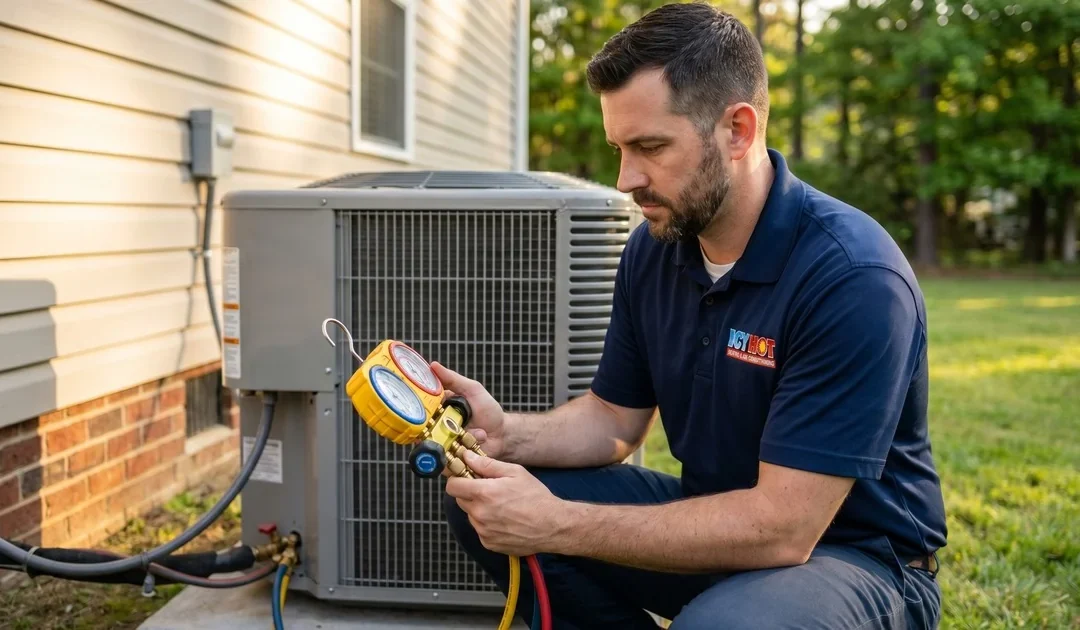
A real AC tune-up covers 12 to 20 specific tasks across the indoor air handler and outdoor condenser, including refrigerant pressure verification with manifold gauges, capacitor microfarad testing, contactor inspection, condenser coil cleaning, condensate drain flushing, blower amp draw measurement, and electrical connection torque check. According to the U.S. Department of Energy, neglecting maintenance leads to a steady decline in performance and increased energy use, which is why the inspection list keeps growing as systems age.
The gap between tiers is the gap between a checkmark and a measurement. A $59 promo technician walks the property with a clipboard, swaps the filter, and rinses the outdoor coil. A $150 to $250 visit attaches gauges to the refrigerant lines, reads the actual subcooling and superheat numbers, tests the capacitor against its rated microfarad value, and measures the blower’s amp draw against spec. The first version tells you nothing went catastrophically wrong since last fall. The second version catches the parts that are about to fail.
The “Sometimes” cells in the basic tier matter. A $99 visit might include gauge work if the technician sees a reason for it, or might skip it if everything visually looks fine. The comprehensive tier doesn’t skip, the gauges go on every time. That’s where the price difference lives.
Why Are Some Tune-Ups $59 and Others $250?
Promotional tune-ups priced at $29 to $89 are loss-leaders. The HVAC company isn’t profitable on the visit itself. They’re paying a technician for 30 to 60 minutes of van time at a fully-loaded labor cost above $100 per hour, plus fuel, parts, insurance, and overhead. The math doesn’t work unless the visit produces something else: a referral, a maintenance plan signup, or, most often, a recommended repair.
That doesn’t make the $59 special a scam. Plenty of homeowners use them as a cheap diagnostic, especially when something feels off but isn’t broken yet. A $59 visit beats a $129 service call fee. The catch is what comes next. The technician’s job description includes finding upsells, and the company tracks the conversion rate. If your house has anything close to a marginal capacitor or a soft refrigerant leak, the $59 visit will surface it, sometimes with appropriate urgency and sometimes with significant pressure.
From the Field
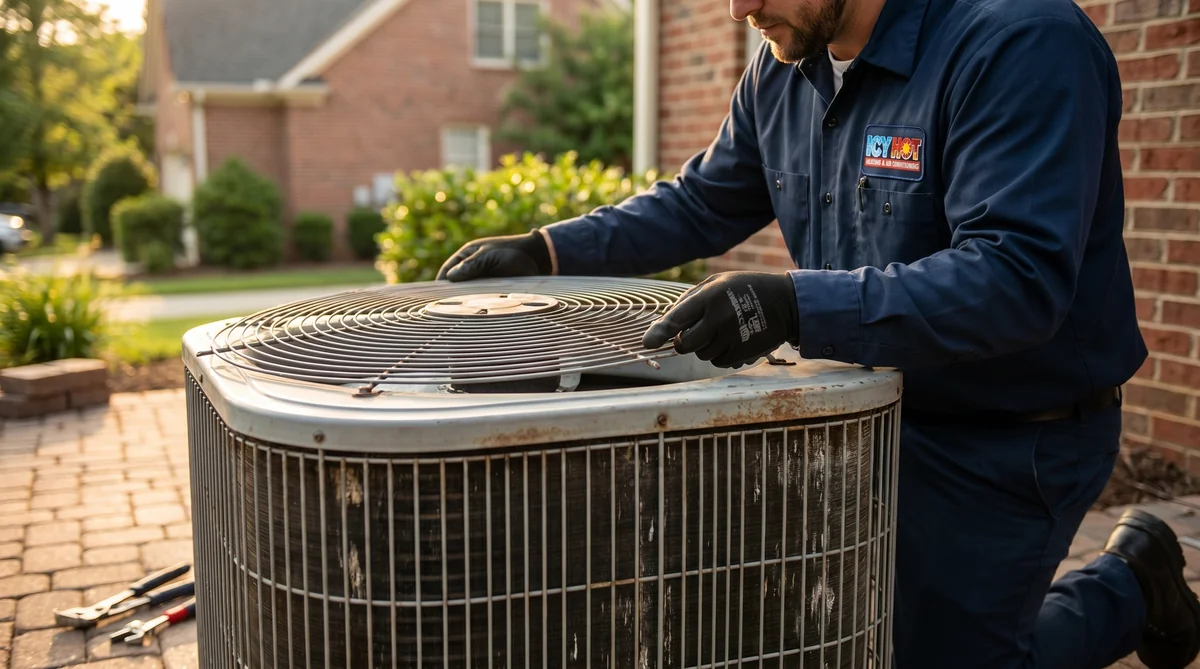
I’ve been called to fix systems that passed a $59 tune-up the previous spring. The promo tech rinsed the coils and ticked the box, but never put gauges on the line. The capacitor that failed in July was already reading 12 percent below spec in April. A real tune-up would have caught it. For what a real coil cleaning involves and what it costs on its own, see how to clean your AC coils.
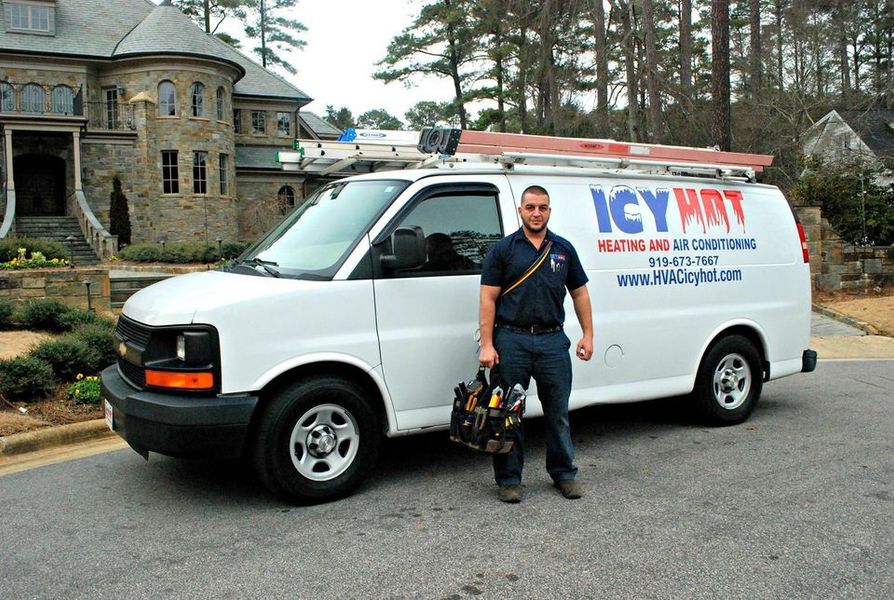
Frankie AsfariOwner · Icy Hot Heating & Air Conditioning
The $150 to $250 standalone tune-up is priced to cover its own cost without depending on add-on sales. That’s why the recommendation list from a comprehensive visit tends to be shorter and more specific than from a promo visit. The technician already got paid; there’s no quota.
None of this is to say every $59 promo is a trap or every $200 visit is honest. Local reputation, online reviews, and clear written reports matter more than the sticker price. But understanding the business model behind the price helps you read the recommendations afterward.
Is an AC Tune-Up Worth the Money?
For most Raleigh homes, yes. A $120 to $175 annual tune-up pays for itself by preventing one mid-summer breakdown, catching efficiency drift before it shows up on the electric bill, and extending equipment life by 3 to 5 years. The break-even math is straightforward: a $150 tune-up is offset by avoiding a single $400 capacitor failure, or by catching a refrigerant leak before the line freezes and damages the compressor.
The most common preventable failure in Raleigh is a weak capacitor. Capacitors lose capacitance gradually, and once they drop more than about 6 percent below their rated microfarad value, the compressor strains to start, draws more current, and eventually fails. A capacitor caught at tune-up is a quick swap, with parts running $100 to $400 (per Fixr, 2026). The same capacitor missed until July becomes an emergency call where the average Raleigh AC repair runs $379 to $503 based on Icy Hot’s first-hand 2026 market data, with $465 typical for the most common repairs we see locally. Third-party aggregators publish lower national averages, but Raleigh pricing tracks higher due to refrigerant supply costs and labor inflation. Our AC repair cost guide for Raleigh breaks down the per-component pricing.
Lifespan extension is the underrated benefit. The U.S. Department of Energy puts the average residential central AC service life at 18 years in hot-humid climates like North Carolina’s. In our experience, well-maintained systems trend toward the upper end of that range and beyond, while systems with multiple skipped years tend to give up several years early. The cost gap between replacing a system at year 13 versus year 20 is several thousand dollars in present-day equipment cost, spread across the extra years of service. That alone justifies the $150 annual investment.
The exception is a system already past 15 years old with deferred maintenance. At that point, a tune-up sometimes accelerates the replacement decision rather than delaying it, because the technician finds three things at once that don’t justify fixing on an aging unit. That’s a useful outcome in its own way, but it means the math shifts from “prevent failures” to “make an informed replacement decision.” See the section below on the $5,000 rule.
How Often Should You Get an AC or HVAC Tune-Up?
How often should your HVAC be serviced? Once per year for AC and once per year for heating, separately. Schedule the AC tune-up between March and May to catch problems before the June heat. Schedule the heating tune-up between September and November to catch problems before the first cold snap. Annual maintenance is the documented industry standard for warranty preservation on equipment from Lennox, Carrier, Trane, and most other major manufacturers.
Heat pumps are a special case because the same outdoor unit handles both heating and cooling year-round. Most heat pump manufacturers recommend twice-yearly tune-ups, one in spring and one in fall, since the system runs roughly 4,000 to 6,000 hours per year in our climate versus 1,500 to 2,500 hours for a separate AC plus furnace pairing. Two visits cost more in absolute dollars, but the per-hour-of-operation maintenance cost is actually lower. Our spring AC tune-up checklist walks through the seasonal cadence in more detail.
Skipping a year isn’t catastrophic on a young system, but the gap shows up later. Capacitors that would have been replaced at year 6 fail at year 7. Refrigerant leaks that would have been spotted in May go undetected until the line freezes in August. Drain pans that should have been flushed clog and overflow into the secondary pan, which then triggers a float switch and shuts the system down on the hottest day of the year. The cost of one year of skipped maintenance is rarely visible the same year. It compounds.
AC Tune-Up vs. Maintenance Plan: Which Costs Less?
An annual HVAC maintenance plan covering both AC and heating tune-ups typically costs $180 to $300 per year in Raleigh, versus $240 to $500 if you book each visit separately. Plans usually include priority dispatch (you skip the wait list during peak season), a 10 to 15 percent discount on any repairs, and waived diagnostic fees (standard troubleshooting visits typically run $75 to $200 per call). For households likely to need at least one repair per year, the plan economics are positive on day one.
The math gets clearer with a single example. Two separate tune-ups at $150 each is $300. A plan at $240 includes both visits plus a waived diagnostic on a single repair call (HVAC.com’s $75 to $200 range), plus 10 percent off the repair itself. If the household has even one $465 average Raleigh repair during the year, the plan typically covers its own cost in repair savings alone, ignoring the priority-scheduling benefit during summer peak.
For low-need households, a single very efficient new system, no kids, no pets, no allergies, the simple two-tune-up cadence at $150 per visit is often the cheaper play. Plans win when at least one of these is true: the system is more than 8 years old, the home has multiple HVAC zones, anyone in the household has respiratory sensitivity, or the homeowner values priority service during summer breakdowns. The Icy Hot Comfort Club page lays out the full inclusion list.
How to Spot Tune-Up Upsells (and What’s a Real Problem)
During or after a tune-up, three repairs are commonly recommended that are usually legitimate when they’re flagged: capacitor replacement when the microfarad reading is more than 6 percent below the rated value, contactor replacement when the contacts show visible pitting or arc damage, and refrigerant top-off when subcooling readings indicate the charge is 5 percent or more below spec. Ask for the measured number on each of these, not just “your capacitor is weak.” A real diagnosis comes with a number.
The recommendations to be more skeptical of: a “deep chemical coil cleaning” on a coil that wasn’t visibly fouled, a UV light sold as a maintenance fix rather than an indoor air quality upgrade, and any push to replace a working blower motor or compressor based on age alone. None of these are categorically scams, sometimes a UV light is genuinely useful, but they’re profit-padders more often than they’re necessary repairs.
The single most useful question to ask: “What did the test read?” A tech who can answer with a number (capacitor at 38 microfarads against a 45 spec, suction pressure at 65 PSI against 70 expected, blower amp draw at 6.2 against 5.4 rated) is doing the work. A tech who can’t is selling something. That’s the reliable filter, regardless of price tier.
When a Tune-Up Won’t Save You: Repair vs. Replace Decisions
The $5,000 rule from Trane helps decide whether to keep tuning up an aging system or move toward replacement: multiply the system’s age in years by the estimated repair cost. If the result is more than $5,000, replacement usually makes more sense. A 14-year-old system facing a $400 compressor capacitor swap (14 × 400 = $5,600) is replacement territory. A 6-year-old system with the same quote (6 × 400 = $2,400) is a repair.
Quick check: Multiply your system age by the latest repair quote. Over $5,000? Get a replacement quote alongside the repair quote. Under $5,000? Do the repair, schedule the tune-up, and revisit next year.
There’s a 2026 wrinkle worth knowing. The federal refrigerant phasedown means new equipment uses R-454B instead of R-410A, which is what’s in most systems installed before January 2025. Older R-410A systems can still be repaired and refrigerant can still be added, but the supply gets more expensive each year as production winds down. For a system already in the borderline replacement zone, this tilts the math slightly toward replace rather than repair-and-keep. The NC HVAC rebates guide covers the state and federal incentives that lower replacement cost, and the AC replacement service page walks through the sizing and selection process if you decide to upgrade.
Frequently Asked Questions About AC Tune-Up Cost in Raleigh
The Bottom Line
AC tune-up cost in Raleigh tracks the work being done. The $29 to $59 promos exist as legitimate visits, but expect a quick inspection without gauge work, and read any post-visit recommendations through the lens of how the company makes its money on a sub-cost service. The $89 to $150 basic tier is honest preventive maintenance for newer systems with low risk profile. The $150 to $250 comprehensive tier is the right call for most households, especially systems past year five, dual-system homes, and any household where summer downtime would be an emergency.
The single best move you can make: book before Memorial Day. Spring slots are cheaper than summer slots, technicians have time to do thorough work, and any failed parts caught now avoid a heat-wave breakdown later. Whether that’s a one-off tune-up or an annual maintenance plan, getting the visit on the calendar before June starts is what protects the rest of the cooling season.
Ready to schedule? Book an AC tune-up in Raleigh, see the full inclusion list at Icy Hot Maintenance Packages, or call (919) 673-7667 for same-week availability. Frankie Asfari and the Icy Hot team have been keeping Raleigh AC systems running since 2008.
Sources: Today’s Homeowner, “How Much Does an AC Tune-up Cost? (2026),” updated May 22, 2025, todayshomeowner.com, retrieved 2026-05-02. Trane Residential, “What Does Home AC Maintenance Cost?” trane.com, retrieved 2026-05-02. Trane Residential, “Air Conditioning Replacement or Repair: What’s Right for You?” trane.com, retrieved 2026-05-02. U.S. Department of Energy, “Maintaining Your Air Conditioner,” energy.gov, retrieved 2026-05-02. U.S. Department of Energy FEMP, “Purchasing Energy-Efficient Residential Central Air Conditioners,” energy.gov/cmei/femp, retrieved 2026-05-02. The Home Depot, “Cost to Repair HVAC,” homedepot.com, retrieved 2026-05-02. Fixr, “Air Conditioner Repair Costs,” fixr.com, retrieved 2026-05-02. Raleigh AC repair cost figures ($379 to $503 typical, $465 average) are based on Icy Hot Heating & Air Conditioning’s first-hand 2026 service-call records..