Air conditioning accounts for about 12% of all U.S. electricity consumption (U.S. Energy Information Administration, 2025). When your AC is running full blast but the house won’t cool down, you’re paying for all that electricity and getting nothing for it. It’s one of the most common calls we receive in Raleigh every summer, and the good news is that many causes have a simple fix.
This guide walks through the 7 most common reasons your AC is running but not cooling, ordered from “check this yourself right now” to “call a pro today.” Most homeowners can narrow down the cause in under 10 minutes.
TL;DR: If your AC is running but not cooling, the most common causes are a clogged air filter (fix it yourself in minutes), low refrigerant from a leak (requires a licensed pro), or frozen evaporator coils (turn the system off and let it thaw for 2 to 4 hours first). A dirty filter alone can cut AC efficiency by 5 to 15% (U.S. DOE). Always start with the simple checks before calling a technician.
1. Check Your Thermostat Settings First
Before assuming anything is broken, spend 30 seconds at your thermostat. Wrong thermostat settings are the easiest-to-miss cause of an AC running without cooling, and they require no tools, no money, and no service call to fix.
One thing to rule out before you go any further: this guide assumes your system is actually running. If nothing happens at all when you call for cooling, no blower indoors and no fan outside, that is a different diagnosis with a different order of checks. Start with our guide to an AC that will not turn on.
Check three things right now:
- Fan set to “ON” instead of “AUTO”: When the fan is set to “ON,” it runs continuously, even when the compressor is off and not producing cold air. You’ll feel air blowing from your vents, but it won’t be cool. Switch the fan to “AUTO” and it only runs during active cooling cycles.
- Mode set to “HEAT” instead of “COOL”: This happens more often than you’d think, especially after a mild spring. Someone bumped the thermostat, or a smart thermostat schedule kicked in from last winter.
- Set temperature too close to current indoor temp: If your home is 78°F and the thermostat is set to 76°F, the system may cycle off quickly before you feel a difference. Try dropping it to 72°F and give it 15 minutes.
Smart thermostats (Nest, Ecobee) add one more potential issue: scheduling conflicts. If you recently changed your schedule, check that the “Away” or “Eco” mode isn’t holding the temperature higher than you expect.
Cost to fix: $0. If adjusting thermostat settings doesn’t resolve it within 20 minutes, move on to the next checks.
2. Dirty or Clogged Air Filter
A clogged air filter is the single most preventable cause of an AC running without cooling. According to the U.S. Department of Energy, dirty filters reduce AC efficiency by 5 to 15%, which means your system works harder, runs longer, and cools less than it should. In severe cases, a completely blocked filter starves the evaporator coil of airflow and causes it to freeze solid. Our guide to why an AC freezes up walks through the full ice-and-airflow failure path and what to do the moment you see it.
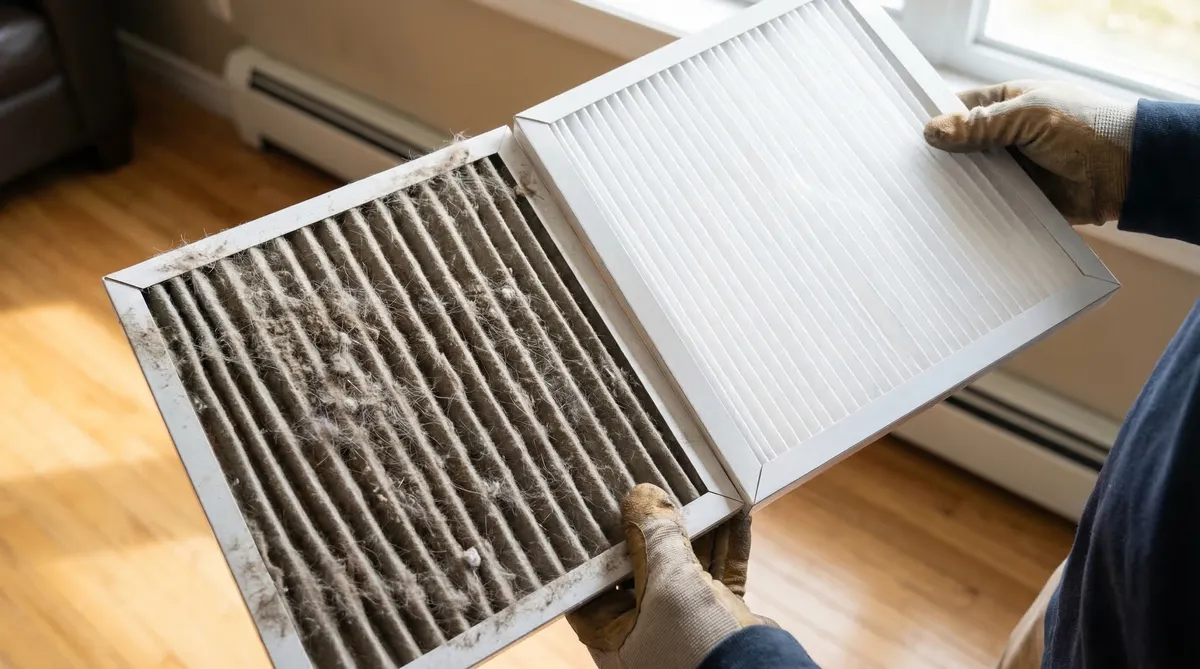
Here’s how to check yours in 60 seconds: Locate your air filter, usually inside the return vent (a large vent grate on a wall or ceiling) or inside your indoor air handler unit. Slide it out and hold it up to a light source. If you can’t see light through it, replace it now. If it looks gray, fuzzy, or thick with dust, replace it even if you can still see some light.
Most filters should be changed every 1 to 3 months depending on your household. Homes with pets, high dust, or anyone with allergies should change filters every 30 days during peak cooling season. In Raleigh’s summers, when systems run 8 to 12 hours a day, filters clog faster than the box suggests.
A citation capsule worth knowing: The U.S. Department of Energy and ENERGY STAR both state that replacing a clogged HVAC air filter can reduce AC energy consumption by 5 to 15%. At 12 cents per kilowatt-hour (the North Carolina average), that efficiency loss costs Raleigh homeowners $50 to $150 per summer on wasted electricity alone, before factoring in the wear on the compressor. If the outdoor unit has started humming, tripping the breaker, or running without cooling, learn how to tell if your AC compressor is bad before you approve any quote.
Cost to fix: $5 to $30 for a new filter, self-installed in under 5 minutes. If a fresh filter doesn’t restore cooling within 30 minutes, move to the next checks.
3. Frozen Evaporator Coils
Frozen evaporator coils are a symptom, not a root cause, but they’re a common reason an AC blows warm or barely cool air. If you see ice on the copper refrigerant lines running into or out of your indoor unit, or frost accumulation on the unit itself, your coils are frozen.
Coils freeze when they can’t absorb heat properly, usually because of restricted airflow (dirty filter, blocked vents, collapsed ductwork) or low refrigerant. The irony: a frozen coil makes the problem worse. Ice insulates the coil and prevents any heat exchange, so the system blows warmer air the more it freezes.
What to do right now: Turn the system off at the thermostat, not to “fan only,” but fully off. Let it thaw for 2 to 4 hours. Running a frozen system forces the compressor to work against a blocked coil, which shortens its life significantly. After the thaw, check and replace the air filter. Then turn the system back on. If it refreezes within a few hours, the cause is likely low refrigerant rather than an airflow issue, and you need a technician.
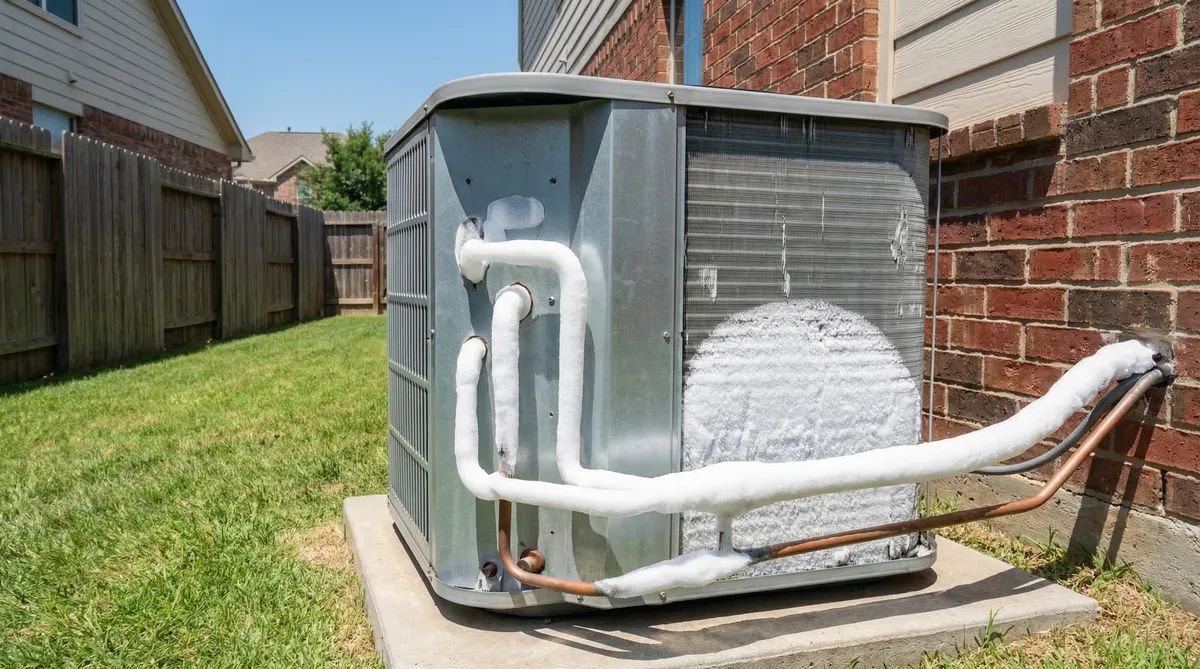
You can check for frozen coils without opening anything: look at the copper line that runs from your outdoor unit into your home. It should be cool and possibly have a bit of condensation on it. If it’s coated in ice or frost, you’ve confirmed the issue.
Cost to fix: $0 if the cause is a dirty filter (replace it after thawing). If it’s refrigerant-related, expect $250 to $1,500-plus for leak repair and recharge, see the next section.
4. Low Refrigerant From a Leak
Refrigerant is what actually moves heat out of your home. It doesn’t get “used up” like gasoline, so if your system is low on refrigerant, there is always a leak somewhere. And according to Angi (2026), minor refrigerant leaks increase your energy bills by 20% or more before cooling problems become obvious. You’re paying higher electric bills for weeks or months before the system finally can’t keep up.
In our experience at Icy Hot, refrigerant leaks are the most common cause of the “it’s been running all day and the house is still 80 degrees” calls we receive throughout Raleigh’s summers. What makes our climate especially demanding: North Carolina’s humid subtropical weather means your AC isn’t just cooling air, it’s removing moisture from it too. That latent heat load, the energy required to dehumidify, puts extra strain on a system that’s already running low on refrigerant. The house feels hotter than the thermometer suggests because the humidity isn’t coming down either.
Signs your system may have a refrigerant leak:
- The AC runs constantly but can’t get the house below a certain temperature, even on mild days
- Ice forms on the refrigerant lines or indoor unit (see above)
- You hear a faint hissing or bubbling sound near the indoor air handler
- Your electric bill spiked without an obvious reason
- The air coming from your vents feels only slightly cool, not cold
This is not a DIY repair. Under EPA Section 608, handling refrigerants requires federal certification. A licensed HVAC technician will perform a leak test, repair the source of the leak, and recharge the system to the proper level. If your system still uses R-22 (phased out in 2020), a leak may make replacement more practical than repair. For newer systems using R-410A or the latest R-454B (A2L), see our guide on what refrigerant your system uses.
Cost to fix: Refrigerant leak repair averages $800, with a typical range of $250 to $1,600 depending on leak location and refrigerant type (Angi, 2026). If the leak is caught early, the repair is usually straightforward. Ignored leaks lead to compressor failure, which runs $1,200 to $2,800.
5. Dirty or Blocked Condenser Unit (Outdoor Unit)
Your outdoor condenser unit has one job: dump the heat your AC pulls from inside your home into the outdoor air. When it’s blocked, dirty, or malfunctioning, that heat has nowhere to go, and your home stays warm no matter how long the system runs. An EPA study found that even a thin layer of 0.042 inches of dirt on condensing coils causes a 21% efficiency drop and can increase energy use by 35% (ACHR News).
Walk outside right now and check for these issues:
- Debris buildup: Leaves, grass clippings, and cottonwood seeds are big culprits in Raleigh through late spring. If you can see material packed against the fins, the unit needs cleaning.
- Blocked clearance: The condenser needs at least 2 feet of clearance on all sides. Overgrown shrubs, privacy fences too close, and stored items nearby all restrict airflow.
- Fan not spinning: When the compressor is running, the large fan on top of the outdoor unit should be spinning. If it’s not, a failed capacitor or fan motor is preventing heat from escaping. The system will continue to run and make noise, but it won’t cool.
- Bent fins: The aluminum fins surrounding the condenser coil can get bent by debris, lawn equipment, or hail. Bent fins reduce airflow. A fin comb (available at hardware stores for under $10) can straighten minor damage.
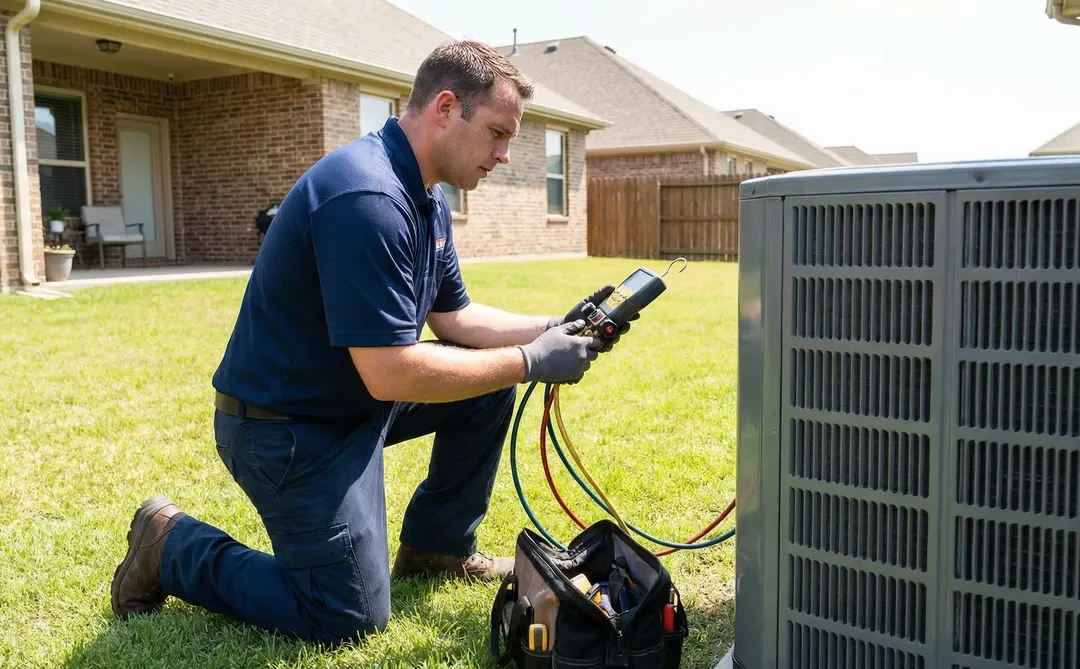
You can rinse the condenser coil with a garden hose (from the inside out, gently) to clear debris. Avoid pressure washing, which bends fins. If the fan isn’t spinning or the coil looks heavily fouled, call a technician for AC condenser repair.
Cost to fix: Free for basic cleaning. Professional coil cleaning and fan motor replacement run $150 to $650.
6. Duct Leaks or Blocked Airflow
Your AC may be cooling air perfectly, and losing that cooled air before it ever reaches your rooms. The EPA estimates that the typical U.S. home loses 20 to 30% of conditioned air to duct leaks, primarily in attics and crawl spaces (ENERGY STAR). In Raleigh, where most homes have ductwork running through unconditioned crawl spaces or attics, leaks are especially common.
Use this quick diagnostic to identify airflow problems before calling a technician:
- Hold your hand over every supply vent in your home. All vents should have roughly similar airflow. A vent blowing weakly or not at all in a specific room points to a duct problem in that branch, not a whole-system failure.
- Check that all supply and return vents are open and unobstructed. Furniture placed over floor vents, closed dampers from last heating season, and blocked return grills are easy fixes that technicians find regularly.
- Check your crawl space or attic if you can do so safely. Disconnected or collapsed flex duct is visible and common, especially in homes over 15 years old.
the EPA’s ENERGY STAR program states that a typical home loses 20 to 30% of the air that moves through its duct system to leaks, holes, and poorly connected ducts. In a home running its AC 10 hours a day, that’s the equivalent of leaving a window cracked open all summer.
If you suspect duct leaks, a duct sealing service can dramatically improve both cooling performance and energy efficiency. Professional duct sealing using Aeroseal or mastic sealant typically pays for itself within 2 to 3 cooling seasons.
Cost to fix: $0 for unblocking vents or closing dampers. Professional duct sealing runs $1,500 to $3,000 for a full home but delivers permanent results.
7. Your AC Is Undersized, or Just Overworked on the Hottest Days
Here’s something most HVAC articles won’t tell you: if your AC can’t keep up on days when the outdoor temperature hits 97°F or higher, that may not be a malfunction at all. AC systems are designed and tested at an “outdoor design temperature,” typically 95°F for residential systems. When Raleigh’s August heat pushes past that, even a properly functioning system may run continuously and still not reach your setpoint.
Raleigh’s humid subtropical climate adds an extra layer of difficulty that purely hot climates don’t face. Your AC isn’t just removing sensible heat (the temperature you feel), it’s also removing latent heat, meaning the moisture in the air. High humidity forces the system to work harder to achieve the same level of comfort. A system that’s borderline undersized for a dry climate can genuinely struggle in Raleigh’s July or August humidity.
Signs that undersizing or heat load is the real issue:
- The system keeps up fine in spring and fall but struggles specifically on the hottest summer days
- You’ve recently added living space (finished basement, converted garage, sunroom addition)
- The system is more than 15 years old and efficiency has declined gradually
- Your attic is poorly insulated or has significant air leaks around fixtures and penetrations
- South and west-facing windows get significant afternoon sun with no shading
If the problem is capacity rather than a mechanical failure, the long-term solution is either upgrading to a properly sized system or improving your home’s thermal envelope (insulation, air sealing, window treatments). See our guide to AC replacement in Raleigh for what a proper load calculation looks like. In the meantime, a professional AC tune-up ensures your existing system is running at its maximum potential.
Cost to fix: A tune-up runs $75 to $200 and optimizes efficiency. Full system replacement typically ranges from $5,500 to $11,000 for a properly sized central AC in a Raleigh home.
8. When to Turn Off Your AC and Call a Pro
Not all AC problems get worse if you keep running the system, but some do. Knowing when to turn it off matters.
Turn off the AC immediately if:
- You see ice or frost on the unit (keeps the compressor from overworking against a blocked coil)
- You smell burning, electrical, or chemical odors coming from the unit or vents
- The system trips the circuit breaker more than once
- You hear loud banging, grinding, or clanking, as those are mechanical failure sounds
- It’s been running for 4 or more hours with no cooling improvement despite checking all of the above
You can keep running with monitoring if:
- Cooling is mildly reduced specifically on the hottest day of the summer (likely a capacity issue, not a breakdown)
- One room is warmer than others but the rest of the home is comfortable (likely airflow, not system failure)
If you’ve worked through this checklist and still can’t identify the cause, Icy Hot offers AC repair in Raleigh with same-day availability throughout the summer. For nights and weekends, our 24/7 emergency AC service is available year-round. Schedule a service call online or call (919) 673-7667.
Frequently Asked Questions
The Bottom Line
An AC that’s running but not cooling is one of the most fixable problems in your home, if you catch it early and start with the right checks. Here’s the quick recap:
- Check the thermostat first, as fan mode and heat/cool setting catch a surprising number of calls
- Replace the air filter, which costs $5 to $30 and takes 5 minutes, and solves roughly 40% of cooling complaints
- If you see ice on the unit, turn it off and let it thaw before doing anything else
- Refrigerant leaks need a licensed tech, they won’t fix themselves and they get more expensive the longer they go
- Check your outdoor unit for debris and make sure the fan is spinning
- Uneven cooling by room points to duct issues, not system failure
- Poor performance on the hottest days may be a capacity issue, not a breakdown
Icy Hot has been diagnosing and repairing air conditioning systems in Raleigh since 2008. If you’ve worked through these checks and still can’t cool your home, call us at (919) 673-7667 or schedule a service call online. We’re available 24/7 for emergency AC service throughout the Triangle.
To keep ahead of problems like these, consider our HVAC maintenance plan, which includes a twice-yearly tune-up that catches low refrigerant, dirty coils, and airflow issues before they become a 95°F emergency. You can also review our spring AC tune-up checklist and our guide to common AC problems in Raleigh for more preventive guidance.