The call comes in October, almost always on the first morning the house does not warm back up by itself. The furnace ran all night, the thermostat says 68, the hallway says otherwise, and somewhere in the back of the homeowner’s mind is a number they heard once: fifteen years. The furnace is seventeen. So the question on the phone is never really “can you fix it.” It is “am I about to spend four thousand dollars.”
Here is what nobody tells you before you go looking up the signs your furnace needs replacing. Age is the least useful signal on the list, and in Raleigh it is less useful than almost anywhere else in the country. There are seven things I would look at before I looked at the date on the rating plate, and a repair quote that crosses one specific dollar figure matters more than all of them put together.
The pages currently ranking for this question are mostly other contractors’ blogs, and they all say roughly the same five things in roughly the same order. None of them tells you what the federal government’s own estimate says an efficiency upgrade is worth in North Carolina, which is the number that should decide whether you replace a furnace that still works. None of them mentions that the state rebate rules changed five weeks ago. And most of them are still pointing you at a tax credit that expired at the end of last year.
So this is the version I would give a neighbor. Eight signs in the order they actually matter, what each one costs to deal with, and the arithmetic underneath, drawn from ENERGY STAR, the Energy Information Administration, the National Weather Service and the four manufacturers we install and service every week.
TL;DR: Replace the furnace when a repair quote crosses roughly half the cost of a new system, when anything points at a cracked heat exchanger, or when it is shutting itself off. Everything else, including age, is a reason to plan rather than a reason to buy. Raleigh runs about 3,153 heating degree days in a normal year against Chicago’s 5,974, so a 20-year-old furnace here has done roughly half the work the national guidance assumes. And by EPA’s own estimate, an ENERGY STAR certified gas furnace saves about $60 a year in the U.S. South, so in Wake County you replace a furnace for safety and reliability, not for the savings. Want a straight second opinion on a quote? Call (919) 673-7667.
Before Anything Else, Confirm You Actually Have a Furnace
In North Carolina there is close to a coin-flip chance that the box you are worried about is not a furnace at all. The Energy Information Administration’s 2020 Residential Energy Consumption Survey counts 4.01 million housing units in North Carolina. Of those, 1.99 million use a furnace as their main heating equipment, which is 50 percent. Another 1.54 million, or 38 percent, use a central heat pump.
Compare that with the country as a whole, where the same survey puts furnaces at 60 percent and central heat pumps at 13 percent. North Carolina has nearly three times the national share of heat pump homes. That is not a rounding difference. It means roughly four in ten people reading an article titled “signs your furnace needs replacing” are looking at an air handler, which has no burner, no heat exchanger, no flue and no gas line, and for which five of the eight signs below simply do not apply.
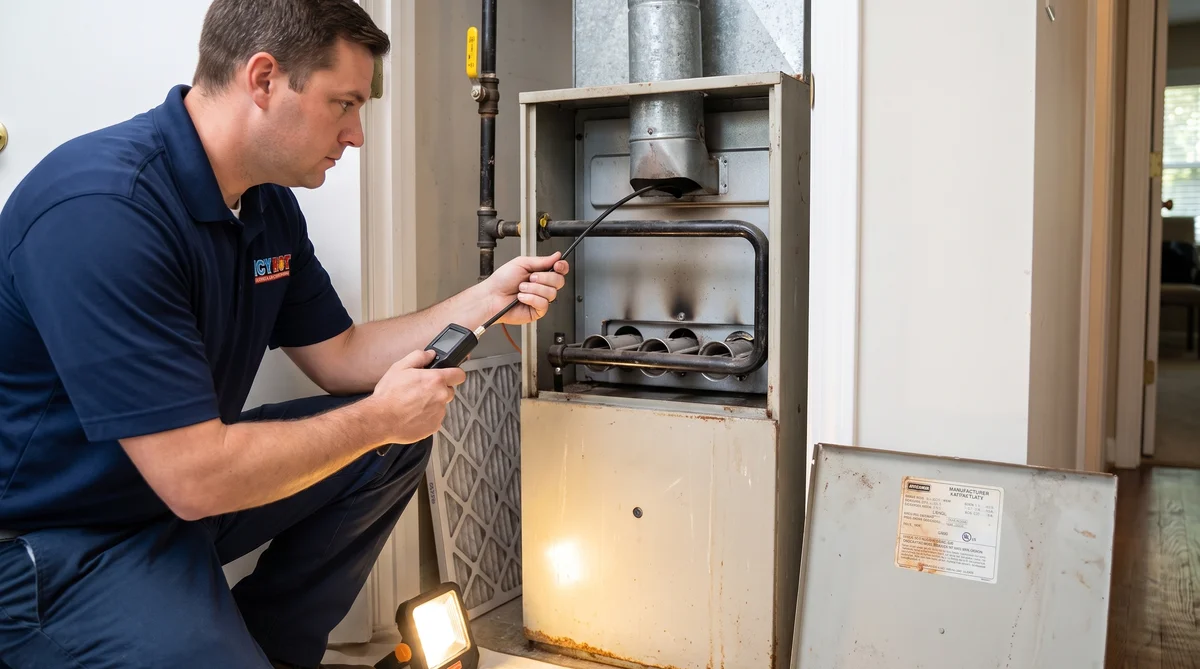
Telling them apart takes about two minutes with a flashlight. Stand in front of the indoor unit, wherever it lives, and look for three things.
A black iron gas pipe with a yellow shutoff handle running into the side of the cabinet. If that is there, you have a furnace. No fuel line means no fuel, which means no furnace.
A round pipe leaving the top of the cabinet and heading for a wall or roof. That is a flue, and its only job is carrying combustion exhaust out of the building. Galvanized metal on an older 80 percent unit, white PVC on a modern condensing unit. If the only thing leaving the top of the box is ductwork, it is an air handler.
A small sight window on the lower access door. That exists so a technician can watch the burner flame. No flame, no window.
We went through this distinction in detail in our guide to air handlers versus furnaces, and it is worth three minutes if you are not certain. If it turns out you have an air handler and a heat pump, the relevant failure signs and the relevant costs are different, and the replacement decision is a different conversation entirely.
How Old Is Your Furnace, Exactly?
The age you half-remember from the home inspection is usually wrong, and the rating plate settles it in under a minute. Open the lower access door and look on the inside face, or on the side of the cabinet near the top. There is a metallic plate with model number, serial number, input BTUH, manifold pressure and electrical ratings stamped or printed on it.
The serial number carries the manufacture date on essentially every residential furnace built in the last forty years, though every brand encodes it differently. Some use the first four digits as week and year. Some use a letter for the month. If you photograph the plate and send it to any licensed contractor, including us at (919) 673-7667, you will get an exact year back the same day.
While you are in there, look to the right of the plate. Most furnaces that have been serviced carry a column of yellow service stickers, one per visit, oldest at the bottom. That column is the single most useful document about your furnace that exists, because it tells you two things the rating plate cannot: how long it has been since anyone looked at this thing, and whether the same part keeps coming back. Three stickers in four years with the same scribbled note is a different situation from eleven stickers over fifteen years.
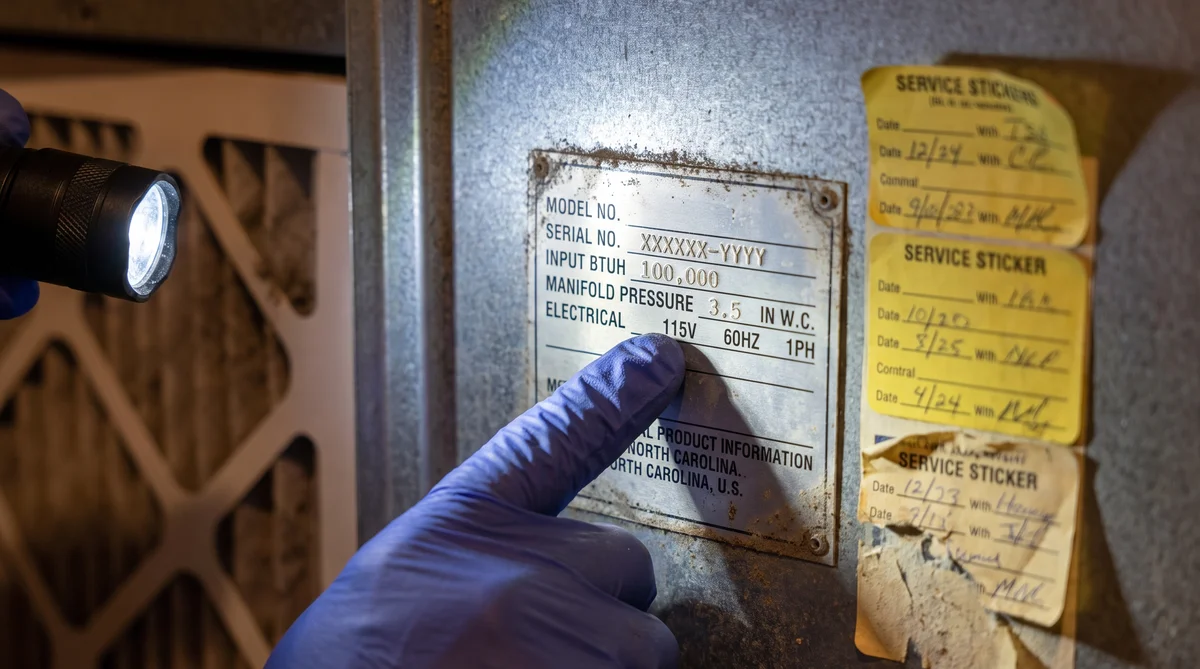
If there are no stickers at all and nobody has had the panel off in years, that is worth knowing before you read the rest of this list. Carrier is blunt about what that does to lifespan: neglecting maintenance “allows dirty buildup to accumulate on vital components like heat exchangers, burners, and fan blades,” and one of the consequences it names is that “dirty heat exchangers transfer heat less efficiently, which can increase run times.” A neglected furnace is mechanically older than its birthday. A maintained one is younger. Our furnace maintenance and maintenance package pages cover what that visit actually involves.
How Long Should a Furnace Last in Raleigh?
All four major manufacturers publish the same window, 15 to 20 years, and in the Triangle that window runs long rather than short. This is unusual. On most components the manufacturers disagree with each other. On furnace lifespan they converge.
Bryant says “a properly maintained gas furnace typically lasts 15 to 20 years.” Carrier says “a well-maintained furnace typically lasts 15 and 20 years,” with “up to 30 years” possible on a high-quality unit. Trane says “in general, a homeowner can expect a furnace to last 15-20 years.” Lennox says “the average lifespan of furnaces is 15-20 years,” and adds that electric furnaces run 20 to 30. ENERGY STAR, from the government side, sets its trigger lower, suggesting you consider replacement when “your furnace or boiler is more than 15 years old.”
Now the part that applies here and almost nowhere in the search results. Trane says plainly that “the same furnace will last longer in a milder climate than it will in northern Minnesota or Massachusetts, for instance.” That is the whole argument, and the National Weather Service puts numbers on it.
In the 2025 calendar year, Raleigh-Durham recorded 2,821 heating degree days against a 1991 to 2020 normal of 3,153. Chicago O’Hare recorded 5,802 against a normal of 5,974. The Twin Cities recorded 6,983 against a normal of 7,399. A normal Raleigh heating season asks a furnace to do roughly 53 percent of the work it would do in Chicago and about 43 percent of what it would do in Minneapolis.
The honest consequence is that a 20-year-old furnace in a Raleigh brick ranch is often in better mechanical shape than a 14-year-old furnace outside Milwaukee, and we see that every fall. Age tells you when to start paying attention, not when to buy. Trane frames the useful version: “if your furnace is more than 10 years old, pay closer attention to how well it is heating your home, since most furnace repairs happen during the last few years of its lifespan.” Its own replacement checklist puts the next step at “15+ years old,” at which point it says to “start budgeting and looking at replacement options.” Bryant puts the budgeting point a little earlier, at the 12 to 15 year mark.
There is a second Raleigh factor working in the same direction, and it is the humidity rather than the cold. Our furnaces sit idle for roughly seven months a year, which is a longer dormant season than the equipment in the cities the guidance was written for. Idle time is not free: condensation, dust accumulation and rodent activity in a crawlspace all do their work while nothing is running. That is the main reason I will not tell a Wake County homeowner their furnace is fine purely because it has low run hours.
Put the two together and the practical rule for the Triangle is that the published window is roughly correct, but the reason it is correct here is different. Elsewhere furnaces wear out from use. Here they more often rust out, corrode out, or fail on a control that sat damp for seven months. That changes what the annual inspection should be looking at, and it is why we pay more attention to the burner compartment, the inducer and the flue on an old Raleigh furnace than to the blower hours.
Sign 1: A Repair Quote That Crosses Half the Cost of a New System
This is the only sign on the list that gives you a number, and it is the one I would weight above everything else. Goodman states the rule directly: “if key parts fail, such as the heat exchanger or control module, or repair costs are more than 50% of the cost of a new product, it may be better to replace the unit.” Lennox says the same thing in one sentence: “it’s best to replace your furnace if a repair costs more than half the cost of a new furnace.”
To use that rule you need the second number, and this is where most articles go vague. HomeAdvisor puts the normal range for furnace replacement at $2,823 to $6,897, with most homeowners spending around $4,814, and the full span from $167 to $13,750 once outliers are included. Take the $4,814 average and the 50 percent line lands at $2,407.
Now look at what actual repairs cost. Bryant puts routine furnace repairs at “$150 to $1,500, depending on the failed component,” against furnace replacement that “often costs $3,000 to $10,000 or more.” Trane gives a similar span, “from under $100 to $3,000 or more if multiple problems exist.” American Standard is the most specific: repair costs “can range between $100 on the low end to $3,000 to replace a cracked heat exchanger.”
So the decision almost makes itself. An ignitor, a flame sensor, a capacitor, a pressure switch: fix it, even at seventeen years old, because you are nowhere near the line. A blower motor or a control board at $1,500 is still a repair. A heat exchanger at $3,000 is not, and neither is any quote that stacks two large parts in the same visit. If someone hands you a number above roughly $2,400 on a furnace past fifteen, ask for a replacement quote alongside it before you decide.
One caveat on the 50 percent rule that nobody states. It assumes the repair buys you years, and on a system with a documented maintenance history it usually does. On a furnace with no service stickers and an unknown history, the same $1,200 repair may buy you one season. Weight the rule accordingly, and see our furnace repair page for what we actually diagnose before quoting.
Sign 2: Anything That Points at a Cracked Heat Exchanger
This is the one sign where the answer is replace, immediately, regardless of age or arithmetic. The heat exchanger is the sealed steel chamber that separates the burner’s exhaust from the air you breathe. When it cracks, those two things mix. The EPA lists “leaking chimneys and furnaces” among the household sources of carbon monoxide, and names “worn or poorly adjusted and maintained combustion devices (e.g., boilers, furnaces)” as a cause when “the flue is improperly sized, blocked or disconnected.”
What makes carbon monoxide genuinely dangerous is that the symptoms do not read as an emergency. The EPA’s own description runs through “fatigue in healthy people and chest pain in people with heart disease” at low concentrations, then “impaired vision and coordination; headaches; dizziness; confusion; nausea” at higher ones, and notes it “can cause flu-like symptoms that clear up after leaving home.” That last clause is the tell. If the whole household feels off in the house and fine at work, that is not a virus.
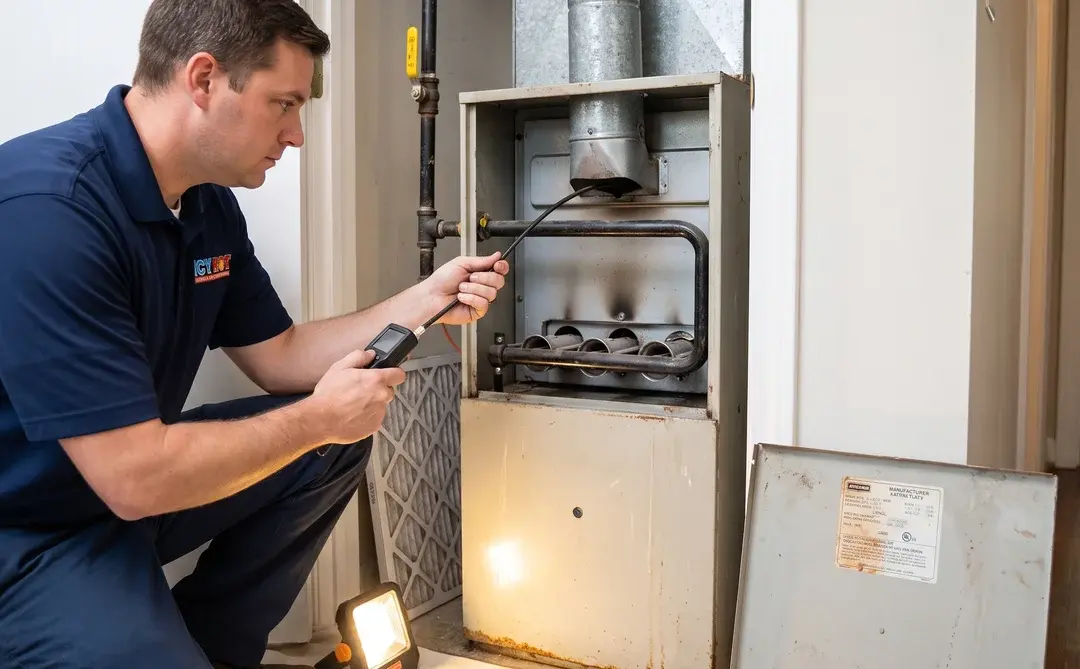
Bryant lists the physical symptoms a technician looks for: “soot buildup, a yellow burner flame, strong odors, or water pooling around the furnace base.” American Standard adds that “a pungent smell can indicate a cracked heat exchanger.” None of these are things you can confirm from the living room. Confirming a crack takes a borescope inside the exchanger or a combustion analysis at the flue.
Two things about this sign are specific to North Carolina and worth knowing before anyone quotes you. First, the law. N.C. General Statute 87-21(c) says the heating contractor licensing article applies to “the installation or replacement of condensing units, air handlers, gas furnaces, package units, boilers, water heaters, heat exchangers.” It then carves out an exemption for minor repairs, and defines the parts that qualify as “a compressor, coil, contactor, motor, or capacitor.” The heat exchanger is named in the first list and absent from the second. In North Carolina this is statutorily not a handyman job.
Second, the warranty, which almost nobody checks before accepting a $3,000 number. Trane publishes that its “furnace warranties cover parts for 5-10 years, and warranty the heat exchanger for 20 years to the life of the furnace, depending on the unit.” If your furnace is inside that window and was registered, the part may be covered even when the labor is not, which can move a replace-or-repair decision substantially. Dig out the paperwork, or ask whoever quotes you to look up the registration by serial number.
Sign 3: A Yellow Flame or a Sooty Burner Compartment
A healthy gas burner flame is blue and sits still. Bryant names the problem version directly: “a yellow or abnormal burner flame can indicate a combustion or ventilation problem and should be inspected by a qualified professional.” The company adds, with more caution than most manufacturers use, that “if you suspect carbon monoxide or a combustion safety issue, leave the area and seek appropriate professional help.”
Yellow means the burner is not getting the air it needs, or the exhaust is not leaving the way it should. Sometimes that is a dirty burner and a sixty dollar cleaning on a maintenance visit. Sometimes it is a partially blocked flue. Sometimes it is the crack from the previous section. The three look identical through the sight window, which is why “it’s just a little yellow” is not a conclusion a homeowner can reach.
Soot is the same story written in carbon. Combustion that is working correctly leaves essentially nothing behind. A gray or black film on the burners, inside the compartment, or on the floor under the furnace means something has been burning incorrectly for a while. Neither of these is a wait-until-spring item, and neither one on its own proves you need a new furnace. It proves you need the panel off and somebody qualified looking in, which is exactly what our annual furnace service is for.
One honest caveat on flame color. A brief flicker of yellow or orange as the burner first lights is normal on many units, and so is a faint burning-dust smell on the first firing of the season. What you are looking for is a flame that stays yellow and lazy once the furnace has been running for a minute, or orange tips that roll upward instead of sitting tight and blue on the burner.
Sign 4: Rooms That Used to Keep Up and No Longer Do
Uneven heating that got worse gradually is the most common real symptom of an aging furnace, and the most commonly misread. Every manufacturer lists it. Carrier names “uneven temperatures throughout your home” and “the system struggles to maintain the thermostat setting” among its replacement warning signs. Bryant calls out “uneven heating” and notes that “cold spots in certain rooms suggest the furnace or another part of the HVAC system may not be distributing conditioned air effectively.”
Read Bryant’s phrasing carefully, because that qualifier is the whole point. “Or another part of the HVAC system” is doing a lot of work in that sentence. A back bedroom that stopped keeping up is as likely to be a crushed flex duct in the crawlspace, a closed damper, failed attic insulation or a filter nobody has changed as it is a dying furnace. We have replaced exactly zero furnaces for a problem that turned out to be a duct, and we have fixed a lot of ducts that somebody else had already quoted a furnace for.
The version that does point at the furnace is different in character: the whole house falls behind on the coldest nights, the burner runs nearly continuously, and the thermostat never quite gets there. That is a capacity problem, and on an old unit it usually means the heat exchanger is transferring less than it used to or the burner is not firing at full input. Our duct sealing page covers the distribution side; the capacity side needs a technician with a manometer.
Sign 5: Noises That Were Not There Last Winter
New noises are a repair signal far more often than a replacement signal, with one exception. Carrier lists “new, loud, or unusual noises during operation” among its replacement warning signs. Bryant is more specific about what each sound suggests: “banging, rattling, or squealing can indicate mechanical problems that warrant professional inspection.”
In practice, squealing is almost always a blower motor bearing or a belt on older equipment, and that is a repair well under the 50 percent line. Rattling is usually a panel, a loose blower wheel or debris. Scraping is a blower wheel touching its housing, which is unpleasant but fixable.
The exception is a hard bang at startup, the kind you feel through the floor. That is often delayed ignition: gas accumulating for a second or two before it lights, then igniting all at once. Delayed ignition puts a shock load on the heat exchanger every single cycle, and it is one of the mechanisms that cracks them. A furnace that booms on startup is not a noise complaint, it is a safety call, and it belongs on the same urgency tier as Sign 2. If it is happening on the coldest night of the year, that is what our emergency furnace service line exists for.
Timing matters as much as the sound itself. A noise that appears once and goes away is usually debris. A noise that gets steadily louder over several weeks is a bearing or a wheel, and catching it before the motor seizes is the difference between a part and a part plus an emergency visit. A noise that arrives suddenly and loudly, at full volume on the first cycle, is the one to stop running the system over.
Sign 6: A Gas Bill That Climbed With No Other Explanation
This is the sign the rest of the internet oversells, and the one where the government’s own numbers say something different in North Carolina. Trane explains the mechanism accurately: “as an oil furnace or gas furnace ages, it becomes less and less efficient. That can mean increased heating costs even if you don’t need repairs.”
The efficiency gap is real, and it is large on paper. Trane notes that condensing furnaces run “an annual fuel utilization efficiency (AFUE) of 90% or better,” while “many older furnaces have an AFUE rating of 60% (when they were first installed) and that efficiency percentage decreases over the years.” Carrier sells models as high as 98.5 percent AFUE. ENERGY STAR says a certified furnace is “15% more efficient than a conventional furnace.”
So here is the arithmetic at North Carolina prices. The EIA put the residential price of natural gas delivered in North Carolina at $17.89 per thousand cubic feet in January 2026, which is the right month to use because summer figures are distorted by fixed customer charges spread across almost no gas. At 80 percent AFUE, a thousand cubic feet of gas delivers about $22.36 worth of actual heat into the house. At 96 percent AFUE, the same gas delivers that heat for about $18.64. The upgrade cuts roughly 17 percent off the fuel side of the heating bill.
Seventeen percent of what, though. That is the question every ranking page skips, and EPA answers it directly.
The ENERGY STAR furnaces page states that certified gas furnaces in the southern half of the country are labeled with a unique U.S. South ENERGY STAR logo, and that “these furnaces will be up to 16 percent more efficient than standard models and can save an average of $60 in energy costs each year.” The same page puts the northern figure at “up to 18 percent more energy efficient than baseline models” saving “$160 a year.”
Sixty dollars a year. That is the federal estimate for the benefit the entire efficiency argument rests on, in the climate region North Carolina belongs to. It is a real number and it is not nothing, but set against a $4,814 replacement it is not a reason to replace a furnace that is otherwise healthy. In Raleigh you replace a furnace because it is unsafe or because it is unreliable. The energy savings are a consolation, not a case. Anyone selling you a replacement primarily on efficiency in Wake County is quoting you a northern number.
One more thing worth ruling out before you blame the furnace. A gas bill can climb because rates climbed, because the winter was colder, because somebody raised the thermostat, or because a filter has been in place since spring. ENERGY STAR’s own replacement checklist pairs the symptoms: consider replacing when “your equipment needs frequent repairs and your energy bills are going up.” Bills alone are weak evidence.
Sign 7: The Furnace Is Shutting Itself Off
A furnace that runs for a few minutes and quits, over and over, is not being temperamental. A safety device is intervening. Modern furnaces carry a stack of them: a flame sensor that proves the burner lit, a rollout switch that trips if flame escapes the burner compartment, a limit switch that trips if the plenum overheats, and a pressure switch that proves the inducer is actually pulling exhaust out of the flue.
Each one has a benign cause and a serious one. A limit switch tripping is usually a clogged filter or a blocked return, and that is a twenty dollar fix. It can also be a failing blower, which means the heat exchanger is cooking every cycle. A rollout switch tripping is never benign; it means flame went somewhere it should not. A pressure switch locking out can be a blocked flue, a cracked inducer hose, or a bird’s nest in the vent termination.
What matters for this article is that repeated short cycling shortens a furnace’s life regardless of its cause. Bryant makes the mechanical point when discussing sizing: short cycling causes “excessive wear on the blower motor and heat exchanger.” A furnace that has been locking out all last winter has aged faster than its calendar years. Diagnose it before the cold snap, not during. Start at furnace repair, or read our walkthrough of a furnace that is not heating for the checks you can safely make yourself.
Sign 8: Age, and Why It Is Last on This List
Age is on every other list first, and it belongs last. Not because it is irrelevant, but because it is a probability statement about a population, and you own exactly one furnace.
Here is the strongest honest version of the age argument. Bryant’s own FAQ says “generally, it’s not worth fixing a 20-year-old furnace, as the cost of repairs often outweighs the benefits compared to installing a new, energy-efficient model.” Carrier says “replacing a 20-year-old furnace is often the smart financial move.” Those are both reasonable positions, and both of them are really restatements of Sign 1: at twenty years, the repairs that show up tend to be the expensive kind, so you cross the 50 percent line more often.
And here is the Raleigh adjustment. The 15 to 20 year window is written for the national average furnace, which does roughly twice the annual work a Wake County furnace does. Carrier also acknowledges that the “end of life” judgment “can be subjective,” and that “it often comes down to a financial decision: at what point do the cumulative costs of repairs outweigh the investment in a modern, more efficient system?” In a climate where the efficiency half of that trade is worth about $60 a year, the repair half carries nearly all the weight.
So: at 12 to 15 years, start budgeting, per Bryant. At 15, start getting quotes so you know the number, per Carrier. But do not replace a quiet, safe, well-maintained furnace because a calendar says so. Replace it when signs 1 through 7 tell you to, and let the age tell you how little patience to extend when they do.
What a Furnace Replacement Actually Costs in Raleigh
Plan on $2,823 to $6,897 for a straightforward residential furnace replacement, with the average landing near $4,814. Those are HomeAdvisor’s national figures, and they track what we see in Wake County on an uncomplicated swap in an accessible location.
The spread inside that range comes from four things: fuel type, input capacity, efficiency tier and how hard the install is. HomeAdvisor breaks the fuel axis out as $3,800 to $10,000 for gas and $2,000 to $7,000 for electric, and puts removal and disposal of the old unit at $60 to $330 on top.
Two line items are worth asking about explicitly, because they are where quotes diverge most. The first is the thermostat. A furnace replacement is the natural moment to deal with a thermostat that was never right, and some quotes include one while others do not. The second is the filter housing. A lot of older Raleigh installs use a one-inch filter slot cut into the return plenum, and moving to a four-inch media cabinet at install time costs very little while the unit is out, and a great deal more as a separate job later. A deeper filter also lasts longer between changes, which matters more here than most places because the Triangle pollen season runs most of the year.
The other thing I would insist on seeing is a load calculation rather than a like-for-like capacity match. Bryant recommends “having a qualified HVAC professional perform a formal load calculation to determine the appropriate furnace size for a home rather than sizing the equipment by square footage alone,” and warns that oversized units short cycle, “causing excessive wear on the blower motor and heat exchanger.” Plenty of Triangle houses were originally fitted with more furnace than they need, and simply replacing what is there carries that mistake forward for another twenty years. The load calculation usually takes an hour, and on a mild-climate house it frequently comes back a size smaller than what is currently installed.
One Raleigh-specific cost that catches people out: going from an 80 percent furnace to a condensing model is not a like-for-like swap. A condensing furnace exhausts cool, wet flue gas through PVC rather than hot gas up a metal flue, and it produces condensate that has to drain somewhere. In a crawlspace or an interior closet that often means new vent routing through a wall and a new drain path, and it is the difference between a one-day job and a one-and-a-half-day job. Ask any quote to state explicitly whether venting and condensate work is included. Our furnace installation page walks through what we include.
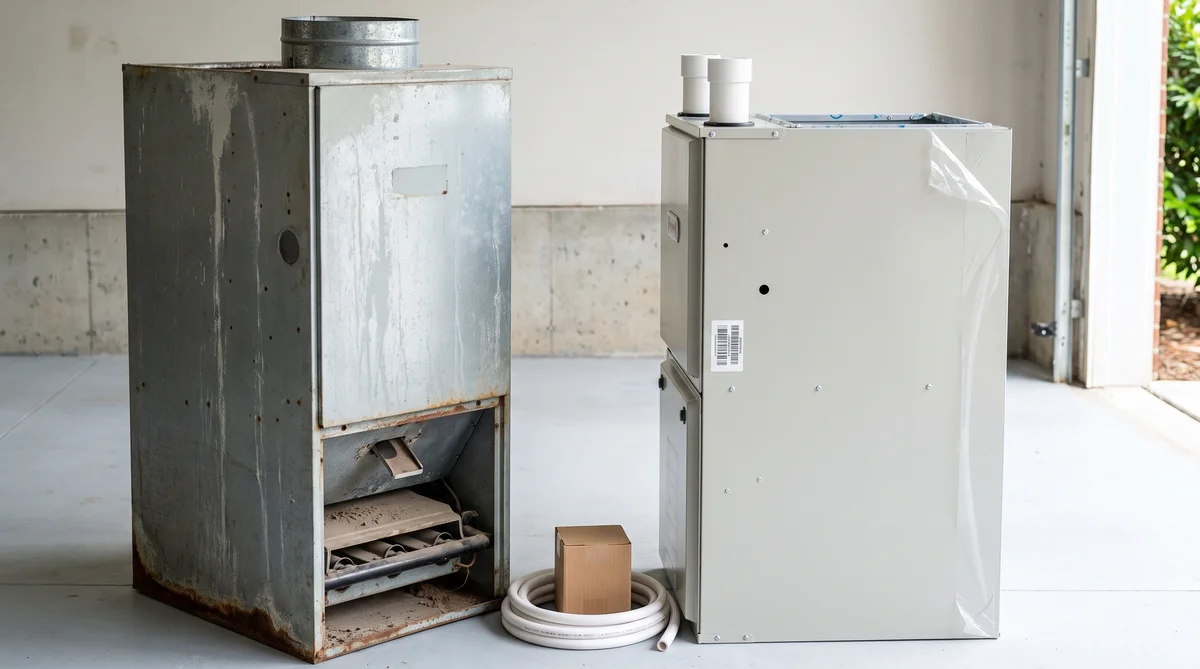
And if you have a gas furnace paired with an aging air conditioner, get both priced together before you commit to either. Replacing them in one visit avoids paying twice for the same labor, and it avoids the refrigerant and coil matching problems that come with half-system swaps. Our post on how long an AC unit lasts covers the other half of that decision.
Two practical notes on getting quotes. Get three, and give all three contractors the same information, including the square footage, the age of the windows and whether the ductwork is in a vented crawlspace or conditioned space. A quote built on a different set of assumptions is not comparable, and the cheapest number in a stack of three is usually the one that assumed the least work. Ask each of them, in writing, what the quoted AFUE is and whether venting and condensate work is included.
And confirm the contractor’s license. N.C. G.S. 87-21(e) requires that a heating contractor’s license number “shall appear on all proposals or contracts and requests for permits issued by municipalities,” so the number belongs on the piece of paper in front of you. Ours is NC HVAC License #L.34356. That same sentence is a reminder that this is permitted work, which is a feature rather than an obstacle: the inspection is the only independent check that the venting, the gas connection and the combustion air were done correctly.
What Changed in 2026: Credits, Rebates and a 2028 Deadline
Three things moved in the last twelve months, and most of the pages ranking for this question have not caught up with any of them.
The federal 25C tax credit is gone. The IRS states that the Energy Efficient Home Improvement Credit “is allowed for qualifying property placed in service on or after Jan. 1, 2023, and before December 31, 2025,” and that you can claim it “for improvements made through December 31, 2025.” A furnace installed in your house in October 2026 does not qualify. If a quote has a federal credit baked into the net price, that line is wrong.
The state rebate rules changed five weeks ago. Energy Saver North Carolina, the state’s program under the federal Home Energy Rebates umbrella, implemented new Department of Energy guidance on September 1, 2026. Its own program changes page states it plainly: “Fuel Switching Projects are NOT allowed: Rebates will no longer be allowed for the replacement of gas or any other fossil fuel appliances through the HEAR rebates pathway.” If you have a gas furnace and you were planning on a state rebate to help you move to a heat pump, that path closed. Income-qualified households should still check the program directly, since the efficiency pathway and other upgrades were affected differently, and we keep our NC HVAC rebates guide current as this moves.
The 80 percent furnace has an expiration date. This one is in the Code of Federal Regulations and nobody writes about it. 10 CFR 430.32(e)(1) sets the minimum AFUE for non-weatherized gas furnaces at 80.0 percent for units “manufactured on or after November 19, 2015, but before December 18, 2028.” For units “manufactured on and after December 18, 2028,” the minimum becomes 95.0 percent.
What that does to your decision depends on where you sit. If you are replacing now and plan to stay in the house twenty years, the condensing unit is worth pricing even though the fuel savings in the South are modest, because you will own the last 80 percent furnace on your street. If you are replacing a rental or a house you expect to sell inside five years, the 80 percent unit is still the cheaper, simpler install, and it is fully legal. Either way, that date is three heating seasons away and it belongs in the conversation.
When We Tell People to Keep the Furnace They Have
We talk homeowners out of furnace replacements several times every fall, and the pattern is consistent enough to describe.
Keep it when the only thing wrong is the calendar. An eighteen-year-old furnace with a column of service stickers, a blue flame, a clean burner compartment and no lockouts is a working appliance. It will need replacing eventually. Eventually is not a diagnosis.
Keep it when the quote is a cheap part. Flame sensors, ignitors, capacitors, pressure switches and limit switches are all well below the 50 percent line, even on old equipment. Bryant’s $150 floor is a real number.
Keep it when the symptom is a distribution problem. If the complaint is one cold room, the first spend should go to the ducts, the filter and the insulation, not to the furnace.
Keep it when the only argument is efficiency. Sixty dollars a year, per EPA, in our climate region. Run that against the quote.
And a note on timing, because the calendar does matter here even if your furnace’s birthday does not. Demand for this exact question is not flat across the year.
September is when people ask, by a wide margin, and September is also the last quiet month in our schedule. The National Weather Service recorded just 9 heating degree days in Raleigh in September 2026 against a normal of 15, so the season has barely started. Diagnostics booked now get an unhurried visit. The same call on the first 25-degree night in January is an emergency heating call at emergency pricing, with whatever equipment is in stock.
Frequently Asked Questions About Replacing a Furnace
The Bottom Line for Raleigh Homeowners
Eight signs, and only three of them should actually move money. A repair quote crossing roughly half the cost of a new system. Anything pointing at a cracked heat exchanger. A furnace that is shutting itself off. The other five tell you to pay attention, book a diagnostic, and start getting numbers.
Age belongs last because the national window was written for a national climate. Raleigh runs about 3,153 heating degree days in a normal year, roughly half of Chicago’s 5,974, and Trane says the obvious consequence out loud: the same furnace lasts longer in a milder climate. Your fifteen-year-old furnace has had an easier life than the guidance assumes.
And treat the efficiency pitch with the skepticism EPA’s own number deserves. Sixty dollars a year in the U.S. South. That is worth having when you are replacing anyway, and it is not a reason to replace anything.
Three things I would actually do this month. Go find the rating plate and the service stickers, so you know the real age and the real history rather than the one you half-remember. If the furnace is past twelve, book the annual service before the first cold snap, because a combustion check is the only way anyone catches Sign 2 before it matters. And if you already have a replacement quote in hand, put the repair number next to $2,407 and see which side of the line it lands on.
One more thing worth settling before you sign anything, if you are replacing rather than repairing: whether to pay the upcharge for a two-stage gas valve. We ran the Raleigh payback arithmetic on that question in our guide to single-stage versus two-stage furnaces, and the short version is that it is a comfort purchase rather than an efficiency one.
If you want a straight answer about your own system, whether that is a furnace repair, a furnace replacement, a look at gas versus electric options, or just a second opinion on a quote that does not smell right, call us at (919) 673-7667. You can also schedule online or reach us through the contact page. We work across Raleigh, Cary, Apex, Garner, Durham, Wake Forest and the rest of the Triangle service area, and we handle heating repair on every system type, not just furnaces.
Written by Frankie Asfari, owner of Icy Hot Heating & Air Conditioning in Raleigh, NC. NATE-certified, NC HVAC License #L.34356.