
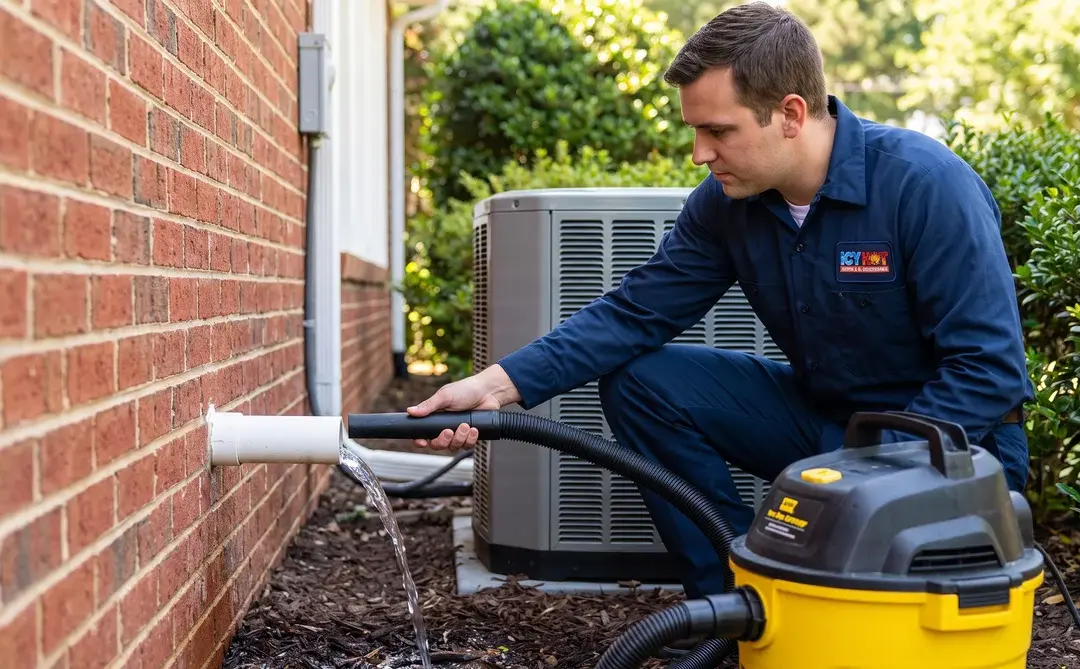
Every August I get the same call from somewhere in Raleigh, and it almost never comes in as a drain problem. It comes in as “my air conditioner just quit,” or “there is water coming through my ceiling,” or “the hallway smells like a wet basement.” Three different complaints, one cause underneath all of them: a plugged condensate drain line on a home central air system.
It is the single most common August service call we run, and it is also the cheapest thing on the truck to fix if you catch it early. The frustrating part is that the ten-second check that tells you whether your line is blocked requires no tools, no ladder, and no crawling into an attic. Most homeowners have simply never been told what to look at.
This guide is about the condensate drain on a residential central air conditioner or heat pump, not the drain in a car. Here is the check I would run first, what the symptoms actually mean, how to clear the line yourself when it is safe to, and the point where continuing to poke at it starts costing more than calling someone.
TL;DR: Walk outside to the small white PVC stub near your outdoor unit while the AC is running on a humid day. If it is not dripping, treat the line as plugged. North Carolina’s own code officials put it plainly: “The absence of dripping from the primary drain line is an indication of it being plugged” (per the NC Office of the State Fire Marshal). A blocked line is why a float switch shuts a perfectly good air conditioner off, and that shutoff is protecting you, not failing you. Clearing the line is about an hour of standard labor at $75 to $150 per hour; letting the pan overflow averages $3,868 in water damage restoration (per HomeAdvisor and its restoration cost guide). Flush the line with distilled vinegar every few months and change the filter on schedule and you will almost never see this problem.
Is Your AC Drain Line Clogged? Start at the Pipe Outside
Yes, if the drain stub outside is dry while the system is running on a humid day, your line is clogged. That is the whole test, and it is the first thing I do when I pull into a driveway.
Somewhere along the exterior wall of your house, usually within a few feet of the outdoor condenser or under an eave, there is a short piece of white PVC pipe sticking out of the wall or foundation. It is small, roughly three quarters of an inch across, and most people have walked past it for years without knowing what it is. On a July afternoon in Raleigh with the system running, that pipe should be dripping, and often running a thin steady stream.
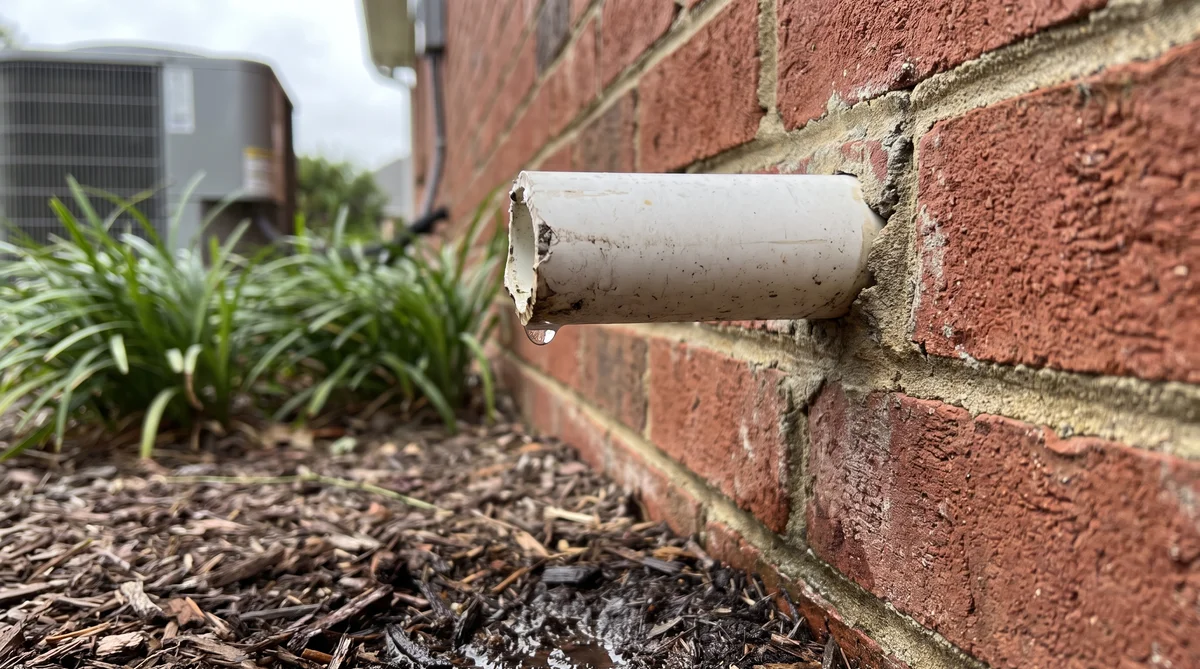
If it is bone dry after the system has been running for twenty or thirty minutes on a humid day, the water your evaporator coil is pulling out of the air is going somewhere else. That is not a maybe. The North Carolina Department of Insurance, Office of the State Fire Marshal, published a formal interpretation of the state mechanical code that says exactly this: “The absence of dripping from the primary drain line is an indication of it being plugged.” When the people who write and interpret the code use that as a diagnostic, you can trust it.
The reason this check matters so much is timing. A drain line does not fail all at once. It narrows for weeks, drains slower and slower, and then one afternoon the pan backs up. If you catch the dry-stub stage, you are looking at a maintenance visit. If you catch it after the ceiling stains, you are looking at a restoration contractor. Everything else in this article is downstream of that one observation.
What the Condensate Drain Line Actually Does
The drain line carries away the water your air conditioner pulls out of your indoor air. It is a plumbing system hiding inside a mechanical one, and it is entirely gravity fed in most Triangle homes.
Here is the physics in one sentence, and Daikin states it cleanly: “When warm air passes over the evaporator coil inside your AC unit, the temperature drop causes moisture in the air to condense into water.” That water beads on the cold coil, runs down into a sloped pan underneath it, and exits through a PVC line that runs to the outside of your house. Nothing pumps it in a standard install. It moves because the pipe is pitched downhill.
Two details from the North Carolina Mechanical Code are worth knowing as a homeowner, because they explain what you are looking at. First, that primary line is required to be “not less than 3/4-inch (19.1 mm) internal diameter” and it “shall not decrease in size from the drain pan connection to the place of condensate disposal.” Second, condensate “shall be conveyed from the drain pan outlet to an approved place of disposal.” Three quarters of an inch is not much pipe, which is precisely why a summer’s worth of sludge closes it.
One thing worth clearing up before you start diagnosing: a clog does not make your air conditioner less efficient. Trane is direct about it. “If your AC drain line is clogged the issue is water leaking and potentially causing water damage to the home, the efficiency of the system is not affected.” The damage from this failure is to your house, not to your power bill.
The Six Signs of a Clogged AC Drain Line
The six signs are a dry drain stub, water near the indoor unit, a musty smell, water stains on a ceiling, a system that shuts off by itself, and gurgling from the air handler. Most homeowners notice number four or number five first, which is unfortunate, because those are the late ones.
The manufacturers largely agree on the list. Trane names “Puddles of water near the indoor unit,” “Water damage near the indoor unit, including rust on the bottom of the unit,” and a “Musty smell when the AC is running.” Carrier adds “Standing water: Puddles forming near the indoor unit” and “System shutdown: The AC turns off or refuses to turn on (often triggered by a safety float switch).” Daikin is the one that calls out the sound: “Dripping or gurgling sounds coming from the unit.”
The smell deserves its own note because people misread it constantly. Lennox describes it as “A musty odor from the AC vents or near the unit could mean there is standing water and mold is growing.” That is not the ductwork and it is not the filter. Standing water in a dark pan is a nearly ideal growth environment, which is exactly how Daikin describes the inside of a drain line: “The inside of a drain line provides a dark, damp environment that is ideal for mould.”
Two of those symptoms overlap with problems that have nothing to do with the drain. A system that will not start has eight or nine plausible causes, which is why we wrote a separate walkthrough on what to check when your AC will not turn on. A system that runs but does not cool is a different branch again, covered in why your AC runs but does not cool. Check the drain stub first anyway. It takes ten seconds and it rules out the cheapest cause before you start chasing the expensive ones.
Why Your AC Shut Itself Off, and Why That Is Good News
Your air conditioner shut off because a float switch did its job. When water rises in the drain pan, that switch opens the control circuit and stops the system before the pan spills. Nothing is broken. A safety device chose a hot house over a ruined ceiling.
Both Carrier and Trane describe the same mechanism. Carrier: “In many cases, the system may also stop cooling because a safety switch shuts the unit down when the drain pan fills with water.” Trane is more specific about the hardware. “Some homes may have a drain pan condensate safety switch that will automatically shut down the indoor unit if the water level inside the drain pan begins to rise, to help prevent water damage from a clog.”
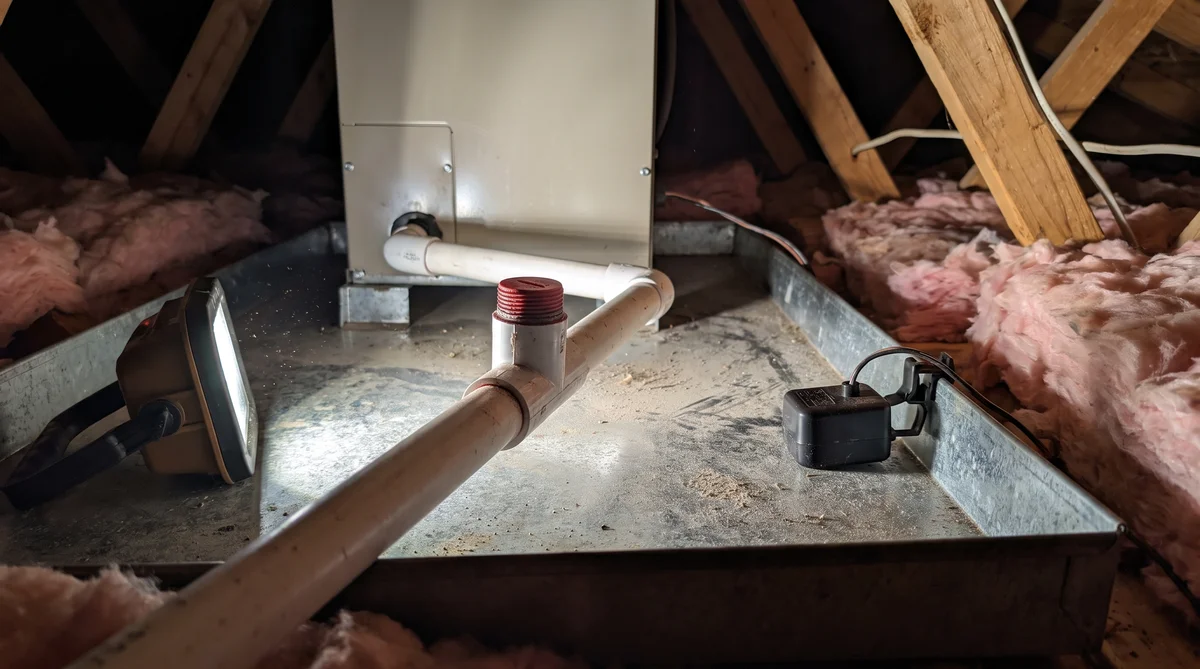
I bring this up because of what people do next. A homeowner finds the little switch, sees that bypassing it makes the system run again, and bypasses it. I have walked into houses in Cary and Apex where someone jumped a float switch in July and by the time I got there in August the ceiling drywall was on the floor. The switch was the only thing standing between a $150 service call and a five-figure claim.
Trane also flags the other half of that sentence, which matters if your house is older: “But, if your system doesn’t have this safety switch,” nothing stops the overflow. Plenty of Triangle homes built before the switch became standard practice have a primary pan, a drain line, and no electrical safety at all. If you do not know which you have, that is worth finding out during your next HVAC inspection.
What North Carolina’s Code Requires Behind Your Ceiling
North Carolina requires a second layer of protection any time an overflowing condensate pan could damage the building, and the code gives installers four acceptable ways to provide it. Knowing which one you have tells you what will happen the day your line plugs.
Section 307.2.3 of the North Carolina Mechanical Code lists the options. You get an auxiliary drain pan with its own separate line running to “a conspicuous point of disposal,” or an overflow line tapped into the primary pan above the primary drain and routed to the same kind of conspicuous spot, or an auxiliary pan fitted with a water-level detection device “conforming to UL 508 that will shut off the equipment served prior to overflow,” or a water-level detection device alone that “will shut off the equipment served in the event that the primary drain is blocked.”
That second-pipe behavior confuses people every summer. If you suddenly have water dripping over a bedroom window, nothing is leaking. Your secondary drain is doing exactly what the code intended, telling you in the most visible way available that the primary line is blocked. Lennox describes the same arrangement, noting that a secondary drain line typically discharges above a door or window as a failsafe.
The state’s own guidance also explains why nobody is required to protect a crawl space the same way an attic is. The Office of the State Fire Marshal wrote that “The intent of Section 307.2.3 is to prevent damage to the building or its contents from overflow of the primary drain pan or blockage of the condensate drain piping.” Water on a crawl space floor is not what that section is about. Water on your kitchen ceiling is.
Why Raleigh Drain Lines Clog Faster Than the National Guides Assume
Triangle drain lines clog faster because they run wetter, longer, and dirtier than the average American system. Three local conditions stack up, and none of them are in the generic advice you find online.
The first is simple runtime. A Raleigh air conditioner runs a long cooling season under high humidity, so it condenses water for far more hours per year than a system in a dry or short-summer climate. Every one of those hours moves a little more dust into the pan. The second is what is in the air. The North Carolina Department of Environmental Quality runs the state’s only pollen sampler on Reedy Creek Road here in Raleigh, and the agency operates it “annually from late-February through mid-November.” That is nine months of tree, grass and weed pollen loading filters and coils in the same window your system is condensing water.
The third is where the equipment lives. A large share of Triangle homes put the air handler in the attic, which puts the pan, the line and the trap in an unconditioned space that runs brutally hot in July. Trane‘s list of causes is worth quoting for the last item alone: “A clog may also be due to general dust, dirt, dander, or debris entering the drain line. It could even be caused by a spider building a web!” That is not a joke on their part. An exterior stub sitting at mulch level is an inviting piece of real estate.
Carrier describes the mechanism that ties it together, dust and airborne particles mixing with the moisture pulled out of the air to create sludge that travels into the line. That sludge is the thing you are actually fighting, and it is why filter discipline matters as much as flushing does. A filter that is doing its job is keeping pollen out of the pan, not just out of your lungs, and a filter that has given up is quietly feeding the clog. It is also why the same house can go five clean summers and then plug twice in one season after a heavy spring, without anything about the equipment having changed.
When Drain-Line Calls Spike in the Triangle
These calls are almost perfectly seasonal, and the swing is steeper than for any other AC problem we track. National search demand for this exact problem runs eleven times higher at the July peak than at the January floor.
The shape tells you something practical. Demand nearly doubles between April and May, from 2,900 to 5,400, well before the worst heat arrives. That is the month the systems that sat idle all winter start running long cycles again and push a spring’s worth of accumulated debris into a line that has been sitting dry. If you are going to flush the line once a year, late March or early April is the month that pays.
How to Clear a Clogged AC Drain Line Yourself
You can clear most partial clogs in about twenty minutes with a wet/dry vacuum and a cup of distilled vinegar. Kill the power first, work from the outside end, and stop if the water does not move.
1. Turn the system off at the thermostat and at the breaker. Lennox puts the reasoning in one line: “To ensure safety; working with water and electricity can be dangerous.” You are about to introduce liquid near an electrical appliance. Turn it off at the panel, not just at the wall.
2. Find both ends of the line. Carrier‘s instruction is to “Locate the drain line access point (usually near the indoor unit) and the drain line exit (outdoors).” Indoors you are looking for a capped PVC tee on the line coming off the air handler. Outdoors you are looking for the stub you already checked.
3. Deal with any standing water in the pan. A wet vac or an old towel both work. If the pan is full, get it empty before you start pushing anything through the line, or you will simply move the mess.
4. Pull the clog from the outside end. This is the step that actually works. Carrier: “Use a wet/dry vacuum to suction out the clog from the outdoor drain line exit.” AC Service Tech describes the same approach for technicians: “Simply connect the wet/dry vacuum hose to the end of the drain line outside and turn on the vacuum.” Seal around the pipe with your hand or a rag, run the vacuum two or three minutes, and check what comes out. Trane sets the expectation for what success looks like: the technician “should pull out a lump of, essentially, gunk that was causing the clog.”
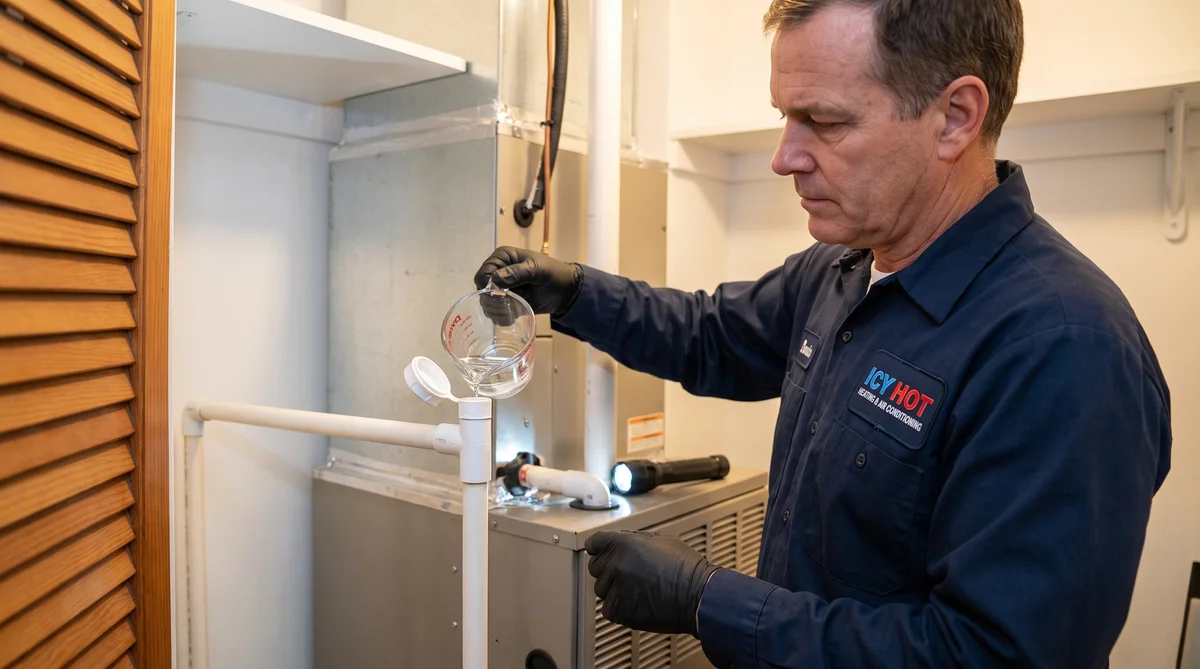
5. Flush from the indoor access point. Lennox: “Pour diluted vinegar or an approved cleaner designed for use on PVC to further break down any clogs and let it sit for 30 minutes or longer. Then, flush the line with water.” Carrier’s version is to “pour a cup of distilled vinegar into the indoor access point to dissolve buildup.” Both are describing the same thing. Give it the full half hour.
6. Clean the pan, and put the water back in the trap. This last part is the step nearly every homeowner guide leaves out, and it causes repeat clogs. The trap on a condensate line is a water seal. If you vacuum it dry, the blower can pull air straight through the drain, which dries the line out and pulls debris into it. AC Service Tech’s instruction to technicians is emphatic: “Always add water back into the trap when complete!” Pour a cup of clean water into the access tee after your vinegar flush and replace the cap.
Restore power, run the system for twenty minutes, and go look at the outside stub again. Dripping means you won. Nothing means the blockage is still in there, and at that point you have learned something useful rather than wasted the afternoon.
Vinegar, Bleach, or Neither? What the Manufacturers Actually Say
Every major manufacturer that gives homeowners a specific chemical names vinegar or a PVC-approved cleaner. Only one of the four mentions bleach at all, and it mentions it to lower expectations rather than to recommend it.
This question comes up on every one of these calls, and the honest answer is that the published guidance is narrower than the internet suggests. Lennox says diluted vinegar or “an approved cleaner designed for use on PVC.” Trane tells homeowners to ask their technician to show them how to “pour a cup of distilled vinegar down the AC drain line to help prevent clogs,” and separately mentions traditional PVC pipe cleaner. Carrier says to use “a cup of distilled vinegar” or a specialized PVC-safe cleaner.
Carrier‘s caveat is the useful part, and it applies to vinegar just as much as to bleach. “While homeowners sometimes use vinegar or bleach in the drain line, those products may not fully prevent blockages because many clogs are caused by debris or buildup that is not organic material.” In plain terms: a chemical dissolves slime. It does nothing to a wad of insulation, a dirt plug, or a spider web. That is why the vacuum step above comes before the vinegar step, not after it.
What It Costs in Raleigh, and What Waiting Costs
Clearing a condensate line is one of the least expensive things a technician does. Repairing what happens when nobody clears it is one of the most expensive things that can happen to a house.
In my experience a straightforward drain clear on a Raleigh house is a single service visit, roughly an hour on site including diagnosis. HomeAdvisor‘s national labor figures put that hour in context: air conditioner technicians “usually charge $75 to $150 per hour” during regular business hours, and “For emergency after-hours or holiday visits, you can expect to pay between $160 and $250 per hour.” Which side of that you land on is mostly a question of whether you called in June or at 9pm on a Saturday in August.
If the pan itself has rusted through, which is common on older attic installs, HomeAdvisor puts a replacement drain pan at “around $200 to $600.” For reference, the same guide reports that most homeowners pay $417 in AC repair costs overall, “typically ranging from $172 and $664.” A drain clear sits at the bottom of that band.
Now the other column. HomeAdvisor‘s water damage restoration data shows that “On average, water damage restoration costs homeowners $3,868,” with most spending between $1,383 and $6,369 in 2025. The same guide says you “can expect to pay between $3.50 and $7.50 per square foot, depending on the water category,” and puts drywall repair at $300 to $850 and ceiling repair at $450 to $1,600. A ceiling under an attic air handler is not a small area.
The arithmetic is not subtle. Even comparing the cheapest restoration job to the most expensive regular-hours service hour, $1,383 against $150, the damage costs more than nine times what preventing it would have. Against a $75 service hour it is more than eighteen times. Our full breakdown of local pricing lives on the AC repair cost guide for Raleigh if you want the wider picture, and AC repair covers what a visit includes.
When to Stop and Call a Licensed Pro
Stop when the vacuum does not move the clog, when you cannot reach the blockage, when the pan is rusted, when the same line clogs twice in a season, or when there is already mold on drywall. Those five conditions all mean the problem is not the one you can reach.
Lennox lists the same triggers from the manufacturer side, including “Recurring Clogs: If you are needing to clean the drain line often, there may be a deeper problem” and “Unreachable Clog Location: Accessing the blog may require special tools if the clog is high up in the drain line.” A repeat clog usually means a dirty evaporator coil feeding sludge into the pan faster than the line can carry it, and that is a coil job, not a drain job.
The mold threshold is not something I made up. EPA‘s homeowner guidance says that “If the moldy area is less than about 10 square feet (less than roughly a 3 ft. by 3 ft. patch), in most cases, you can handle the job yourself.” Above that, it is a remediation job. EPA also gives you the clock that matters after a leak: “If wet or damp materials or areas are dried 24-48 hours after a leak or spill happens, in most cases mold will not grow.” That window is why a Saturday overflow is worth an emergency call rather than a Monday appointment.
How to Keep It From Clogging Again
Three habits prevent essentially all of these calls: stay ahead of the filter, flush the line a few times a year, and get the coil and pan cleaned professionally once a season. None of it is expensive and none of it takes long.
Start with the filter, because it is upstream of everything else. ENERGY STAR‘s maintenance checklist tells homeowners to “Inspect, clean, or change air filters once a month in your central air conditioner, furnace, and/or heat pump.” Lennox‘s own interval is to “Change the air filters regularly (every three months).” Those are not in conflict. Look at it monthly, replace it when it is loaded, and in a Raleigh spring that will be more often than the box on the filter claims.
Then the line itself. Lennox recommends that “you flush the drain line every few months,” and Daikin says essentially the same thing: “Checking and cleaning the drain line every few months is sufficient. Systems that run constantly may require more frequent attention.” That last sentence describes a Raleigh July precisely. A cup of distilled vinegar in the access tee, thirty minutes, then a rinse, is the whole procedure.
Finally, the part you should not do yourself. ENERGY STAR puts the drain on its homeowner checklist for a reason: “Check and inspect the condensate drain in your central air conditioner, furnace and/or heat pump (when in cooling mode). A plugged drain can cause water damage in the house and affect indoor humidity levels.” Trane‘s advice is simply to “Schedule professional air conditioner maintenance every spring.” That visit is where the coil gets cleaned, the pan gets treated, the float switch gets tested, and the line gets blown clear before the season loads it up. It is what our maintenance packages and AC maintenance visits are built around, and the full walkthrough is in our spring AC tune-up checklist.
One more reason to keep the drain working: it is part of how your house manages humidity. EPA recommends you “keep indoor humidity below 60 percent (ideally between 30 and 50 percent) relative humidity,” and a system backing water up into its own pan is working against you on that. If humidity is a running battle in your house, our humidity guide and whole-home dehumidifiers go deeper.
Frequently Asked Questions
The Bottom Line for Raleigh Homeowners
Go look at the pipe. That is the whole recommendation. On the next humid afternoon with the system running, walk out to the small white PVC stub near your outdoor unit and see whether it is dripping. If it is, your condensate system is doing its job and you can stop thinking about it until your next tune-up. If it is dry, you have found a problem while it is still a twenty-minute problem.
Almost every expensive version of this failure started as a dry pipe that nobody looked at. The float switch, the secondary pan, the overflow line over the window: all of those exist because the industry knows this line plugs, and North Carolina’s code requires one of them for exactly that reason. They are backstops. The pipe outside is the early warning.
If the line will not clear, if it clogs again a month later, or if you are already looking at a stain on a ceiling, that is our call to take. Icy Hot has been working on Triangle systems since 2008, we are NATE-certified and licensed in North Carolina (License #L.34356), and a drain clear is one of the shortest visits we run. Reach us at (919) 673-7667 or through our contact page, and if you would rather never think about this again, an annual tune-up handles it before the season does.
Written by Frankie Asfari, owner of Icy Hot Heating & Air Conditioning in Raleigh, NC. NATE-certified, NC HVAC License #L.34356.