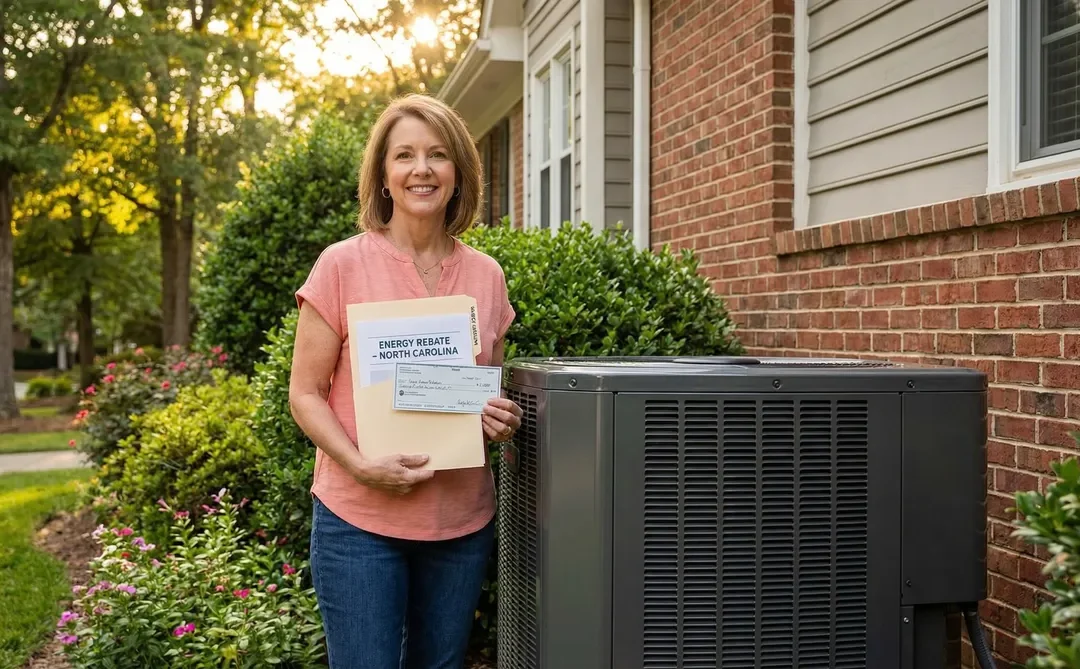
North Carolina just made it possible for Raleigh homeowners to get a new heat pump for free, or close to it. The state allocated $208 million through its Energy Saver NC program, which expanded to all 100 counties in February 2026 (NC DEQ). Meanwhile, the federal 25C tax credit that used to cover up to $2, 000 for heat pumps? Gone as of December 31, 2025.
But here’s the good news: state and utility incentives are bigger than the federal credit ever was. If you’re thinking about replacing your HVAC system or upgrading to a heat pump, the money available right now is historic. This guide covers every NC HVAC rebate and incentive available in 2026, who’s eligible, and exactly how to stack them.
TL;DR: North Carolina allocated $208 million for Energy Saver NC rebates, up to $8, 000 for a heat pump (HEAR) or $16, 000 for whole-home upgrades (HOMES). Duke Energy Smart Saver adds $350 to $900 for a qualifying heat pump. The federal 25C tax credit expired Dec 31, 2025. For a Raleigh homeowner earning under 80% AMI (~$105, 850 for a family of four), state + utility incentives can cover the entire cost of a heat pump installation. Apply at energysavernc.org, funding is first-come, first-served.
What HVAC Rebates Are Available in North Carolina in 2026?
Three tiers of savings exist for Raleigh homeowners upgrading HVAC equipment in 2026: the Energy Saver NC state program (the largest), Duke Energy Smart Saver (available to all Duke customers), and the now-expired federal 25C tax credit. North Carolina was the first state in the country to simultaneously launch both the HEAR and HOMES rebate tracks (NC DEQ, 2026).
Here’s a quick overview of what’s still on the table:
| Program | Max Rebate | Who Qualifies | Status |
|---|---|---|---|
| Energy Saver NC (HEAR) | $8, 000 (heat pump) | Income <150% AMI | Active |
| Energy Saver NC (HOMES) | $16, 000 (whole-home) | Income <150% AMI | Active |
| Duke Energy Smart Saver | $350–$900 (heat pump) | All Duke Energy customers | Active |
| Federal 25C Tax Credit | Was up to $2, 000 | N/A | Expired 12/31/25 |
North Carolina allocated $208 million in IRA-funded rebates through its Energy Saver NC program, available in all 100 counties as of February 2026 (NC DEQ). The state was the first to simultaneously launch both the HEAR and HOMES rebate tracks, giving homeowners two pathways to significant savings on energy-efficient upgrades.
How Much Can You Get for a Heat Pump Through Energy Saver NC?
Up to $8, 000 for a heat pump through the HEAR (Home Electrification and Appliance Rebates) track, or up to $16, 000 for whole-home energy upgrades through the HOMES (Home Owner Managing Energy Savings) track (NC DEQ). These aren’t tax credits you wait a year to claim, they’re point-of-sale discounts applied directly to your project cost. Curious what a full system replacement costs before rebates? Our 2026 guide breaks it down by size.
The HEAR track covers specific equipment upgrades. Here’s what each category is worth:
The HOMES track works differently. Instead of rebating specific equipment, it rewards measurable energy reduction. An energy assessor measures your home’s performance before and after upgrades. Achieve at least 20% energy reduction and you qualify, up to $4, 000 for moderate-income or $16, 000 for low-income households at 35%+ reduction. HOMES can include HVAC installation, duct sealing, insulation, and indoor air quality improvements all under one project.
The HEAR track provides up to $8, 000 for an ENERGY STAR-certified electric heat pump and up to $14, 000 per household when combined with electrical panel, insulation, and appliance upgrades (NC DEQ). Both tracks are point-of-sale rebates, meaning savings are applied at checkout, not claimed on your taxes months later.
Do You Qualify? Wake County Income Limits Explained
Most Raleigh homeowners do. Energy Saver NC covers Wake County households earning up to 150% of Area Median Income (AMI), which is $198, 450 for a family of four in 2026 (Energy Saver NC AMI Income Summary, June 2026). For context, Wake County’s median household income is about $107, 083 (FRED/U.S. Census Bureau), comfortably under that ceiling. If your household earns less than the 150% limit, you’re eligible for at least 50% coverage on qualifying upgrades.
Here’s what those income thresholds actually look like in real dollars for Wake County:
| Income Tier | 1 Person | 2 People | 3 People | 4 People | Rebate Level |
|---|---|---|---|---|---|
| <80% AMI | ~$74, 100 | ~$84, 700 | ~$95, 300 | ~$105, 850 | 100% of costs |
| 80–150% AMI | $74, 100–$138, 950 | $84, 700–$158, 800 | $95, 300–$178, 650 | $105, 850–$198, 450 | 50% of costs |
| >150% AMI | Above $138, 950 | Above $158, 800 | Above $178, 650 | Above $198, 450 | Not eligible for state |
Wake County limits, 2026 program year. Source: Energy Saver NC AMI Income Summary, June 2026.
Don’t count yourself out too quickly. Even at the 80–150% AMI tier, you’d get 50% of project costs covered, that’s up to $4, 000 toward a heat pump. And if you earn above 150% AMI? You’re still eligible for Duke Energy’s Smart Saver incentive (more on that below). The income thresholds are based on gross household income, not individual salary.
For Wake County, households earning under 80% of Area Median Income, approximately $105, 850 for a family of four, qualify for 100% coverage of eligible Energy Saver NC rebate costs (Energy Saver NC AMI Income Summary, June 2026). That means the full $8, 000 HEAR heat pump rebate with no out-of-pocket share.
Two eligibility rules catch people out. Energy Saver NC is currently open to single-family homes only, including houses, townhouses, duplexes, and mobile homes. If you live in an apartment or a multi-floor condo you can join the waitlist, but the program is not serving multifamily buildings yet. And HEAR will not fund replacing an existing heat pump, so the rebate is aimed at homes upgrading from something else.
What Happened to the Federal Heat Pump Tax Credit?
The Section 25C Energy Efficient Home Improvement Credit was terminated effective December 31, 2025. The “One Big Beautiful Bill, ” signed July 4, 2025, eliminated it entirely (IRS). There is no federal HVAC tax credit for equipment installed in 2026. If you see a website still advertising a $2, 000 federal heat pump credit, that information is outdated.
Here’s what the 25C credit used to cover before it ended:
- Heat pumps: up to $2, 000
- Central air conditioning: up to $600
- Gas furnaces (95%+ AFUE): up to $600
- Annual cap: $3, 200 across all categories
The 25D Residential Clean Energy Credit (which covered 30% of geothermal heat pump costs with no cap) was also terminated on the same date. Will these credits come back? There’s no legislation pending to reinstate them as of February 2026.
The federal Section 25C tax credit, which provided up to $2, 000 for heat pumps, was terminated effective December 31, 2025 by the One Big Beautiful Bill (IRS). North Carolina’s state rebate programs now represent the primary financial incentive for HVAC upgrades in Raleigh.
Does Duke Energy Offer HVAC Rebates in Raleigh?
Yes. Duke Energy’s Smart Saver program pays $350 to $900 for a qualifying air-source heat pump and $200 to $500 for central AC. The exact amount depends on the equipment’s SEER2 rating and on whether your old system had already failed. All equipment must be AHRI certified with an ECM blower motor and installed by a participating Smart Saver contractor. These amounts apply to projects completed after August 1, 2025 (Duke Energy).
Additional Duke Energy incentives available in 2026:
- Smart thermostat: $125, when purchased and installed alongside qualifying HVAC equipment by a participating contractor
- Duct sealing: $350
- Attic insulation and air sealing: $700
- Heat pump water heater: $500
- Electric furnace, baseboard, or radiant heat converted to a heat pump: $1, 500, Duke’s largest standard residential conversion rebate
- Weatherization: free energy-efficiency work for income-qualified households, meaning income below 200% of Federal Poverty Guidelines or enrollment in SNAP, WIC, or LIHEAP. Duke does not publish a dollar cap; the work is delivered through NC Community Action agencies
The best part? Duke Energy incentives stack with Energy Saver NC. They come from different funding sources, so claiming both is allowed and encouraged. You don’t need to choose one or the other.
Smart Saver is open to Duke Energy Progress and Duke Energy Carolinas customers in Raleigh, and the current rebate schedule took effect for projects completed after August 1, 2025 (Duke Energy). Rebates are paid as a prepaid Mastercard once your contractor submits the application. The utility credit stacks with Energy Saver NC state funding since the two programs use separate funding sources.
How to Stack NC HVAC Rebates for Maximum Savings
Combining Energy Saver NC with Duke Energy Smart Saver puts up to $8, 900 toward a single heat pump installation, meaning up to $8, 000 from the HEAR track plus up to $900 from Duke. A home converting electric furnace, baseboard, or radiant heat to a heat pump can claim Duke’s $1, 500 conversion rebate instead of the standard equipment rebate, which lifts the combined total to $9, 500.
Duke’s heat pump rebate is not a single flat number. It rises with the efficiency of the equipment, and it is higher when the old system is replaced before its compressor, heat exchanger, or refrigerant lines fail:
For Raleigh households earning under 80% of Area Median Income, the HEAR track covers 100% of eligible project costs up to the $8, 000 heat pump cap, so a qualifying system can be installed with no out-of-pocket share. Duke’s Smart Saver rebate is separate and arrives afterward as a prepaid Mastercard, so it is money back rather than money off the invoice.
Households in the 80 to 150% AMI band get 50% of project costs from HEAR and the same Duke rebate on top, which is why the two programs are worth applying for together rather than picking one.
How to Apply for Energy Saver NC Rebates (Step by Step)
As of February 2026, the Energy Saver NC program has received 4, 818 applications with 1, 709 approved (WUNC/NC DEQ). Funding is first-come, first-served, the $208 million runs through 2031 or until it’s gone. Here’s how to claim your savings:
Step 1: Check your income eligibility. Visit energysavernc.org and use the eligibility screener. You’ll need your household size and gross annual income. Refer to the Wake County table above for approximate thresholds.
Step 2: Find an approved contractor. Energy Saver NC requires you to work with an approved contractor from their directory at energysavernc.org. Not every HVAC company is enrolled yet. As a Raleigh NATE-certified contractor, Icy Hot can walk you through the process, schedule a consultation to get started.
Step 3: Get a home energy assessment (HOMES track). For the HOMES whole-home rebate, a certified energy assessor evaluates your home before and after upgrades. The initial assessment is free for qualifying households.
Step 4: Choose qualifying equipment. For the HEAR track, your heat pump must be ENERGY STAR-certified. For the HOMES track, the full package of upgrades must achieve at least 20% modeled energy reduction.
Step 5: Submit your application. Apply online at energysavernc.org, by phone at (866) 998-8555, or by mail. You’ll need proof of income, property ownership, and contractor documentation.
Step 6: Get approval before work begins. Wait for your application to be approved before starting the installation. The rebate is a point-of-sale discount, your contractor applies it directly to your invoice.
Step 7: Complete installation and submit documentation. After the work is done, your contractor submits the final paperwork. The discount has already been applied to what you paid.
What Other Equipment Qualifies for NC Rebates?
Heat pumps get the most attention, and the biggest incentive, but Energy Saver NC covers a range of home electrification upgrades. If you are still deciding whether a heat pump is right for your home, compare a heat pump vs. central air system first. If you’re planning multiple improvements, the HEAR track lets you stack equipment credits up to the $14, 000 household maximum.
Beyond the heat pump, here’s what else qualifies:
- Electrical panel upgrade: $4, 000, Often required when switching from gas to electric systems. Many older Raleigh homes have 100-amp or 150-amp panels that can’t support a heat pump plus water heater.
- Electrical wiring: $2, 500, For homes that need new circuits to support upgraded equipment.
- Heat pump water heater: $1, 750, Replaces gas or electric resistance water heaters. Uses 3–4x less energy than conventional models.
- Insulation: $1, 600, Attic, wall, and crawl space insulation that improves your new system’s efficiency.
- Electric dryer: $840, Heat pump dryers use 28% less energy than conventional models (ENERGY STAR).
- Electric range/stove: $840, Replaces gas cooking equipment as part of home electrification.
A homeowner switching from a gas furnace to a heat pump, adding a ventilation system, and upgrading their electrical panel could receive $8, 000 + $4, 000 = $12, 000 in HEAR credits alone. Add Duke Energy’s heat pump rebate of up to $900 and that’s up to $12, 900 off the project.
Timing note: that gas-to-electric example, and the rebates above for replacing a gas range, gas dryer, or gas water heater, all count as fuel switching. Under the DOE guidance described at the top of this page, those applications need to be submitted before August 31, 2026. Homes replacing electric strip heat or an older electric system are not affected by that change.
Frequently Asked Questions
Don’t Leave Money on the Table
Here’s what to remember:
- Energy Saver NC (HEAR): Up to $8, 000 for a heat pump, $14, 000 per household
- Energy Saver NC (HOMES): Up to $16, 000 for whole-home upgrades
- Duke Energy Smart Saver: $200–$900 depending on equipment and whether the old system had failed
- Federal 25C tax credit: Expired December 31, 2025, no longer available
- Low-income Raleigh homeowners: Can get a heat pump installed for $0 out of pocket
- Apply now: $208 million is first-come, first-served through 2031
Not sure if you’re eligible? Call Icy Hot at (919) 673-7667 or schedule a free consultation. As Raleigh’s NATE-certified HVAC contractors, we help homeowners navigate incentive paperwork every week. We’ll walk you through eligibility, recommend qualifying equipment backed by our service guarantees, and make sure you’re getting every dollar available.
The NC Energy Saver program estimates homeowners save an average of $945 per year on energy costs after upgrades (NC DEQ). That’s savings that start the day your new system turns on. Once your upgraded equipment is running, protect your investment with a maintenance package, regular tune-ups keep your system at peak efficiency and preserve manufacturer warranties.