A coupon shows up in the mail every October in Raleigh. Whole house air duct cleaning, unlimited vents, ninety nine dollars. Sometimes it is a door hanger, sometimes it is a robocall, and every few years it is a van parked in a Harris Teeter lot with a before-and-after photo board. The photos are always real. Somebody’s ducts really did look like that. The question is whether yours do, and whether paying someone to clean them will change anything you can measure. Put plainly: is duct cleaning worth it in a Raleigh house, or is it the HVAC version of undercoating?
I have been in Raleigh crawl spaces for eighteen years. Here is the honest answer, and it will cost me some work to say it out loud: most homes in Wake County do not need their air ducts cleaned. That conclusion is mine, but it follows directly from a federal position published in 1997 and never revised. There are three specific conditions that make duct cleaning the right call, all three are visible, and if a company cannot show you one of them with a flashlight, you are being sold a service rather than a solution.
That is not a contrarian take. It is the position of the U.S. Environmental Protection Agency, and it has not moved in twenty nine years. What almost nobody mentions is that the only federal field study of residential duct cleaning I can find was run here, in Research Triangle Park, in nine North Carolina houses, in the summer of 1996. Its report came out two months after the consumer guidance, so I cannot tell you the guidance was built on it, but it remains the closest thing to a controlled test anyone has run on this question. Six of the eight occupied homes in that study had their air handler and most of their ductwork in a crawl space, which is to say they were ordinary Triangle houses. The researchers measured everything. What they found, and what they could not find, is the most useful thing any Raleigh homeowner can know about this subject, and I have never once seen a duct cleaning sales page cite it.
So this is the version I would give a neighbor. It is built from that EPA field study, from EPA’s consumer guidance, from the duct cleaning industry’s own homeowner flyer, from EPA ENERGY STAR’s savings methodology, from Bureau of Labor Statistics price data, from the National Weather Service record at RDU and from HomeAdvisor’s national pricing data, which is a home-services marketplace reporting what its own customers paid rather than an independent survey. No competitor blogs, and no numbers I cannot show you the source for.
TL;DR: Duct cleaning is worth it under three conditions and almost never otherwise. EPA’s position is that it “has never been shown to actually prevent health problems” and that ducts should be cleaned “only as needed,” not on a schedule. The three conditions are substantial visible mold, vermin infestation, and ducts clogged badly enough that debris actually blows out of your registers. In the federal field study run in nine Research Triangle Park homes, cleaning measurably improved supply airflow at eight of the nine houses, between 4 and 32 percent, though partly from leak repairs made at the same time, while the effect on the air people were breathing could not be distinguished from ordinary background variation. A market-rate cleaning in 2026 runs $271 to $509, averaging $389. A $99 whole house special cannot pay for a scope that opens, cleans, inspects and verifies every component, and the industry’s own trade association tells homeowners to avoid those ads. In a Raleigh house, the money almost always does more good in duct sealing and insulation than in duct cleaning. Want someone to look first and tell you honestly? Call (919) 673-7667.
Is Duct Cleaning Worth It? The Short Answer
It is worth it when one of three visible conditions exists, and EPA explicitly does not recommend it as routine maintenance. That is the whole decision, and it is written in plain language in a federal consumer document that anyone can read in ten minutes.
EPA’s guidance says you should consider having your air ducts cleaned if there is “substantial visible mold growth inside hard surface (e.g., sheet metal) ducts or on other components of your heating and cooling system,” if the “ducts are infested with vermin, e.g. (rodents or insects),” or if the “ducts are clogged with excessive amounts of dust and debris and/or particles are actually released into the home from your supply registers.”
Notice what those three have in common. Every one of them is something a person can see. Not infer, not test for with a petri dish, not deduce from your allergy symptoms. See. EPA is specific about this too: “Many sections of your heating and cooling system may not be accessible for a visible inspection, so ask the service provider to show you any mold they say exists.”
And then the sentence that the entire marketing category is built on top of and never quotes: “EPA does not recommend that air ducts be cleaned except on an as-needed basis because of the continuing uncertainty about the benefits of duct cleaning under most circumstances.”
One more line worth keeping in your pocket, because it comes up on doorsteps. EPA says: “You should also be wary of duct cleaners who claim to be certified by EPA. Note: EPA neither establishes duct cleaning standards nor certifies, endorses, or approves duct cleaning companies.” If anybody tells you they are EPA certified for duct cleaning, that company has just told you something true about itself and nothing true about EPA.
What the One Federal Field Study Actually Found
Cleaning moved airflow, which the researchers could measure, and left no detectable mark on the air in the house, which they tried hard to measure. Both halves of that sentence matter, and the second half is the one that gets left out.
The study is EPA-600/R-97-137, published December 1997 by EPA’s National Risk Management Research Laboratory in Research Triangle Park. Nine houses were cleaned by professional contractors representing the trade association, using “practices commonly used in the HVAC system cleaning industry,” with no proprietary methods and no chemical biocides. Eight were owner-occupied homes in the Research Triangle Park area, cleaned during the summer of 1996. The ninth was EPA’s own Indoor Air Quality Test House. The houses ran 1,500 to 2,000 square feet. As the report puts it, “The AHU and most of the ductwork were located in a crawl space under the house at six of the eight occupied field study houses.” If you own a 1970s or 1980s ranch in Raleigh, that is a description of your house.
It is worth pausing on how small that evidence base is. One federally funded field study, nine houses, cleaned thirty years ago, is the entire field-evidence base under a service category that is sold door to door and by mail across the country every year. The authors knew it, and said so: because of the limited scope, “the statistical significance of the results could not be determined.” They recommended further testing in a controlled facility. As far as I can find, that larger follow-up never happened. So when you read a confident claim about what duct cleaning does or does not accomplish, from anybody including me, the field evidence underneath it is these nine North Carolina houses.
The cleaning worked, in the narrow sense of removing dust. Pre-cleaning dust in the supply ductwork ranged from 1.48 to 26.03 grams per square meter across the nine houses, and the return ducts were worse, 5.26 to 35.11 grams per square meter. After cleaning, the mean residual across all 58 post-cleaning samples, supply and return together, was 0.43 grams per square meter with a standard deviation of 0.34. That is real source removal. Measured the trade association’s own way, with “the NADCA Standard 1992-01 vacuum method,” residual dust “ranged from 0.01 to 0.36 mg/100 cm2, meeting the NADCA criterion that residual dust must be less than 1.0 mg/100 cm2 to demonstrate that the cleaning was effective.” Worth noting that the two methods do not agree: the researchers’ own sampler collected more than the NADCA method did, and they suggested that a criterion based on it “should be higher, probably 5 mg/100 cm2.”
Then came the performance measurements, and this is the strongest pro-cleaning finding in the study. “Supply air flows increased between 4 to 32% at eight houses based on measurements at the floor registers and diffusers in the house.” Return air flows “increased 14 and 38% at two houses, but were not substantially different after cleaning at the other seven.” Engineering calculations on two of the houses estimated the cooling coil’s heat transfer improved by 14 percent at one and 23 percent at the other. Blower motor current went up. Return static pressure went up. All of that points one direction: the system breathed easier.
Read the caveat the authors attached, though, because it is the kind of thing a sales page omits. “Some of this increase in supply air flow rates may have been attributable to minor repairs of leaks in the ducts and at loose floor boots of supply registers.” The crews fixed leaks while they were under the house. Nobody separated the value of the vacuum from the value of the repair.
And now the part that decides the whole question. On the air people actually breathe, the study came up empty. “Indoor respirable (PM2.5) and inhalable (PM10) particle concentrations in air samples collected after HAC system cleaning were not substantially different from the samples collected prior to HAC system cleaning.” In fact the ratio of post-cleaning to pre-cleaning respirable particles indoors “was greater than 1.0 at seven of the nine houses,” which is to say the air tested marginally dustier afterward at most of them, tracking the outdoor air rather than the ducts. Laser particle counters found no substantial difference. Fungal bioaerosols: “with the exception of one house, there was no substantial difference between the pre-cleaning and post-cleaning bioaerosol samples.”
The authors are careful about why, and the honesty is worth quoting: changes “may not be measurable with the methods used in this study due to the presence of other sources of particles indoors, including outdoor sources and occupant activity.” That is not the same as proving cleaning does nothing. It means that in nine real houses, with real instruments, the effect on indoor air was smaller than the noise from cooking, walking around and the weather outside. Twenty nine years later, that is still the best field evidence anyone has.
Will Duct Cleaning Make My House Less Dusty?
Probably not, and the reason is physics rather than marketing. This is the single most common thing homeowners want from duct cleaning, so it deserves a direct answer.
EPA’s explanation is one sentence: “much of the dirt that may accumulate inside air ducts adheres to duct surfaces and does not necessarily enter the living space.” Dust inside a duct is mostly stuck to the duct. It is not circulating. The grey film on your return grille is dust the grille caught on its way in, which is the grille doing its job, and EPA says so directly: “It is normal for the return registers to get dusty as dust-laden air is pulled through the grate. This does not indicate that your air ducts are contaminated with heavy deposits of dust or debris; the registers can be easily vacuumed or removed and cleaned.”
The RTP study backs that up from the other direction. Researchers compared how much dust was sitting in each house’s ducts against how much particulate was in each house’s air before any cleaning happened, and found the comparison “did not show any substantial relationship.” The dirtiest ducts were not in the dustiest houses.
Where household dust actually comes from is the uncomfortable part. EPA: “Pollutants that enter the home both from outdoors and indoor activities such as cooking, cleaning, smoking, or just moving around can cause greater exposure to contaminants than dirty air ducts.” In the RTP houses, indoor particle levels tracked the outdoor air so closely that two homes across the street from each other rose on the same days after cleaning, “even though AHU operation patterns and occupant activities differed dramatically at the two houses.”
If dust is your complaint, the lever with evidence behind it is filtration and air sealing, not vacuuming the ducts. We walk through that in detail in our guide to improving indoor air quality in a Raleigh home, and EPA’s own prevention list starts with “use the highest efficiency air filter recommended by the manufacturer of your heating and cooling system” and “change filters regularly.”
What Does Duct Cleaning Cost in 2026? (And in Raleigh)
A real, whole-system cleaning runs about $271 to $509, averaging $389, and can reach $800 on a large or badly contaminated system. Those are national figures from HomeAdvisor’s cost data, last updated June 20, 2026. I have not found a published Raleigh-specific dataset, so treat the national numbers as the benchmark and my own observation as the local check: they match what I see on quotes around Wake County.
The useful thing is not the headline number, it is the structure underneath it, because that is how you tell a real quote from a hook. Pricing lands one of four ways: a flat fee plus a per-vent charge, straight per vent, a trip fee plus per vent, or by the square foot. Per vent runs $25 to $50 with $35 typical. By area it is $0.15 to $0.30 per square foot, which puts a 1,500 square foot house at $225 to $450. Labor itself is $90 to $125 an hour.
Then there are the add-ons, and these are where a $389 job turns into a four-figure one. Mold remediation is $1,100 to $3,400. Rodent extermination is $200 to $1,200 and has to happen before the cleaning, not after. Asbestos, if a tech finds it in old register boots or insulation, is $5 to $20 per square foot and a different contractor entirely. Dryer vent cleaning bundled in is about $100.
One honest note on counting vents, since that is what most quotes hinge on. A typical Raleigh three bedroom ranch has somewhere between 10 and 16 supply registers plus two or three returns. At $35 a vent that is $420 to $665 before anybody touches the air handler, which is why the per-vent number and the total so often disagree. Get the vent count written on the quote.
The $450 to $1,000 Figure Everyone Quotes Is From 1997
The price range you will see quoted today, including by the duct cleaning industry’s own homeowner flyer, was published in October 1997, and in today’s dollars it is two to five times what the work actually sells for. I have not seen anyone point this out, and it changes how you should read a quote.
EPA’s consumer document says duct cleaning services “typically but not always range in cost from $450 to $1,000 per heating and cooling system.” That document is EPA 402-K-97-002, dated October 1997. The duct cleaning industry’s own homeowner flyer still hands the figure to consumers as current: “According to the Environmental Protection Agency, properly cleaning an entire system in an average-sized home typically ranges in cost from $450 to $1,000.”
Run it through the consumer price index and the gap opens up. Bureau of Labor Statistics CPI-U was 161.6 in October 1997 and 336.940 in September 2026, a factor of 2.085. So EPA’s 1997 range is $938 to $2,085 in 2026 dollars. Against that, today’s actual average of $389 is 41 percent of the low end and 19 percent of the high end.
Two readings of that, and I think both are true. One: duct cleaning equipment and competition got a great deal cheaper over three decades, the way most services with a truck and a vacuum did. Two, and more importantly: the scope shrank. EPA’s 1997 price may well have bought more work than today’s price does. I cannot prove that from the two documents alone, since the consumer guidance never says what scope its range covered, but the next section puts a number on the gap worth thinking about.
Why a $99 Whole-House Special Cannot Cover the Job
Because $99 cannot pay for a scope that opens, cleans, inspects, re-cleans and then verifies every component, and the one federal study that documented the full scope needed sixteen to thirty worker-hours to do it. This is the one calculation I wish every homeowner in Raleigh would do before answering a duct cleaning call, and it needs nothing but two published numbers.
From the RTP study, which recorded what the crews actually did: “Cleaning of the HAC system in the study homes, which had floor areas of 1500 to 2000 ft2, was accomplished by two to three workers during an eight to ten hour period. This level of effort was required to adequately clean and inspect all supply and return grills, the air handler components, and the ductwork.” Two to three people, eight to ten hours. That is 16 to 30 worker-hours per house, and the report is explicit that it took “a combination of cleaning methods, including hand vacuuming, and routine inspection and re-cleaning, as required.”
Now take HomeAdvisor’s current labor rate of $90 to $125 per hour. Sixteen worker-hours at the low rate is $1,440. Thirty worker-hours at the high rate is $3,750. Two caveats I owe you, because this is my arithmetic rather than anybody’s published figure. That hourly rate is what a customer is billed, so it already carries equipment, travel, insurance and profit inside it. And I am treating it as a rate per worker rather than per crew; read it per crew and the band falls to roughly $720 to $1,250.
Set the real prices against that. Today’s $389 average buys roughly three to four worker-hours. A $99 special buys about one, and that is before anyone gets paid for driving to your house. You cannot open and reseal access ports, vacuum every branch, brush the trunk lines, pull and clean every register, service the blower housing, clean both faces of the coil and inspect the drain pan in one worker-hour. Nobody can. So one of three things is usually happening on a $99 job: a quick vacuum at the registers and nothing beyond arm’s reach, a sales visit where the real pitch starts once the van is in the driveway, or both.
In fairness to the trade, the 1996 protocol is a demanding benchmark and I should say why. The report notes that “truck-mounted systems were not used in the study” and that “no proprietary methods were used,” so those crews were working with hand vacuums and brushes. A modern truck-mounted negative-air rig plausibly does the same source removal in fewer hours, and I have no published figure telling me how many fewer. So narrow the claim with me: $99 is not impossible because cleaning a duct must take sixteen hours. It is impossible because $99 cannot cover a scope that opens, cleans, inspects, re-cleans and then verifies every component, which is what that study documented and what the trade’s own standard requires be verified at the end.
The duct cleaning industry says the same thing about those ads, more politely. Its homeowner flyer tells people directly: “Avoid advertisements for ‘$99 whole house specials’ and other sales gimmicks.” When the trade association that profits from duct cleaning is warning you off a price point, believe it.
There is a structural reason this persists in North Carolina, and homeowners should know it. EPA’s guidance lists the states that required air duct cleaners to hold special licenses: “As of 1996, the following states require air duct cleaners to hold special licenses: Arizona, Arkansas, California, Florida, Georgia, Michigan and Texas.” That list is thirty years old, and EPA notes other states may require them as well, so treat it as a snapshot rather than today’s law. North Carolina was not on it. Installing or repairing a heating system here does require a license under N.C.G.S. 87-21, though that statute carves out an exemption for minor repairs and replacements to an already installed system. I am not aware of any North Carolina license classification for duct cleaning as such. If I am right about that, the barrier to entry is a vacuum and a magnet sign, and it is worth asking any company what license it does hold.
In Raleigh, the Real Enemy Is Moisture, Not Dust
EPA’s single strongest recommendation on ductwork is not to clean it, it is to keep water out of it, and that is where the Triangle climate gets personal. The guidance is unambiguous: “Controlling moisture is the most effective way to prevent biological growth in air ducts,” and separately, “Whether or not you decide to have the air ducts in your home cleaned, preventing water and dirt from entering the system is the most effective way to prevent contamination.”
Raleigh supplies the moisture for free. The National Weather Service climate summary for RDU put 2025’s average relative humidity at 64 percent, with 129 days of fog, 48 thunderstorm days, and 2,062 cooling degree days against a 1,804 normal. Hot, wet, and the air conditioning running hard.
Now put the ductwork where Triangle builders actually put it. In the RTP study, the air handler and most of the ducts sat in a crawl space at six of the eight occupied homes. A crawl space in a Raleigh July is humid outdoor air against sheet metal that is carrying 55 degree supply air. EPA names that exact failure mode: “Research suggests that condensation (which occurs when a surface temperature is lower than the dew point temperature of the surrounding air) on or near cooling coils of air conditioning units is a major factor in moisture contamination of the system.” And then the fix: “Make sure ducts are properly sealed and insulated in all non-air-conditioned spaces (e.g., attics and crawl spaces).”
That reframes the whole question. If your ducts are in a crawl space, the risk is not that they are dusty. It is that they are sweating, and that the dust plus the water is what actually grows something. Cleaning a wet duct accomplishes nothing, and EPA is blunt about the worst case: once fiberglass duct liner is contaminated with mold, “cleaning is not sufficient to prevent re-growth and there are no EPA-registered biocides for the treatment of porous duct materials.” That biocide statement is EPA’s as of its 1997 guidance, so confirm the current registration status before anyone sprays anything. EPA states that it, NADCA and the North American Insulation Manufacturers Association “all recommend the replacement of wet or moldy fiber glass duct material.”
Oversizing makes it worse, which is why I bring up sizing on every replacement quote. EPA again: “A unit that is too big will cycle on and off frequently, resulting in poor moisture removal, particularly in areas with high humidity.” That is the Triangle in one sentence, and it is the same mechanism behind the clammy 74 degree house we write about in our guide to reducing indoor humidity in a Raleigh home.
Where That Money Does More Good
Spend it on sealing and filtration. Envelope sealing carries a published savings figure, filtration sits at the top of EPA’s own prevention list, and duct cleaning has neither. This is the part where I am talking myself out of an upsell, so let me show the arithmetic rather than just assert it.
EPA ENERGY STAR models air sealing plus insulation on a typical existing U.S. home and publishes the result by climate zone. Raleigh sits in Climate Zone 3. For Zone 3 the published estimate is 8 percent off the total utility bill and 14 percent off heating and cooling alone. The national averages are 11 and 15 percent. Be precise about what that package is, because I have seen it misquoted: EPA models sealing air leaks “to the attic space, through the foundation, and around windows and doors” plus insulation in “attics, floors above unconditioned basements and crawlspaces, and basement walls.” It is envelope work, not duct sealing, so do not let anyone quote you 14 percent for taping duct joints. Still, those are modeled numbers with a stated methodology, which is more than exists for duct cleaning’s effect on energy use or on indoor air.
The baseline in that model is the detail that should get a Raleigh homeowner’s attention: EPA assumes a typical 1970 to 1989 American house has 23 percent total system duct leakage. That is a modeling assumption about a housing archetype rather than a measurement of your house, but it means the model expects nearly a quarter of the system’s air to end up somewhere other than where it was aimed. The RTP study found the same thing by hand, in houses a few miles from here: “External insulation on ductwork was deteriorated or inadequate in many cases. Duct leakage was substantial at some homes. Loose floor boots and poor ductwork construction were observed at many of the homes.”
And the kicker, hiding in the airflow result everyone cites as the pro-cleaning finding: part of that 4 to 32 percent supply airflow gain “may have been attributable to minor repairs of leaks in the ducts and at loose floor boots of supply registers.” The leak repairs were free riders on the cleaning. You can buy them on purpose, as duct sealing, instead of hoping they come free with a cleaning.
The other evidence-backed line item is the equipment itself, not the ducts. EPA: “Some research also suggests that cleaning dirty cooling coils, fans and heat exchangers can improve the efficiency of heating and cooling systems. However, little evidence exists to indicate that simply cleaning the duct system will increase your system’s efficiency.” A coil cleaning is part of a normal maintenance visit, and we cover the mechanism in our guide to cleaning AC coils.
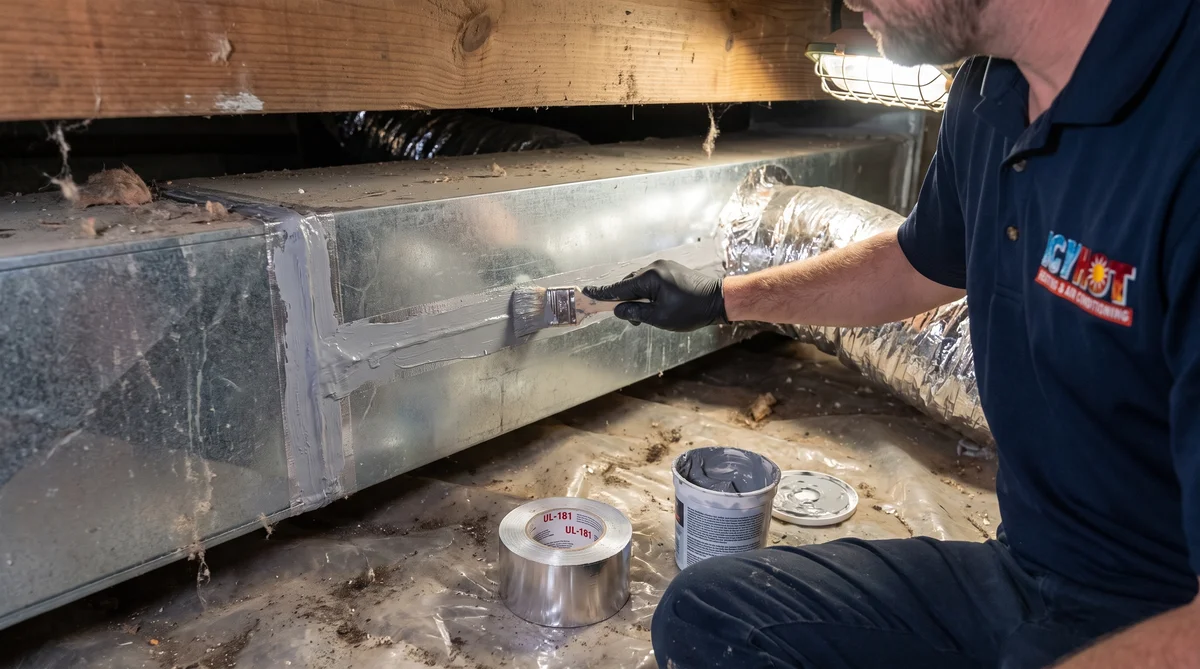
What sealing actually involves is worth knowing, because it is not glamorous and it is not expensive relative to what it returns. A tech goes under the house with mastic, a brush, UL-181 foil tape and a pair of knees that will complain about it later. The targets are the joints in the sheet-metal trunk, the collars where the flex duct takeoffs clamp on, the seam at the plenum, and the floor boots where a register meets the subfloor. Those boots are the ones the RTP researchers kept finding loose, and they are the ones that leak conditioned air straight into a crawl space you are not trying to cool. The work is done from outside the duct, which means nothing gets stirred up and nothing gets sprayed into the air you breathe.
It also attacks the moisture problem at the same time, which duct cleaning cannot do. A sealed, properly insulated duct in a humid crawl space does not sweat, and a duct that does not sweat does not grow anything that would need cleaning later. That is the whole reason EPA puts sealing and insulating in non-air-conditioned spaces on its prevention list rather than on its cleaning list. You are removing the cause instead of the symptom, once, instead of paying somebody to remove the symptom every few years.
When Duct Cleaning Is Genuinely the Right Call
There are real cases, I clear them every year, and they almost always come with a cause you have to fix at the same time. EPA puts that condition on the whole thing: “If any of the conditions identified above exists, it usually suggests one or more underlying causes. Prior to any cleaning, retrofitting, or replacing of your ducts, the cause or causes must be corrected or else the problem will likely recur.”
Beyond the three named conditions, the industry’s homeowner flyer lists the situations that make more frequent cleaning reasonable: “smokers in the household, pets that shed high amounts of hair and dander, water contamination or damage to the home or HVAC system, residents with allergies or asthma, and homes that have just been renovated.” Renovation is the one I would underline for Raleigh, because so much of Wake County is being remodeled. EPA’s prevention list says it outright: “During construction or renovation work that produces dust in your home, seal off supply and return registers and do not operate the heating and cooling system until after cleaning up the dust.” If nobody did that during your kitchen job, drywall dust went into the return and settled in the trunk line, and that is a genuine cleaning candidate.
If you do go ahead, EPA’s expectations list is your scope of work, and it is worth holding a contractor to it. Open access ports so the entire system can be cleaned and inspected. Check for asbestos first. Use vacuum equipment that exhausts outside the home, or HEPA equipment if it exhausts inside. Protect your carpet and furnishings. Use well-controlled brushing together with contact vacuuming, and soft-bristled brushes only on fiberglass duct board or fiberglass-lined sheet metal. Reseal and re-insulate every access hole airtight. And either refuse biocides or understand exactly what is being sprayed, remembering that as of EPA’s guidance no product was registered as a biocide for fiberglass duct board or fiberglass-lined ducts at all.
On verification, the trade association’s current standard, the 2025 edition of ACR released in September 2025, specifies cleanliness verification by a Surface Comparison Test and a NADCA Vacuum Test, and the association’s stated position is “source removal as the only acceptable method of cleaning.” Ask which verification method will be used and what the result was. A company doing the work properly will have an answer ready.
Two more things I would want in writing before a crew starts. First, the vent count, because almost every dispute I hear about afterward is really a dispute about how many openings were included. Second, who owns the access holes. A proper job cuts access into the trunk line in a few places, and EPA expects those to be closed back up airtight, “sealing and re-insulating any access holes the service provider may have made or used so they are airtight.” A hole closed with a strip of duct tape is a leak you paid someone to create, and you will not find it for years because it is in a crawl space.
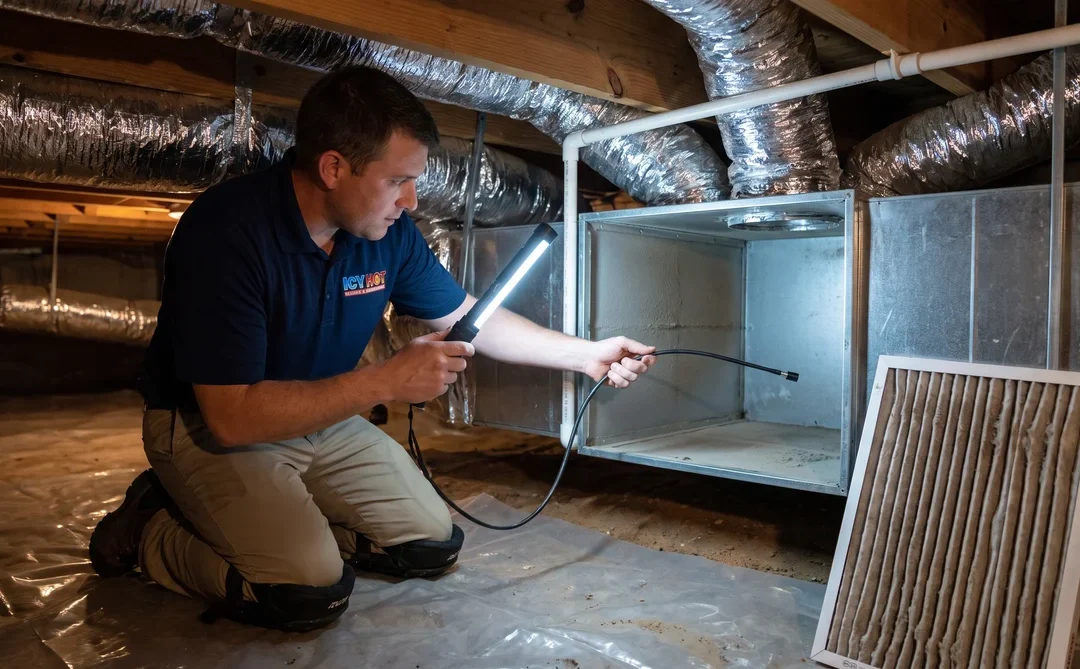
Finally, keep the three-estimate rule even when a company seems good. EPA recommends it, and there is a reason beyond price: three different people looking into the same ductwork is the cheapest second opinion available on whether there is anything in there worth removing. If one of three says your system needs cleaning and the other two say it looks normal, you have learned something useful for the cost of three service calls, and many companies do not charge for that look. It also gives you three different flashlights pointed into the same return plenum, which is the only way most homeowners will ever see the inside of their own ductwork.
How to Hire Without Getting Taken
Three written estimates, a visual demonstration of the problem before anyone quotes a price, and no biocides without a label in your hand. EPA’s hiring guidance is the most practical section of the whole document and it is almost never repeated.
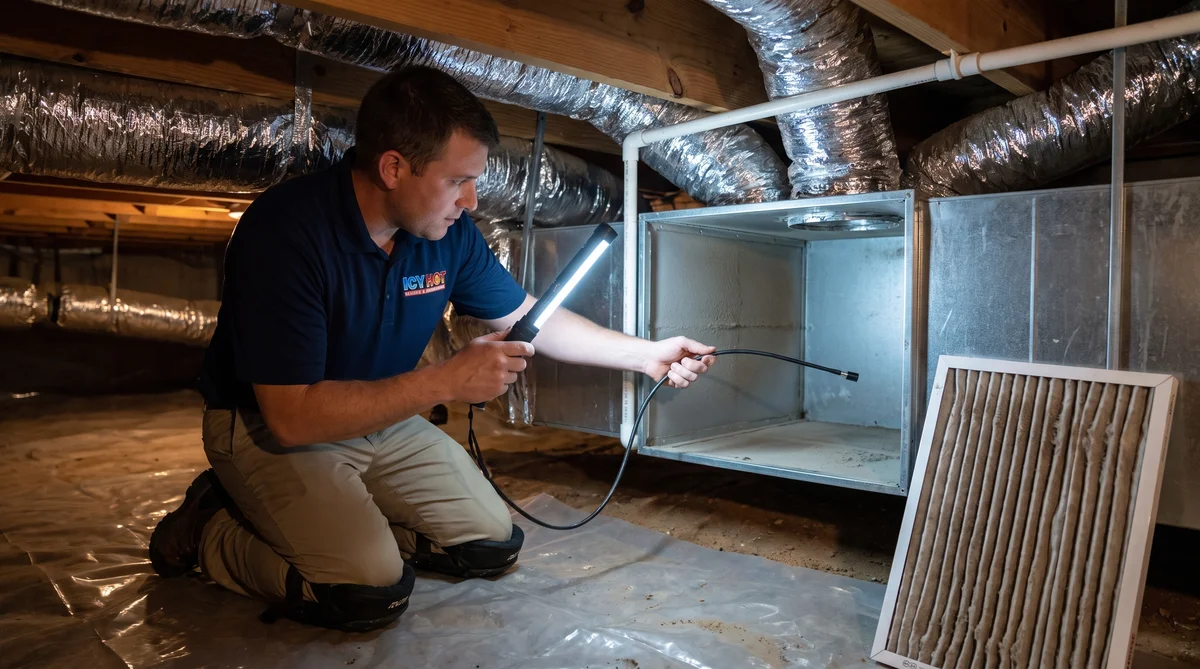
Start with the demonstration. EPA: “Talk to at least three different service providers and get written estimates before deciding whether to have your ducts cleaned. When the service providers come to your home, ask them to show you the contamination that would justify having your ducts cleaned.” If a company will not put a light and a camera into a duct and show you something, there is nothing to show. Pull a return grille yourself first if you want a head start; it takes two screws and a flashlight, and it tells you whether you are looking at a normal grey film or something that actually warrants a quote.
Refuse the petri dish. This is a specific trick EPA calls out by name: “Some service providers may attempt to convince you that your air ducts are contaminated by demonstrating that the microorganisms found in your home grow on a settling plate (i.e., petri dish). This is inappropriate. Some microorganisms are always present in the air, and some growth on a settling plate is normal.” A plate with fuzz on it after a day on your counter proves you live on Earth, and nothing whatsoever about your ductwork. If somebody opens with one, ask instead for the flashlight and the camera, and judge the answer by whether they reach for them.
Be careful with sealants, which are a different product from duct sealing even though they sound identical. EPA notes the distinction itself: “Use of sealants to encapsulate the inside surfaces of ducts is a different practice than sealing duct air leaks.” On the encapsulating kind, EPA, the duct cleaning association, the insulation manufacturers and the sheet metal contractors’ association “do not currently recommend the routine use of sealants to encapsulate contaminants in any type of duct,” and laboratory tests show sprayed sealants “tend not to completely coat the duct surface.” Sealing the outside of a leaky joint with mastic is good practice. Spraying a coating inside your ducts is not.
Say no to ozone. EPA describes it plainly as “a highly reactive gas that is regulated in the outside air as a lung irritant” and notes that little research supports its use inside ducts. It is sometimes offered under friendlier names, so listen for any version of “shock treatment,” “oxidation” or “air purification” bundled into a cleaning quote, and ask directly whether ozone is being generated.
And whatever you decide, do not let steam near your ductwork. EPA: “Steam cleaning and other methods involving moisture should not be used on any kind of duct work.” In a climate like ours, adding water to a duct is the one thing you genuinely should not do.
The One Duct You Should Actually Clean
Your dryer vent, and this one is a fire-safety item rather than an air-quality one. It gets lumped in with air duct cleaning on the same coupon, which is unfortunate, because the evidence here is strong and specific while the evidence for air ducts is not.
The National Fire Protection Association reports that in 2014 through 2018, U.S. local fire departments responded to an average of 13,820 home structure fires a year in which dryers were involved in the ignition, causing an average of seven civilian deaths, 344 civilian injuries and $233 million in direct property damage annually. The cause breakdown is the part that matters: “One-third (32 percent) of dryer fires were caused by a failure to clean. This appears to be mainly lint build-up, as 27 percent of dryer fires started when dust, fiber or lint ignited.”
Thirty two percent, attributable to a maintenance task, with a documented outcome. There is nothing like that number anywhere in the air duct cleaning literature. And bundled onto another visit, HomeAdvisor puts dryer vent cleaning at about $100, or $100 to $170 as a standalone job. That is the clearest dollar-for-dollar case on this entire page.
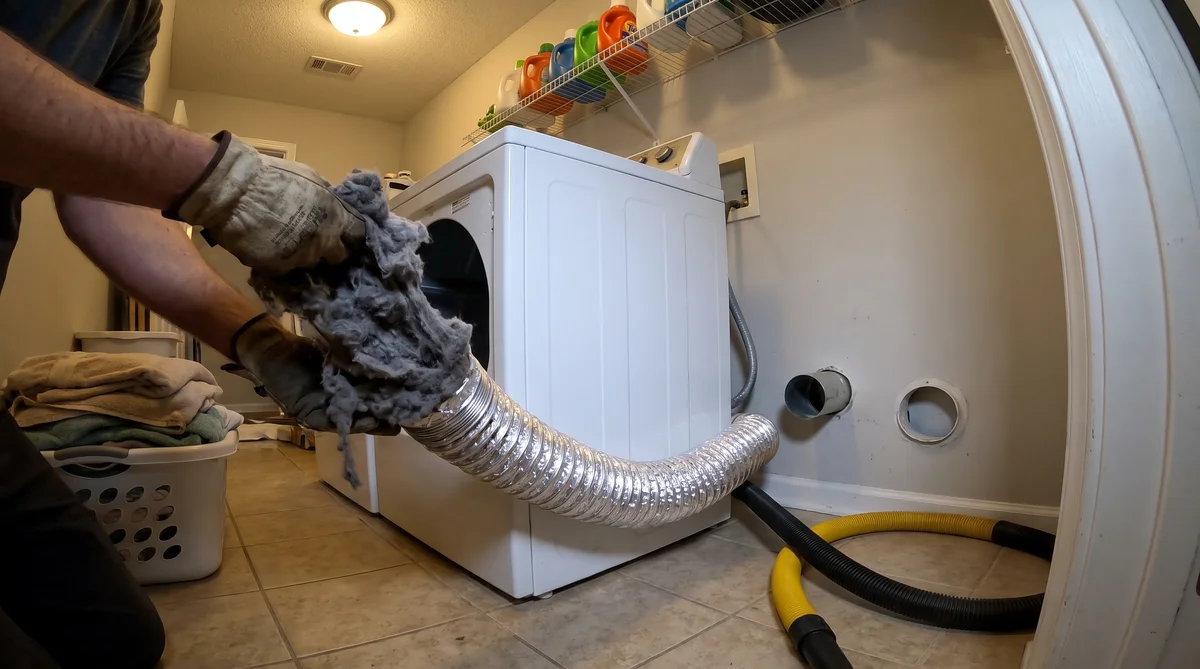
A few practical notes, because this is work most homeowners can do themselves. The transition hose behind the machine is where lint packs in hardest, and the flexible foil or plastic kind traps more of it than rigid metal does. The run through the wall matters too: long runs, multiple elbows and a screened exterior cap all slow the airflow and give lint somewhere to settle. The symptom to watch for is a load of towels that used to dry in one cycle and now takes two, because that means the moist air is not getting out. A shop vacuum, a long flexible brush and twenty minutes handles most of it, and if the run is long or goes up through a second story, that is the version worth paying someone about a hundred dollars for.
One more thing to check while the dryer is pulled out: whether the exterior cap actually opens. The louvered kind sticks shut with lint and paint, and a cap that does not open sends the moist air back down the pipe, where it turns the remaining lint into a damp mat that packs even tighter. I have pulled caps in Raleigh that had not moved in a decade. Replacing one is an inexpensive part and about ten minutes of work.
The NFPA numbers are worth seeing laid out, because they are the only place in this entire subject where a maintenance task has a documented outcome attached to it.
If you take one action after reading this, make it that one. Pull the dryer out, disconnect the transition hose, and look. If you can grab a handful of lint, you have found a real problem for about a hundred dollars, which is more than most people get from a $389 air duct cleaning.
Frequently Asked Questions About Duct Cleaning
The Bottom Line for Raleigh Homeowners
So, is duct cleaning worth it? It is a real service that is almost always sold for the wrong reason. If you can see substantial mold on hard duct surfaces, if something has been living in your ductwork, or if debris genuinely blows out of your supply registers, clean it, fix whatever caused it, and the money is well spent. If none of those three things is true, the federal guidance says you do not need it, the one federal field study could not detect any change in the air people were breathing, and the price you are being quoted will not buy the hours that a thorough job actually takes.
What I would do instead, in this order. Look in a supply register with a flashlight before you call anybody, because thirty seconds of looking settles the question that the coupon is trying to settle for you. Change the filter, and make sure there are no gaps around the filter holder, which is EPA’s own first prevention step. Then, if your ducts run through a crawl space or an attic, which in Raleigh they usually do, put the money into sealing and insulating them. That is the work the EPA crews quietly did for free while they were under those nine RTP houses, and it goes after the leakage EPA’s own model puts at 23 percent of a typical older system. While a contractor is under there, the envelope work beside it, sealing air leaks and insulating the floor above the crawl space, carries the published figure: 8 percent of the total bill and 14 percent of heating and cooling in our climate zone.
If you want someone to look at your ductwork and tell you honestly which of these you need, call us at (919) 673-7667. We will put a light in the duct and show you what is in there, and if the answer is nothing, we will tell you that. We handle duct sealing, indoor air quality work and the ordinary HVAC maintenance that actually keeps a system clean. You can schedule online or reach us through the contact page, and we serve Raleigh, Cary, Apex, Garner, Durham, Wake Forest and the rest of the Triangle service area.
Written by Frankie Asfari, owner of Icy Hot Heating & Air Conditioning in Raleigh, NC. NATE-certified, NC HVAC License #L.34356.