
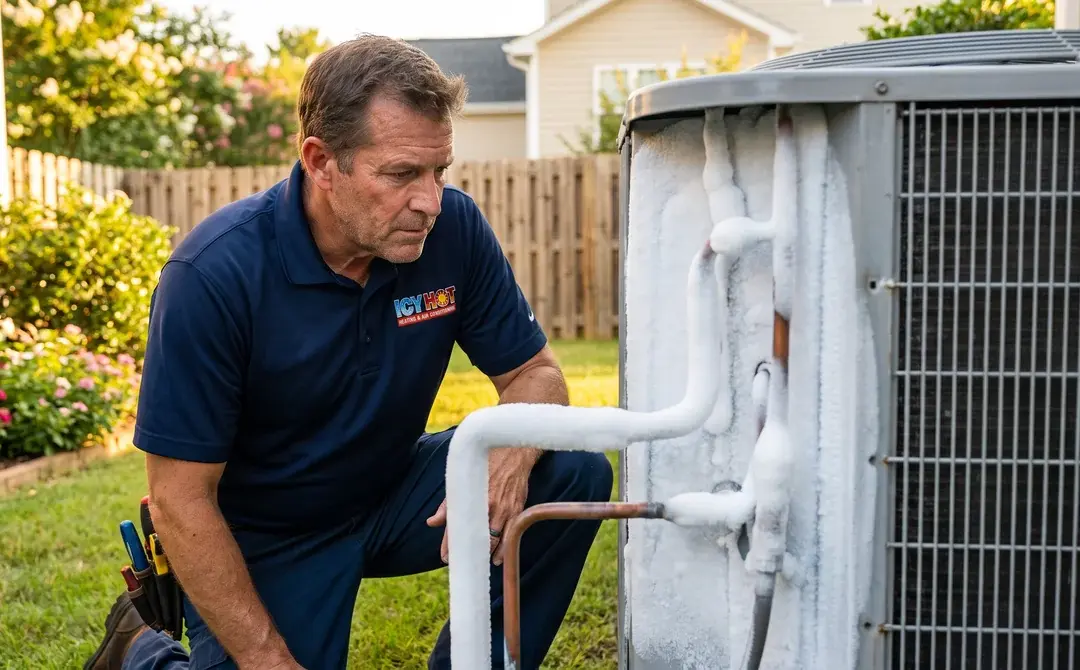
It is 95°F in Raleigh, your AC is running non-stop, and the air limping out of the vents is barely cool. Then you check the outdoor unit or the indoor coil and find it wrapped in a solid block of ice. It feels backwards for an air conditioner to be freezing up in the middle of summer, but it is one of the most common calls we get once the Triangle heat and humidity really settle in.
The short version: an AC freezes up when the evaporator coil gets too cold, and that almost always traces back to one of two things, restricted airflow or low refrigerant. When warm indoor air stops moving across the coil, or the refrigerant pressure drops too low, the coil temperature falls below freezing and the moisture condensing on it turns to ice. Here is exactly why it happens, what to do the moment you notice it, and how to keep it from coming back.
TL;DR: Your AC freezes up because the evaporator coil drops below 32°F, and the cause is almost always restricted airflow (a dirty filter, closed or blocked vents, a dirty coil, or a weak blower) or low refrigerant from a leak. The instant you see ice, turn the AC off and set the thermostat fan to ON to thaw it, then replace the air filter. Never run a frozen AC or chip at the ice, because you can slug the compressor with liquid refrigerant and turn a filter that costs $10 to $30 into a repair that runs into the thousands. If it refreezes after a filter change and a full thaw, it is a refrigerant or mechanical problem that needs a licensed tech. In Raleigh’s humid summers, a clogged, pollen-choked filter is the number one culprit.
Why Is My AC Freezing Up?
Your AC freezes up when its evaporator coil, the indoor coil that absorbs heat from your home’s air, gets colder than 32°F and the water condensing on it turns to ice. In normal operation that coil runs cold but stays above freezing because a steady stream of warm indoor air keeps washing over it. Take that warm airflow away, or drop the refrigerant pressure too low, and the coil temperature crashes below freezing. Bryant puts it the same way: it is “restricted airflow or low refrigerant levels, which cause the system’s evaporator coil to drop below freezing temperatures.”
Once ice starts forming, the problem feeds itself. A thin layer of frost on the coil blocks even more airflow, which makes the coil colder, which grows more ice, until the whole coil is encased and your AC is blowing warm air while the copper lines outside are frosted white. That runaway loop is why a small airflow issue on Monday can be a fully frozen system by Wednesday. It is also why catching it early matters so much.
So when your AC is running but not cooling and you find ice on the unit, you are not looking at a mystery. You are looking at either an airflow problem you can often fix yourself, or a refrigerant problem that needs a professional. The next section is what to do before you figure out which.
What to Do Right Now If Your AC Is Frozen
Turn the system off, help it thaw, and change the filter. Do those three things in order and you will fix a large share of frozen-AC cases without a service call, and you will avoid the expensive mistake of running a frozen unit. Here is the step-by-step:
- Turn the AC off at the thermostat. Switch the mode from Cool to Off. Running a frozen system forces liquid refrigerant back toward the compressor, and that is how a cheap fix becomes a compressor replacement.
- Set the thermostat fan to ON. This runs the blower without cooling, pushing room-temperature air across the iced coil to melt it faster. Per Bryant, thawing “can take anywhere from a few hours to an entire day, depending on the severity of the ice buildup.”
- Do not chip, scrape, or pick at the ice. The coil fins and refrigerant lines are thin and soft. One slip with a screwdriver and you turn a frozen coil into a leaking one.
- Lay towels down and check the drain. All that ice becomes water as it melts. Make sure your condensate drain is keeping up so you do not end up with water damage around the indoor unit.
- Replace the air filter. Once everything is thawed and dry, put in a fresh filter before you restart. A clogged filter is the single most common cause, so this is the highest-odds fix.
- Restart and watch it. Turn cooling back on. If it cools normally and stays ice-free, the filter was your answer. If it frosts up again within a day, stop running it and call a pro, because now you are likely looking at low refrigerant or a mechanical failure.
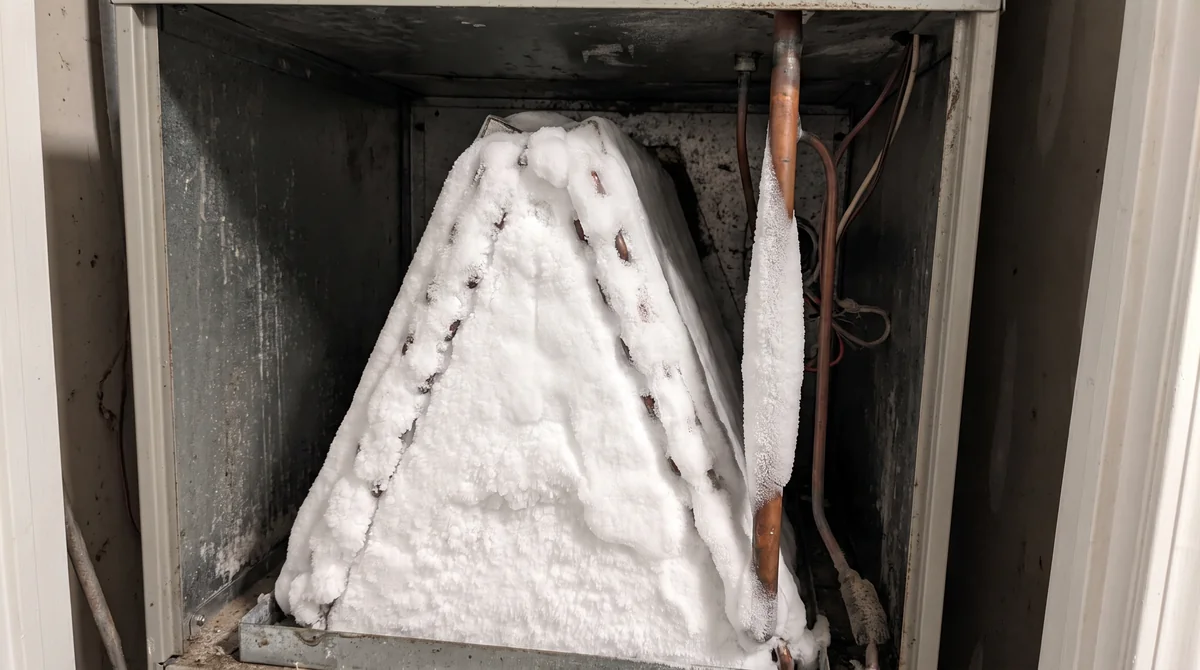
The 6 Most Common Causes of a Frozen AC Coil
Nearly every frozen AC traces back to one of six causes, and the first four are all versions of the same core problem: not enough warm air moving across the coil. Work down this list roughly in order of how often we see it in Raleigh homes.
1. A dirty air filter. This is the leader by a wide margin. A filter clogged with dust, pet hair, and Triangle pollen starves the coil of the warm airflow that keeps it above freezing. Trane lists it first too, and ENERGY STAR is blunt about the stakes: “A dirty filter can increase energy costs and damage your equipment, leading to early failure.” It is also the cheapest and easiest cause to rule out, which is why it is always the first thing to check and the fix that clears most freeze-ups on its own.
2. Closed or blocked supply vents. Shutting vents in unused rooms, or blocking returns with furniture and rugs, chokes the airflow the system was sized for. Your AC needs most of its vents open to breathe.
3. A dirty evaporator coil. Even with a good filter, the coil itself collects a film of grime over the years that insulates it and drops its surface temperature. This one usually needs a professional tune-up to clean safely. If you want the full procedure, including why the indoor coil is the one to leave alone, see how to clean your AC coils safely.
4. A failing blower motor. If the fan that moves air across the coil weakens or quits, airflow drops even with a clean filter and open vents. It is one of the reasons the ENERGY STAR maintenance checklist puts “clean and adjust blower components to provide proper system airflow” on every annual tune-up. This is a repair, not a DIY fix.
5. Low refrigerant from a leak. Refrigerant does not get “used up,” so if you are low, you have a leak. Low pressure makes the coil run colder than designed and it ices over. This is the second big category, and it always needs a licensed tech, because handling refrigerant legally requires an EPA Section 608 certified technician.
6. Running the AC when it is too cool outside. As Lennox puts it, “Running your AC when it’s too cool outside (below 60°F) can actually cause it to freeze up.” In Raleigh this is the classic “why does it freeze at night” culprit on those mild spring and early-summer evenings.
From the field (Frankie Asfari, NATE-certified, NC License #L.34356): When a Raleigh homeowner calls about a frozen unit, my first question is always “when did you last change the filter?” More often than not the answer is a shrug. In our pollen season a one-inch filter can clog in three or four weeks, and I have pulled filters so packed you could not see light through them. The frustrating part is that folks often keep running the AC because it is hot, and that is exactly what turns a filter you could have grabbed for pocket change into a compressor call. If you see ice, shut it off. The house staying warm for two hours while it thaws is a lot cheaper than what happens if you do not.
Why Does My AC Freeze Up at Night but Not During the Day?
If your AC only freezes overnight, the most likely reasons are cooler outdoor temperatures and a thermostat that is not cycling the system off. When the outdoor air drops into the 50s or low 60s on a mild Raleigh night, the refrigerant pressure falls and the coil can slip below freezing even though the same system runs fine in the afternoon heat (this is the pattern behind the common “freezes at night” complaint).
A thermostat that fails to shut the system off at your setpoint compounds it, and Trane lists a faulty thermostat among the causes of a frozen coil outright. If the AC keeps running long after the house has cooled, the coil has no warm return air to keep it above freezing, so it ices over in the small hours. A short overnight run cycle is normal; an all-night run on a cool evening is not. If yours does that, it is worth having the thermostat and refrigerant charge checked.
The everyday version of this is simpler: do not run the AC when it is cool enough outside to open the windows. On those pleasant Triangle evenings in May and September, giving the system a night off is easier on it and on your Duke Energy bill.
Can a Frozen AC Damage the System?
Yes, and this is the part worth taking seriously. The expensive damage does not come from the ice itself, it comes from running the system while it is frozen. When the coil is iced over, refrigerant that should have boiled into a gas can slide back to the compressor as a liquid. Compressors are built to pump gas, not liquid, and “slugging” one with liquid refrigerant can wreck it. Bryant does not hedge on this: running a frozen unit “places extreme strain on the compressor, which can lead to complete and costly system failure.” In Raleigh, compressor replacement runs $1,000 to $2,900 (HVAC.com), which is why this is the failure that turns a cheap fix into a four-figure repair.
There is a water side to it too. A big coil of ice holds a lot of water, and when it melts fast it can overflow the drain pan and soak the ceiling below an attic air handler or the floor around a closet unit. That is a second, avoidable bill sitting on top of the mechanical risk. Both problems disappear if you simply shut the system off the moment you spot ice, which is the whole reason step one is “turn it off.”
How to Keep Your AC From Freezing Up
Most frozen-coil calls are preventable, and the prevention is mostly about protecting airflow. Build these habits in and you will likely never see ice on your system again:
- Change the filter on schedule. ENERGY STAR says to “inspect, clean, or change air filters once a month,” and Carrier puts a one-inch pleated filter at 30 to 90 days. Check yours monthly through Raleigh’s cooling season and swap it when it looks gray. With pets or allergies, change it sooner.
- Keep vents and returns clear. Leave supply registers open and pull furniture, rugs, and drapes off the return grille so the system can breathe.
- Get a professional tune-up each spring. A pro cleans the evaporator coil, checks the blower, and verifies the refrigerant charge, the three things a filter change cannot reach. Our AC maintenance guide walks through what a real tune-up includes.
- Do not over-cool on mild nights. Give the system a break when it is cool enough to open the windows instead.
- Act on the early warning signs. Weak airflow, higher bills, or a line that sweats more than usual are the quiet signals that airflow or charge is off. Catching those is a lot cheaper than a frozen coil. See our roundup of common AC problems in Raleigh for the full list.
A yearly maintenance plan handles most of that for you and puts a set of trained eyes on the coil, blower, and charge before summer, which is when the majority of these freeze-ups happen.
When to Call a Raleigh HVAC Pro
Call a professional when the AC refreezes after a filter change and a full thaw, when you see oily residue on the refrigerant lines, or when airflow is clearly weak with a clean filter. Those point to low refrigerant, a dirty coil, or a failing blower, none of which is a safe or legal DIY job once refrigerant is involved. And if the ice has already tripped a safety and the system now will not start at all, our guide to an AC that will not turn on covers what to check next.

A leak is the big one. Because refrigerant is never consumed, being low always means it is escaping somewhere, and simply “topping it off” without finding the leak is throwing money at a symptom. A licensed tech will locate the leak, make the repair, and recharge the system to spec. If your unit is completely iced and you need cooling back fast in a Raleigh heat wave, that is what our emergency AC service is for, and if the diagnosis turns into a repair, our AC repair cost guide shows what typical fixes run.
Frequently Asked Questions
Quick answer for Raleigh homes: Ice on your AC means the coil is running below freezing, almost always from restricted airflow or low refrigerant. Turn the system off, set the fan to ON, and change the filter. If it refreezes after a full thaw and a fresh filter, stop running it and call a licensed tech, because you are into refrigerant or mechanical territory where running it risks the compressor.
The Bottom Line for Raleigh Homeowners
A frozen AC in July feels like a paradox, but it is really just a coil that got too cold because warm air stopped moving across it or the refrigerant ran low. Here is what to remember:
- Ice forms when the evaporator coil drops below 32°F, and the cause is almost always restricted airflow or low refrigerant.
- The instant you see ice, turn the AC off and set the fan to ON. Never run a frozen system.
- A dirty filter is the number one cause, and in Raleigh’s pollen season it clogs fast, so check it monthly.
- Do not chip at the ice, and do not just add refrigerant, because low refrigerant means a leak.
- Running a frozen AC can slug and ruin the compressor, turning a $10 filter into a repair that starts around $1,000.
- If it refreezes after a filter change and a full thaw, it is time for a licensed technician.
Still finding ice on your system after a fresh filter and a full thaw? That is the point where guessing gets expensive. We will find out whether it is airflow, a dirty coil, or a refrigerant leak, fix it right, and get your cooling back. Call Icy Hot at (919) 673-7667 or request a free instant quote, and if it is an emergency in the heat, our Raleigh AC repair team is available around the clock.