When you’re shopping for a new air conditioner in Raleigh, the contractor is going to ask you a question that sounds technical but really isn’t: single-stage or two-stage? Most of the blog posts you’ll find online will tell you two-stage is “more efficient.” That’s true, but it’s the wrong reason to upgrade in our climate.
The real reason is humidity. Summer afternoons in the Triangle regularly sit in the mid-70s for relative humidity, based on long-term NOAA station data at Raleigh-Durham International Airport (KRDU), and the way a two-stage unit runs is built to handle that. Here’s what the two types actually do differently, how much you’ll save, and when the upgrade is worth the $1,000–$2,000 price jump.
TL;DR: A two-stage air conditioner runs on a low setting (about 65% capacity) most of the time and ramps to full power only in peak heat. That cuts cooling energy use roughly 15–20% versus a single-stage unit and removes significantly more humidity (per manufacturer data and U.S. DOE operating principles). In Raleigh’s humid summers, the upgrade typically pays back in 6–10 years on homes over 1,800 sq ft and qualifies for Duke Energy Smart Saver rebates starting at 15.2 SEER2. Skip it if your ducts are leaky. Fix those first.
What’s the Difference Between a Single-Stage and Two-Stage Air Conditioner?
A single-stage air conditioner has one cooling speed: 100% on or 100% off. A two-stage unit has two speeds, roughly 65% capacity on low and 100% on high, and it spends most of its runtime on the low setting (per Carrier and Trane residential equipment documentation). That low-speed, longer-runtime behavior is the mechanical difference. Everything else a two-stage unit does better, from humidity control to quieter operation to longer lifespan, traces back to it.
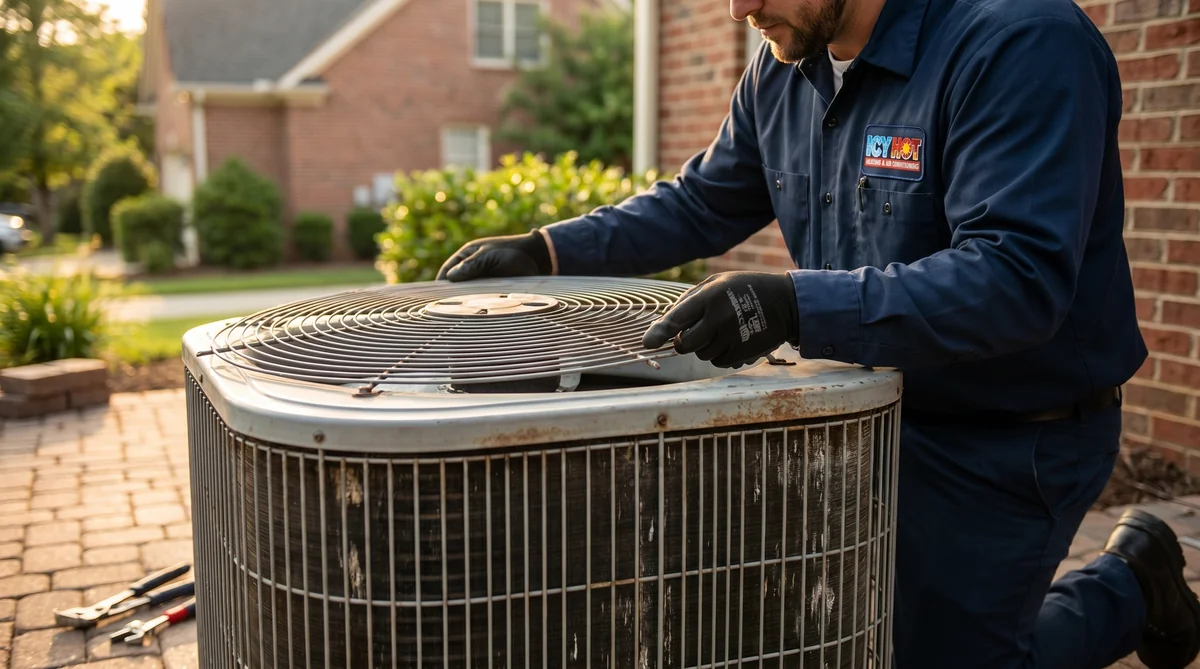
Under the hood, a single-stage compressor is a fixed-speed scroll compressor. It gets a call from the thermostat, fires up at full power, runs until it hits setpoint, and shuts off. A two-stage compressor is a dual-capacity scroll, which means it has an internal bypass that lets it run at reduced capacity most of the time and only load up to 100% when the house is hot enough to need it.
There’s a third tier above this, called variable-speed (or “inverter-driven”), which modulates anywhere from 25% to 100% capacity. We’ll come back to that at the end. Most homeowners in Raleigh are choosing between single-stage and two-stage, because that’s the price jump where the math either works or it doesn’t.
Here’s how the two stack up side by side:
Is a Two-Stage AC More Energy Efficient?
Yes, but not dramatically. A two-stage air conditioner cuts cooling energy use by roughly 15–20% versus a same-capacity single-stage unit, because longer low-speed cycles are mechanically more efficient than repeated full-power on/off cycles (per manufacturer data and U.S. DOE operating principles). For a typical 2,000 square foot Raleigh home, that works out to about $100–$180 per cooling season at current Duke Energy residential rates.
The reason comes down to motor physics. A compressor pulls a big spike of startup current every time it fires up, and that spike is wasted energy that doesn’t produce any cooling. A two-stage unit starts fewer times per hour and spends most of its time at a low steady state, which is where electric motors are most efficient. Think of it like highway driving versus stop-and-go traffic. Same car, same destination, different MPG.
Put $115 a year in context before you decide. Annual AC maintenance on a well-installed system is $150–$250. A smart thermostat saves roughly $75–$100 a year. Proper duct sealing can save 15–20% on both heating and cooling. The stage jump is one of several levers you can pull, and it’s rarely the biggest one. SEER2 rating still matters too. A 14.3 SEER2 two-stage unit uses about the same energy per season as a 15.2 SEER2 single-stage in our climate. For context on rating tiers, see our guide to what is a good SEER rating for NC homes.
How Does a Two-Stage AC Handle Humidity in Raleigh’s Climate?
In humid climates like Raleigh, a two-stage AC removes significantly more moisture than a single-stage unit, and this is usually the real reason to upgrade. Longer runtime at low capacity gives the evaporator coil extended contact time with the air, which is how dehumidification actually works. Summer afternoons in the Triangle regularly sit in the mid-70s for relative humidity (based on long-term NOAA station data for Raleigh-Durham), and longer cooling cycles are the single biggest factor in indoor moisture control.
Here’s how the short-cycling problem plays out in a typical single-stage install. The thermostat calls for cooling on a 90°F July afternoon. The compressor fires up at 100%. It cools the air fast and hits setpoint in 8 or 10 minutes. The condenser shuts off. The coil warms back up. Ten minutes later, the thermostat calls again. Short, aggressive cycles cool the air but never give the coil enough cold contact time to pull much humidity out. Result: the thermostat reads 72°F, the house feels clammy, and you turn the setpoint down to 70°F to compensate. That costs you more in electricity than the two-stage upgrade would have.
From the field (Frankie Asfari, NATE-certified, NC License #L.34356): The biggest complaint we get after a new single-stage install in Raleigh isn’t temperature. It’s humidity. Customers tell us the house is at 72°F but it still feels sticky. That’s short-cycling. I’ve stood in kitchens where a two-stage unit was running on low for 35 minutes, quiet as a fridge, and you could feel the air getting drier minute by minute. A single-stage running full-blast for 9 minutes can’t do that. In the Triangle, that’s the real reason to upgrade, not the SEER number.
The EPA recommends keeping indoor relative humidity between 30% and 60%, ideally 30–50%, to keep mold growth and dust mites in check. In a leaky Raleigh house with a short-cycling single-stage AC, summer indoor humidity often sits at 55–65%. Not dangerous, but it’s the clammy end of the scale. A properly sized two-stage unit running on low typically holds the same house at 45–52% through July and August. That’s the difference between “set it to 74°F and feel fine” and “set it to 70°F and still feel sticky.”
Southern households run AC longer than any other region in the country and spend accordingly, with central AC the dominant cooling equipment in roughly two-thirds of U.S. homes (per the EIA Residential Energy Consumption Survey). Much of that Southeast cooling bill is dehumidification load, not straight temperature. In our climate, whatever equipment handles humidity best wins on both comfort and long-term bills.
How Much More Does a Two-Stage AC Cost Than a Single-Stage?
A two-stage central AC typically costs $1,000–$2,000 more installed than a comparable single-stage unit in the Raleigh area. Single-stage installed prices run about $5,500–$8,800 nationally, and two-stage runs $6,700–$9,400 for the same capacity (per Angi and HomeAdvisor 2026 cost data). Your actual number depends on system size, ductwork condition, and how much refrigerant line the installer has to run.
The upcharge pays for three things: the dual-capacity compressor itself, a matching air handler or furnace rated for two-stage operation, and in most cases a two-stage-compatible thermostat. If you’re keeping your old air handler and the old thermostat, you can’t install a two-stage condenser on top of that. The indoor and outdoor equipment have to match, and the controls have to know what to do.
The cost gap gets smaller when you factor in NC HVAC rebates. Duke Energy Smart Saver pays $300 for qualifying systems at 15.2 SEER2 and above, and $500 for units at 17 SEER2 with an ECM blower motor (per the Duke Energy Smart Saver program terms). Most two-stage systems clear the 15.2 SEER2 bar easily; many clear 17. That takes your real upcharge down to $700–$1,500 after rebate. Still more than a budget single-stage, but the gap is narrower than the sticker suggests.
When Is a Two-Stage AC Worth It in a Raleigh Home?
A two-stage air conditioner is worth the upgrade for most Raleigh homes over 1,800 square feet, for households that notice humidity or AC noise, and for anyone planning to stay in the home eight or more years. It’s harder to justify on small homes, short expected ownership, or budgets that are already stretched by ductwork or insulation work the home needs more.
Here’s the quick decision framework we use when customers ask:
Upgrade to two-stage if any of these apply:
- Home is 1,800+ square feet, especially two-story or with bonus room over garage
- You’ve had humidity complaints with a previous AC (clammy feel, sticky walls, musty smell)
- Bedrooms sit far from the air handler and run warmer than the thermostat location
- You’re sensitive to AC noise, especially near a bedroom window
- You plan to stay in the home eight or more years
- You want to qualify for Duke Energy Smart Saver and other rebate programs
Skip the upgrade and stick with single-stage if any of these apply:
- Home is under 1,400 square feet and well insulated
- You’re planning to sell within three to five years
- Your ductwork is visibly leaking or undersized (fix that first, it returns more than the stage jump)
- Budget is tight and the single-stage meets NC code at 14.3 SEER2
- You’re replacing in an emergency and need equipment fast
The counterintuitive call we make more often than you’d think: on a 2,200 square foot home with visibly leaky attic ducts, we usually recommend single-stage AC plus professional duct sealing over two-stage AC alone. A leaky duct system loses 20–30% of the air moving through it in typical homes (ENERGY STAR Duct Sealing). Fixing that bottleneck returns more dollar savings than a compressor upgrade every time. When we install the two-stage later as the system ages out, it’ll actually deliver what it’s rated for.
Does a Two-Stage AC Last Longer Than a Single-Stage?
Two-stage air conditioners typically last 15–20 years with regular maintenance, versus 12–17 years for a single-stage unit of the same tier. The reason is mechanical: low-speed operation means fewer hard starts and stops, less peak current on the motor, and less thermal cycling on the compressor’s internal components. The ENERGY STAR replacement guidance uses a 10-to-15-year window as the point to start evaluating a new system regardless of stage count. The stage-based spread within that window lines up with what we see in the field.
That said, maintenance habits matter more than stage count for how long any AC actually lasts. A neglected two-stage unit with clogged filters, a dirty coil, and low refrigerant charge will fail before a well-maintained single-stage. What actually kills air conditioners in Raleigh is a combination of dirty evaporator coils from neglected filter changes and hard starts on a compressor that was already low on charge. Neither problem cares whether your unit is single- or two-stage.
The lifespan gap mostly shows up at the 12-15 year mark. Single-stage units from that era start needing compressor replacements, which often triggers full replacement because the cost of a new compressor plus refrigerant on an old system gets close to a new install. Two-stage units more often push through that window because the compressor hasn’t taken as much wear. Annual AC maintenance and a maintenance plan are the difference between getting the full life out of either type.
Do You Need a Special Thermostat for a Two-Stage AC?
Yes. A two-stage air conditioner needs a two-stage-compatible thermostat with Y1 and Y2 wiring terminals to control both cooling speeds. A standard single-stage thermostat will force a two-stage unit to run only in high mode, which cancels out the efficiency and humidity-control benefits you paid extra for. This is a failure mode we see on service calls more than we’d like.
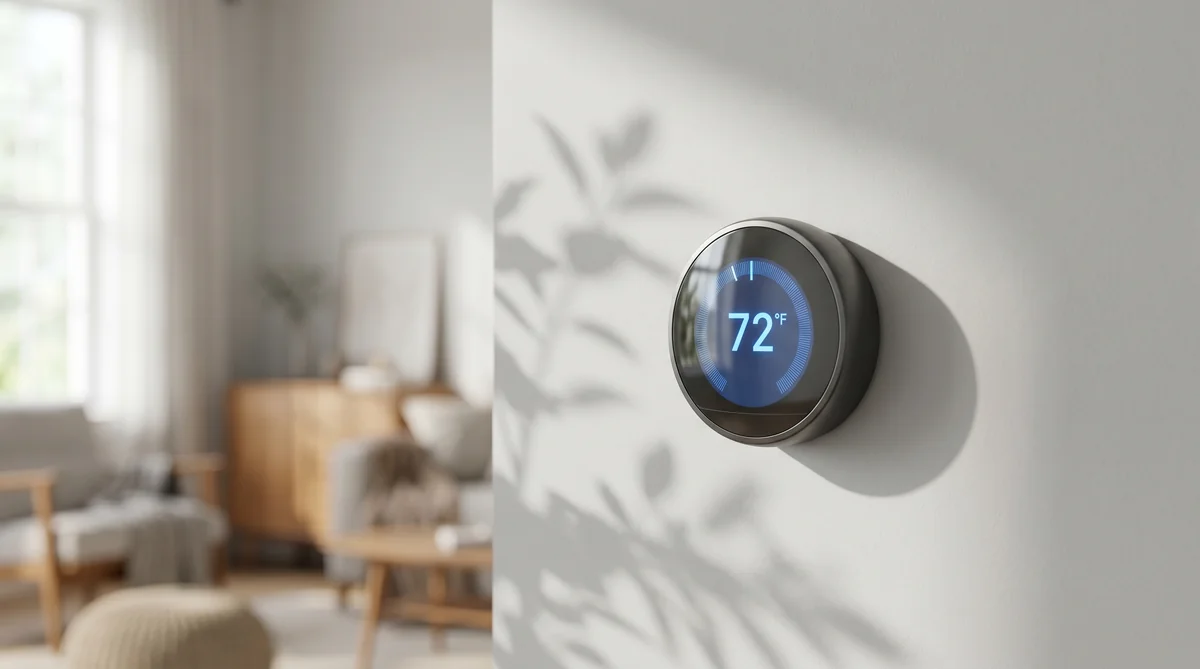
Most smart thermostats made after 2018 support two-stage wiring. Compatible options include ecobee, Nest 3rd generation and newer, Honeywell T-Series (most models), Lennox iComfort, and Trane ComfortLink. Communicating thermostats from Lennox, Carrier, and Trane go a step further and let the outdoor unit report capacity and runtime back to the indoor control, which squeezes out a bit more efficiency on the margins.
If you’re paying for a two-stage install, make the thermostat part of the quote from day one. A compatible unit costs $180–$350 and makes the difference between the two-stage hardware actually working the way it was designed and running like an expensive single-stage. See our guide to two-stage-compatible thermostats for Raleigh homes for the full list of what works with what.
From the field: We’ve rolled up to a few service calls where the homeowner swore their new “high-efficiency” two-stage AC wasn’t living up to the quote. Nine times out of ten, it’s the thermostat. The installer swapped the outdoor unit but left the old single-stage thermostat on the wall, so the compressor only ever runs in high mode. The fix is a $200 thermostat and ten minutes of wiring. Ask your installer to put the thermostat in writing before you sign.
What About Variable-Speed? Should I Skip Two-Stage Entirely?
Variable-speed air conditioners modulate from 25% to 100% capacity and deliver the best humidity control and efficiency available on residential equipment (per Trane residential equipment documentation). They typically cost $2,500–$4,500 more than a comparable two-stage unit. For most Raleigh homes, a two-stage unit captures roughly 70–80% of the comfort benefit at about half the upcharge over single-stage.
We recommend variable-speed for a narrower set of situations: homes over 3,000 square feet, multi-zone systems that need the dynamic range, problem rooms like bonus rooms over garages or finished crawl spaces, and households where someone has allergy or asthma triggers tied to humidity swings. For a standard 2,000–2,400 square foot Raleigh home with decent ducts, the payback on the step from two-stage to variable-speed is usually longer than the warranty.
If you’re choosing between two-stage and variable-speed in NC, the difference in your power bill will be smaller than the salesperson suggests. The difference in temperature steadiness and humidity precision is real, but whether that’s worth $2,000 extra is a personal comfort call, not a straight financial one. For most homes, two-stage is the right answer.
Frequently Asked Questions
Quick answer for Raleigh homes: If your home is 1,800+ square feet, you’ve had humidity complaints, and you plan to stay eight or more years, upgrade to two-stage. If your home is under 1,400 square feet, you’re selling soon, or your ducts are visibly leaky, stick with single-stage and put the savings into duct sealing. Either way, pick a SEER2 rating of 15.2 or higher to qualify for Duke Energy rebates.
The Bottom Line for Raleigh Homeowners
Single-stage versus two-stage is really a comfort-first decision dressed up as an efficiency decision. The energy savings are real but modest in our climate. The humidity-control and noise differences are what you’ll actually feel every day from May through September. Here’s what matters:
- Two-stage runs at 65% most of the time and 100% only during peak heat.
- Energy savings in Raleigh are roughly 15–20%, about $100–$180 per cooling season.
- Humidity control is significantly better, which is the real comfort win in NC.
- Installed cost is typically $1,000–$2,000 higher, narrowed by Duke rebates.
- Worth it for homes 1,800+ sq ft, humidity complaints, or 8+ year ownership.
- Skip it if ductwork is leaky. Fix that first.
- Must be paired with a two-stage-compatible thermostat to work correctly.
Still weighing single-stage versus two-stage for your Raleigh home? We’ll run a proper Manual J load calculation, check your ductwork, walk you through the rebate-eligible options, and tell you straight up when the upgrade pays back and when it doesn’t. Call Icy Hot at (919) 673-7667 or request a free instant quote.
The same question comes up on the heating side of the system, and the answer there is different because the arithmetic is different. We covered it in our guide to single-stage versus two-stage furnaces.