Heating and cooling account for 52% of your home’s total energy use, according to the U.S. Energy Information Administration. In the Southeast, air conditioning alone eats up 27% of total home energy costs: nearly triple the national average (EIA). A single clogged filter can inflate your AC’s energy consumption by 5% to 15% (U.S. Department of Energy). That’s real money, and most Raleigh homeowners leave it on the table every summer.
We’ve been servicing air conditioners across the Triangle since 2008, and the pattern never changes: the $150 tune-up that gets skipped in April turns into a $6,000 replacement in July. This guide covers what you can do yourself, when to call a pro, and how to squeeze every year of life out of your system.
TL;DR: Annual professional AC tune-ups ($75–$200) plus monthly filter changes can cut energy bills by up to 15% and extend your system’s lifespan from the ASHRAE median of 15 years to 20+ years. In Raleigh, schedule your tune-up in March or April, before the rush. Schedule yours here.
Why Does Regular AC Maintenance Matter in Raleigh?
Raleigh sits squarely in the Southeast’s hot-humid climate zone, where AC systems run 5+ months per year. The EIA reports that Southeastern households spend 27% of their total energy budget on air conditioning alone. Skip maintenance, and that percentage climbs, along with your risk of a mid-summer breakdown. Here’s what’s at stake.
Lower Energy Bills
A dirty filter forces your compressor to run longer and harder. The U.S. Department of Energy estimates that swapping a clogged filter for a clean one reduces AC energy consumption by 5% to 15%. The average North Carolina household pays about $141 per month for electricity (EIA, 2024). Even a 10% reduction saves roughly $170 per year. Are you leaving that on the table?
Longer System Life
A well-maintained central air conditioner typically lasts 15 to 20 years (Trane; Lennox). ASHRAE data puts the median service life at 15 years. Neglecting maintenance can shorten that lifespan significantly, and with AC replacement averaging $3,911 to $8,068 (HomeAdvisor, 2026), premature failure is expensive.
Better Indoor Air Quality
Your AC system filters every cubic foot of air in your home multiple times daily. Dirty filters, moldy evaporator coils, and clogged drain lines don’t just cut cooling, they actively worsen your indoor air quality. Mold spores, dust, and allergens get pushed through your ductwork instead of captured. In our experience, homeowners with allergy issues often see noticeable improvement after a thorough coil cleaning and filter upgrade to MERV 11 or higher. A neglected filter also starves the coil of airflow, which is the number one reason an AC freezes up in a Raleigh summer.
Fewer Emergency Breakdowns
Here’s a pattern we see every summer in Raleigh: a homeowner calls on a 98°F day with a completely dead system. The diagnosis? A worn capacitor that’s been struggling for months, or electrical connections that loosened gradually. A spring tune-up catches these problems for $150. An emergency weekend repair starts at $350 and goes up from there. Which would you rather pay?
How Often Should Raleigh Homeowners Schedule AC Maintenance?
Most major manufacturers, including Lennox, Carrier, and Trane, require documented annual maintenance to keep equipment warranties valid. Skip it, and you risk paying out of pocket for a part that should’ve been covered. Here’s the schedule we recommend for Raleigh’s climate:
- Professional tune-up: Once per year, ideally March through May (before cooling season)
- Filter checks: Monthly during cooling season (May through September)
- Outdoor unit inspection: Monthly during cooling season
- Condensate drain flush: Every 3 months during operation
Why spring? Every HVAC company in the Triangle is booked solid by June. Schedule early, and you get your pick of appointment times. Wait until July, and you’re competing with every homeowner whose system just quit.
What AC Maintenance Can You Do Yourself?
The most impactful maintenance task, replacing your air filter, takes five minutes flat. No tools required. Here’s everything you can handle on your own between professional tune-ups.
Monthly Tasks
- Check and replace your air filter: Hold it up to a light source. Can’t see through it? Swap it. Most 1-inch filters need replacing every 30–60 days during heavy use. We recommend MERV 11–13 for Raleigh’s pollen-heavy springs. MERV 8 is the absolute minimum.
- Clear the condensate drain: Find the PVC drain line near your indoor unit. Pour 1/4 cup of white vinegar through it to prevent algae buildup. Clogged drain lines are one of the most common causes of water damage we see in Raleigh homes.
- Clean around the outdoor condenser: Keep at least 2 feet of clearance around the unit. Pull away leaves, grass clippings, and debris. Your condenser needs airflow to reject heat, block it, and your system works overtime for less cooling.
Seasonal Tasks (Spring and Fall)
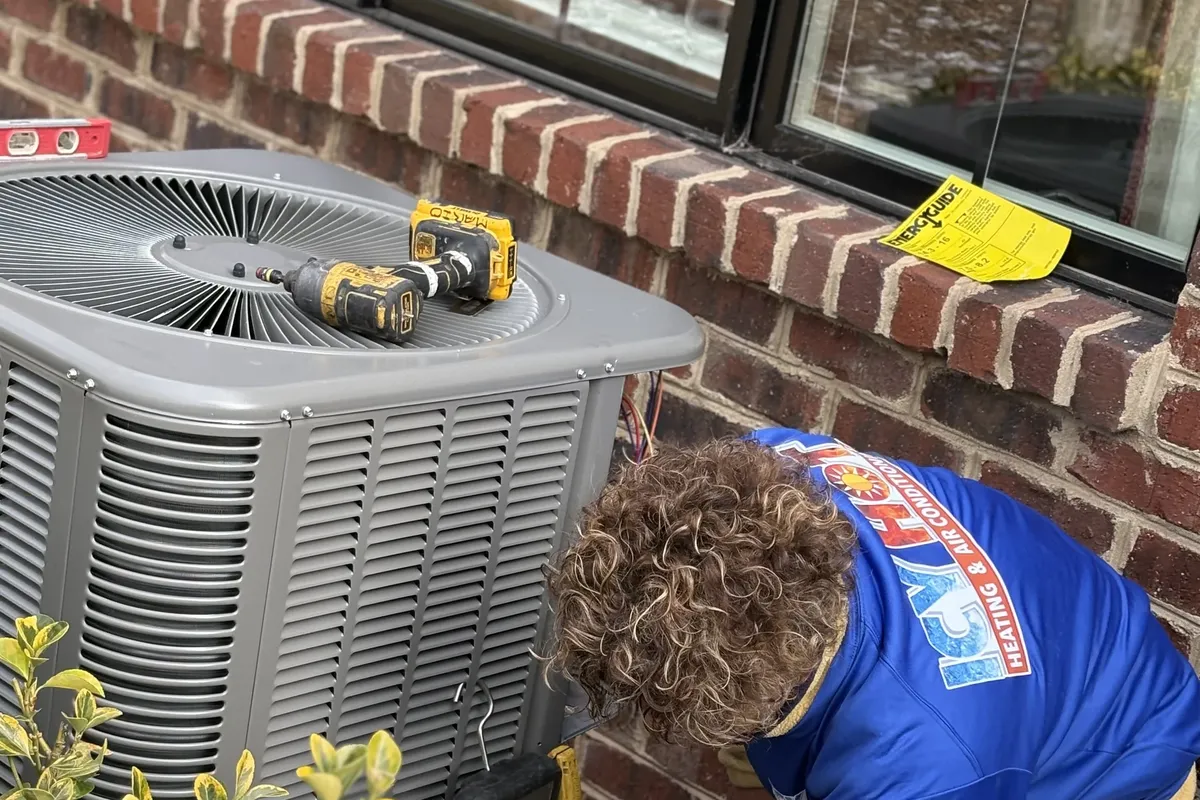
- Rinse the condenser coils: Use a garden hose, never a pressure washer, to gently spray the outdoor fins from inside out. Straighten bent fins with a fin comb. They’re surprisingly fragile.
- Inspect the blower fan: Check indoor blower blades for dust buildup. Heavy dust throws off the balance and cuts airflow.
- Check refrigerant line insulation: The larger copper line from the outdoor unit to your house should be wrapped in foam. Cracked or missing insulation wastes energy every day. A few dollars of foam pipe insulation from the hardware store fixes it.
When Should You Call a Professional?
DIY maintenance keeps your system running between tune-ups, but some problems need a licensed HVAC technician. If you notice any of these warning signs, don’t wait, call for professional AC repair:
- Grinding, screeching, or banging noises from the indoor or outdoor unit
- Warm air from vents even though the system is running
- Short cycling: system kicks on and off every few minutes
- Water pooling around the indoor unit or oily residue near refrigerant connections
- Musty, burning, or chemical smells from your vents
- Temperature gaps: your house reads 3°F or more above the thermostat setting
A small issue today becomes an expensive repair tomorrow. When in doubt, give us a call. We’d rather tell you it’s nothing than show up after the compressor has burned out.
What Does a Professional AC Tune-Up Include?
A standard AC tune-up in the Raleigh area costs $75 to $200 (HomeGuide, 2025; Angi, 2026). That buys you far more than what a garden hose and screwdriver can accomplish:
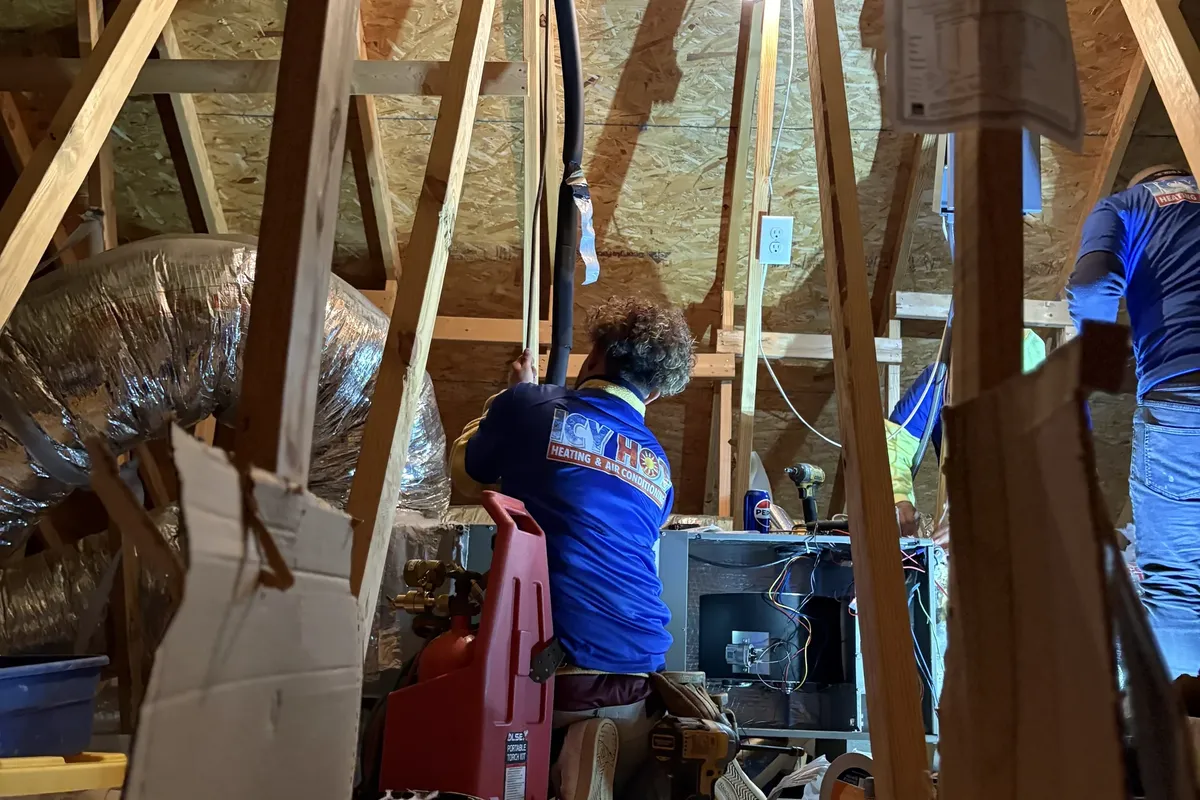
- Refrigerant level check: Low refrigerant means a leak somewhere, topping off is a temporary bandage, not a fix
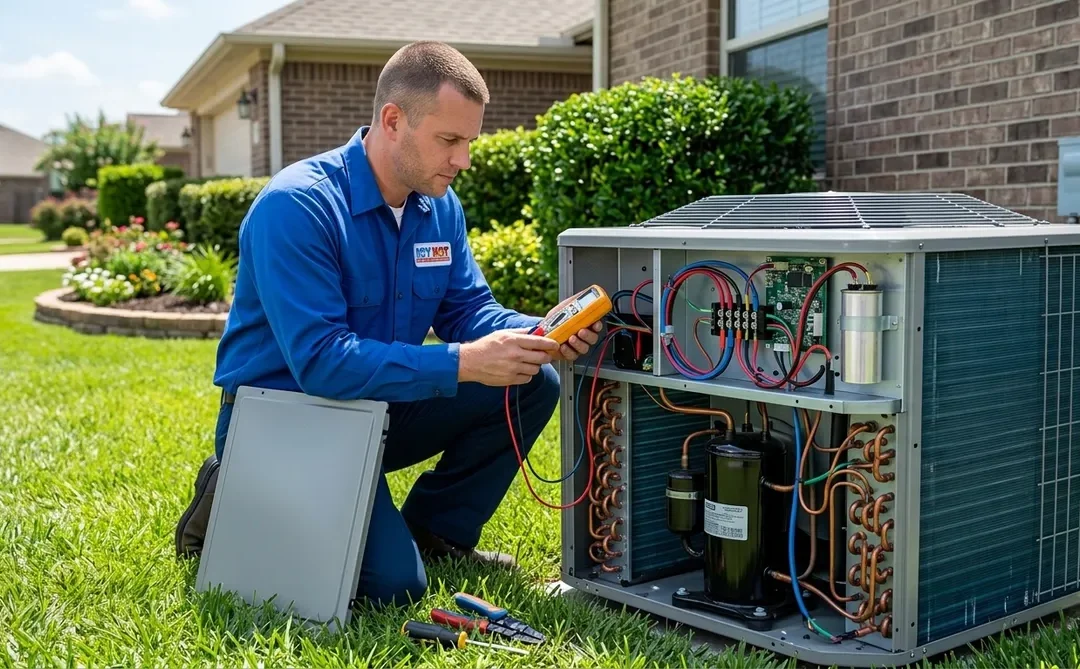
- Electrical testing: Tighten connections, test capacitors, and inspect contactor condition. Loose wires cause roughly a third of the no-cool calls we diagnose.
- Motor voltage and amp readings: Compared against manufacturer specs to catch motors that are trending toward failure
- Lubrication: Oil motor bearings and moving parts on systems that require it
- Performance testing: Measure temperature split across the evaporator coil (15–20°F is normal), check airflow, verify thermostat calibration
- Safety inspection: Test gas connections (if applicable), verify safety controls, confirm emergency shut-offs function
If your technician finishes in 15 minutes, they didn’t do a real tune-up. A thorough inspection takes 45 to 90 minutes.
AC Maintenance Checklist
Bookmark this page or print this table. It’s the easiest way to stay on top of every maintenance task throughout the year.
| Task | Frequency | Who | Time |
|---|---|---|---|
| Check/replace air filter | Monthly | DIY | 5 min |
| Clear condensate drain | Monthly | DIY | 10 min |
| Clean around outdoor unit | Monthly | DIY | 15 min |
| Rinse condenser coils | Spring & Fall | DIY | 30 min |
| Inspect blower fan | Spring & Fall | DIY | 10 min |
| Check line insulation | Spring & Fall | DIY | 5 min |
| Refrigerant level check | Annual | Professional | , |
| Electrical connection inspection | Annual | Professional | , |
| Motor voltage/amperage test | Annual | Professional | , |
| System performance test | Annual | Professional | , |
| Full safety inspection | Annual | Professional | , |
Frequently Asked Questions
Is Annual AC Maintenance Worth the Cost?
Your air conditioning system is a $4,000 to $8,000 investment (HomeAdvisor, 2026). Spending $150 a year to protect it isn’t an expense, it’s insurance. Between energy savings of up to 15%, avoided emergency repairs, extended equipment life, and preserved warranty coverage, maintenance pays for itself several times over.
Ready to protect your system before Raleigh’s next summer? Call Icy Hot at (919) 673-7667 to schedule your tune-up, or check out our maintenance packages for year-round coverage.