Every October the same conversation happens in a Raleigh hallway. A homeowner has two quotes on the kitchen counter, both from people they liked, and the second one is about fifteen hundred dollars higher. The only real difference on the page is one line: two-stage. The salesperson said it would be quieter, more even, and would pay for itself. The homeowner wants to know whether that is true or whether it is the furnace version of undercoating.
Here is the short version, and it is not what either quote will tell you. A two-stage gas valve changes how your house feels. It does not change the efficiency number printed on the furnace label, and in Wake County it will not pay for itself in any timeframe you should plan around. Both of those statements come straight from the manufacturers and from the federal agencies that write the efficiency rules, and I will show you exactly where.
The pages currently ranking for two stage furnace vs single stage are almost all other contractors’ blogs, and they repeat the same three promises: lower bills, quieter operation, longer life. What none of them does is put a number on the savings, check that number against the gas bill of an actual North Carolina household, or mention that two of the biggest furnace manufacturers in the country flatly refuse to publish the figures their dealers quote.
So this is the version I would give a neighbor, built from EPA ENERGY STAR, the federal efficiency rules themselves, Energy Information Administration gas data for North Carolina, the National Weather Service record for Raleigh-Durham, the North Carolina Residential Code and the four brands we install and service every week.
TL;DR: A two-stage furnace buys comfort, not efficiency. It runs at roughly 60 to 65 percent output most of the winter and steps up to 100 percent when it has to, which in Raleigh is almost never: the 1991 to 2020 normal at RDU is 2.4 days a year when the high never clears freezing. The comfort case here is genuinely good. The money case is not. The average North Carolina gas household spends about $671 a year on space heating, EPA credits an entire ENERGY STAR furnace upgrade in the U.S. South with $60 a year, and the two-stage upcharge runs $1,000 to $2,500, so payback lands somewhere between 10 and 186 years depending on which savings claim you believe. Buy it for the even temperatures and the quiet. Treat the fuel savings as a rounding error. Want a straight read on your own quote? Call (919) 673-7667.
What Is the Difference Between a Single-Stage and a Two-Stage Furnace?
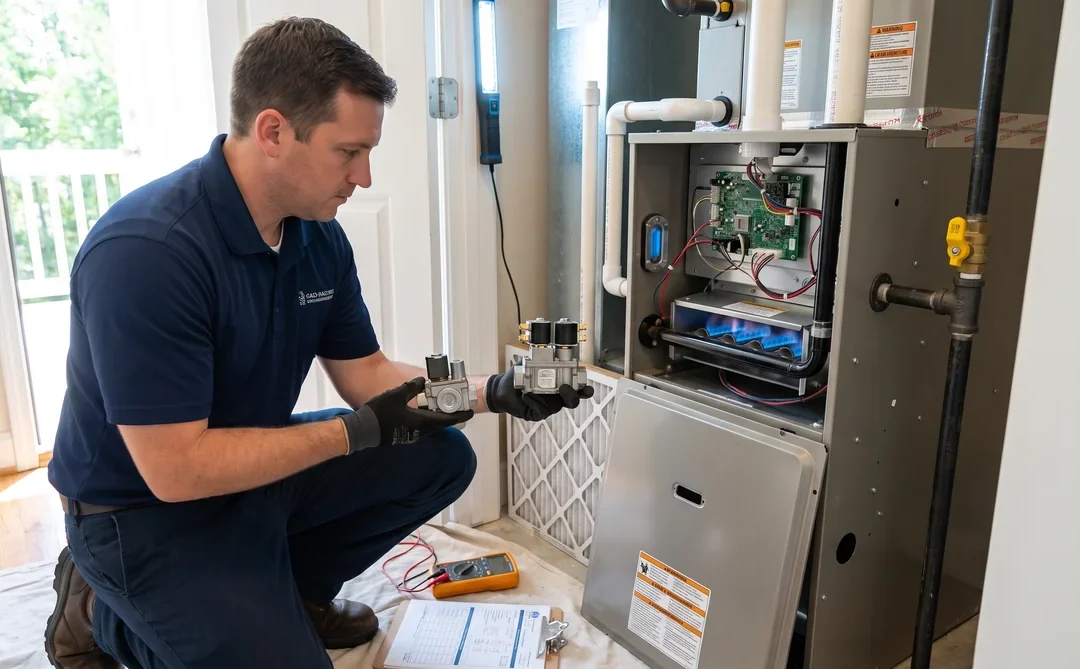
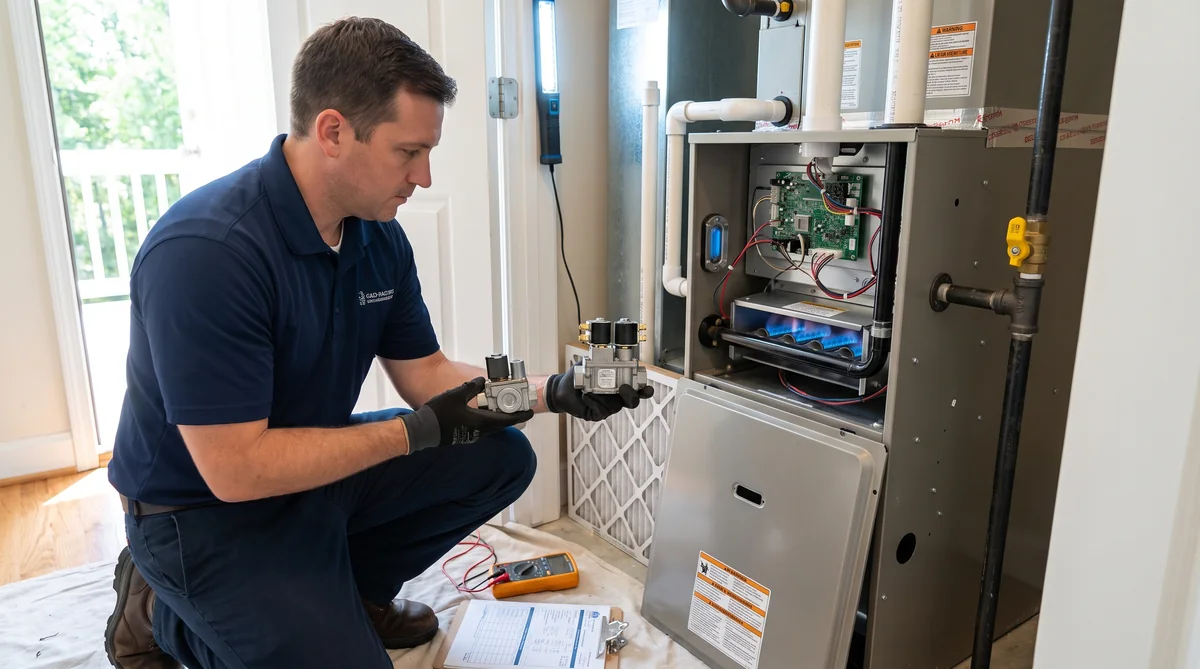
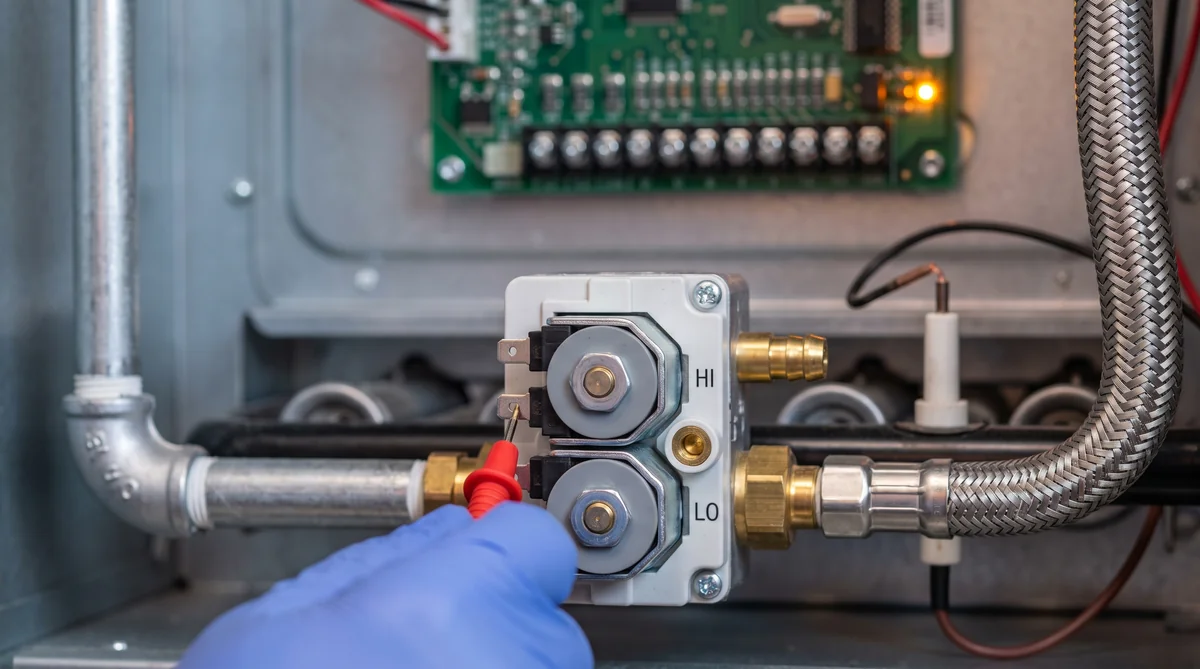
The difference is the gas valve, and nothing else is required to change. Goodman puts it in one sentence in its gas furnace features comparison guide: “The stage is all about the gas valve and the burner.” A single-stage valve has one position. When the thermostat calls, fuel flows at the full rate until the call ends. A two-stage valve has a low position and a high position, so the same furnace can burn at part output on a 48 degree morning and at full output on a 22 degree one.
How much is the low stage? The manufacturers are consistent. Bryant states that “a two-stage gas valve typically operates at about 60% to 65% capacity during mild weather and opens to 100% capacity when more heat is needed.” American Standard describes the same split: a two-stage system “can operate at 65% or 100% capacity.” Bryant says a single-stage furnace “turns on at maximum capacity, heats the house rapidly, and then shuts off,” while a two-stage furnace “can spend more time operating at its lower stage before increasing output when heating demand rises.”
Carrier is more specific about how much of the season that low stage actually covers. Its two-stage furnace guide notes that the Infinity 96 Gas Furnace, model 59TN6, “can operate in low stage up to 90% of the time,” and says the same of the Infinity 97, model 59TN7. Ninety percent of run time at roughly two thirds output is the entire pitch for two-stage heating in one number.
What does not change is just as important. Both valves bolt into the same cabinet, feed the same burners, and push heat through the same heat exchanger. Neither one is inherently a condensing furnace, neither one is inherently high-efficiency, and neither one carries a different AFUE rating by virtue of its staging. Bryant’s own catalog settles this cleanly. Its Evolution 80, model 880TA, lists a gas valve type of two-stage, a variable-speed ECM blower motor, and a gas efficiency of 80 percent AFUE. Its Preferred 97, model 927T, is also two-stage and reaches up to 97 percent. Same gas valve architecture, seventeen AFUE points apart. The staging did not set the efficiency in either case; the heat exchanger did.
Does a Two-Stage Furnace Actually Use Less Gas?
A little, probably, and nobody who builds them will tell you how much. That is not a dodge on my part. It is the literal position of two of the largest furnace manufacturers in the United States.
Bryant, on its own two-stage product page, says this: “Bryant does not publish a universal percentage of energy savings for two-stage furnaces versus single-stage models, so actual savings depend on equipment efficiency, runtime, climate, sizing, and operating conditions.” Carrier reaches the same place from the other direction: “Rather than assuming a fixed percentage of fuel savings, homeowners should compare the AFUE rating, furnace size, installation requirements and expected operating conditions of the models being considered.”
Read that twice. The companies with the test labs, the dynamometers and the engineering staff decline to name a savings figure. Then go read the contractor blogs on page one of this search, and you will find confident claims of 10 to 15 percent, sourced to nothing.
So let us bound the problem instead. If no one will supply the percentage, we can at least work out what the percentage would have to be worth.
The Energy Information Administration publishes monthly residential natural gas consumption for North Carolina. In 2024 the state’s residential customers used 68,778 million cubic feet, and the summer months of June through September averaged 1,220 million cubic feet, which is the baseload for water heating, cooking and dryers. Subtract twelve months of that baseload and 54,141 million cubic feet is attributable to space heating. Spread across the 1,444,353 North Carolina residential gas customers on the system that year, that is 37.5 thousand cubic feet of heating gas per household.
At the January 2026 North Carolina residential price of $17.89 per thousand cubic feet, the typical North Carolina gas household therefore spends roughly $671 a year heating the house. That is the entire pot a two-stage gas valve is competing for.
Now the ceiling. EPA’s ENERGY STAR page on furnaces states that a certified gas furnace in the southern half of the country is “up to 16 percent more efficient than standard models and can save an average of $60 in energy costs each year.” That $60 is what EPA credits to the entire jump from a code-minimum 80 percent furnace to a certified 95 percent or better one. It is 8.9 percent of a $671 heating bill.
Which means any claim that a two-stage valve alone saves 10 or 15 percent is claiming that moving one valve beats the whole efficiency upgrade the federal government actually measures. I have never seen anyone defend that claim, because it is not defensible. The honest range is somewhere below $60 a year, and probably well below it.
What Will Each Manufacturer Actually Put in Writing?
Less than your quote does, and on two points they contradict each other outright. This is the most useful table on this page, and I have not seen anyone else build it. Each row is a claim a salesperson is likely to make, and each cell is what the brand’s own published page says about that claim.
I want to be precise about what follows. Every cell below is drawn from a page the manufacturer publishes under its own name, not from a dealer, a distributor or a reseller, and not from a quote anyone handed me. Where a brand says nothing on a point, the cell says so rather than filling the gap with an inference. That is a lower bar than it sounds: three of these four companies say nothing at all about noise, and two of them go out of their way to tell you a number does not exist.
Two things fall out of that table. The first is that a confident percentage, from anyone, is a sales number rather than an engineering one. The second is the lifespan row, where Bryant and Trane are plainly in disagreement in print. Trane says the longer, gentler cycles reduce stress. Bryant says that is not established. They are both reputable, they both build good equipment, and on this question only one of them can be right.
For what it is worth, after twenty years of pulling furnaces out of Triangle houses, I lean toward Bryant’s caution. What kills furnaces here is a cracked heat exchanger, a failed inducer, corrosion from a bad condensate path, or a filter nobody changed. I cannot point to a single Raleigh furnace that died early because its gas valve had one position instead of two. If that matters to you, our guide to the signs a furnace needs replacing walks through what actually ends a furnace’s life here.
What Does a Two-Stage Furnace Cost in Raleigh?
Plan on $1,000 to $2,500 over the comparable single-stage model, and know where that number comes from, because its origin is odder than you would expect.
Carrier’s FAQ states that “on average, a two-stage furnace costs $1,000 to $2,500 more upfront than a comparable single-stage model,” and footnotes it to a Today’s Homeowner article. Go read that article and the range is not there. What is there are two separate installed-cost spans: a single-stage furnace “costs between $2,500 and $4,000 installed” and a two-stage furnace “typically costs $3,500 to $6,500 installed.” Subtract the low ends and you get $1,000. Subtract the high ends and you get $2,500. Carrier’s figure is the arithmetic gap between two ranges, not a measured upcharge.
That does not make it wrong. It makes it an estimate built from a third party’s estimate, which is worth knowing before you treat it as a fact. Bryant, separately, answers the cost question on its own two-stage page by saying “Installed costs range from $4,000 to $12,000” depending on brand and efficiency, a span wide enough to contain almost any quote.
The broader replacement numbers come from HomeAdvisor, updated in June 2026. Its normal range for a furnace replacement is $2,823 to $6,897, with most homeowners spending around $4,814 and the full span running $167 to $13,750 once outliers are counted. Gas furnaces specifically average $3,800 to $10,000 installed, and removing and disposing of the old unit adds $60 to $330.
One Triangle-specific warning about any of these numbers. The expensive surprise in a Raleigh furnace replacement is almost never the staging. It is the jump from an older 80 percent furnace to a condensing model, which needs new PVC venting and a condensate drain path the old metal flue cannot provide. Ask every quote to state in writing whether venting and condensate work is included, then compare the staging line afterward. We cover the full picture on our furnace installation page.
What Is the Payback on a Two-Stage Furnace in Raleigh?
Between about ten years and about a hundred and eighty-six, and the honest end of that range is the long end.
We now have both halves of the arithmetic. The heating bill is roughly $671 a year. The upcharge is $1,000 to $2,500. All that is left is to pick a savings rate and divide, which is the step every page on this topic skips.
Pick the rate honestly, though. A two-stage valve does not change combustion efficiency; the burner and heat exchanger are doing the same chemistry at either output. What it changes is cycling loss, the heat that goes up the flue during the startup and cooldown of each cycle, plus a small reduction in standby loss from fewer purge cycles. Those are real effects and they are also modest, which is the engineering reason no manufacturer wants to stamp a percentage on them.
Read the chart from the bottom up, because the bottom is where the evidence points. A 2 percent saving, which is roughly what you would expect from slightly better combustion staging on a mild-climate load, is $13 a year and never pays back anything. Five percent is $34 a year and lands at 30 to 75 years. Even the aggressive 15 percent claim, which exceeds what EPA credits to a whole efficiency upgrade, needs 10 years on the cheapest possible upcharge and 25 on the dearest.
Set that against Trane’s own lifespan figure: “an average gas furnace will last 15-20 years.” HomeAdvisor says 15 to 25. Bryant says two-stage furnaces last “around 15 to 20 years with regular care,” the same as standard models. So on the most favorable assumption in the table, you break even at roughly the point the equipment is due for replacement.
There is one more way to sanity-check this, which is to ask what the two-stage upcharge buys if you spend it on something else. Twelve to fifteen hundred dollars is a duct sealing job, or a properly sized return added to a starved system, or a good part of a whole-home dehumidifier. Each of those changes how the house feels too, and two of the three show up on the energy bill in a way staging will not. That is the comparison I would want a homeowner to make before the comfort argument carries the day by default.
I want to be careful here, because this is the section where it would be easy to overclaim in the other direction. These are modeled numbers built from state-level averages, and your own house is not the state average. If you heat 3,800 square feet to 74 degrees, your bill is larger and every payback above shortens. If you have a tight new build in Holly Springs, it lengthens. The shape of the answer does not change, though. At Raleigh gas prices and Raleigh heating loads, no plausible staging benefit pays back a four-figure upcharge inside the equipment’s life.
Why Raleigh’s Winter Changes the Answer
Because the high stage is engineered for a day the Triangle gets about twice a year. This is the part of the decision that no national guide can do for you, and it cuts in two directions at once.
Every furnace is sized for the design day, the cold snap it has to handle without help. Everything milder than that is part load. The National Weather Service 2025 annual climate report for Raleigh-Durham shows exactly how much of a Triangle winter is part load, and the answer is nearly all of it.
The numbers below are worth sitting with for a moment, because they are the single most Raleigh-specific input in this entire decision and almost nobody puts them in front of a homeowner.
In a normal year, RDU records 2.4 days when the temperature never climbs above freezing, 64.7 nights that drop to 32 degrees or below, and zero days at or below 0 degrees. In 2025 the observed numbers were 2, 55 and 0, with a yearly low of 14 degrees on December 15. The same report puts 2025 heating degree days at 2,821 against a normal of 3,153.
Here is the cut that goes for two-stage. A furnace sized for a 2.4-day-a-year event is, on the other 120 heating days, drastically more furnace than the house needs. That mismatch is exactly what produces the short, hard cycles a single-stage furnace is known for: a blast of 110 degree air, a fast overshoot, a shutdown, and a slow sag until it does it again. A two-stage valve is a direct fix for that specific problem, and Raleigh has more of that problem than Minneapolis does, not less. The comfort argument is strongest in mild climates, which is the opposite of what most of the ranking articles tell you.
And here is the cut that goes against it. The reason the comfort gain is large is the same reason the fuel gain is small: there are very few heating hours to save fuel across. Lennox says plainly that in regions “with long, cold winters, a modulating furnace’s efficiency and comfort can be especially valuable,” and that “smaller homes may see less dramatic differences.” Raleigh is on the mild end of that spectrum, with the heating degree days to prove it.
So the correct way to frame the purchase is this: in Raleigh you are buying a comfort feature that works unusually well here, at a price that will never be repaid by the gas meter. If you want even temperatures and a quiet house, that is a perfectly good reason to spend the money. If someone sells it to you as an investment, they are selling the wrong thing.
Is a Two-Stage Furnace Quieter?
Yes, noticeably, and the reason is mostly the blower rather than the burner.
What you hear when a furnace starts is almost entirely air. Air moving through a return grille, through a filter, around a duct elbow and out a supply register. Burner noise is a small part of it in a modern sealed-combustion cabinet. So the quiet comes from moving less air, more slowly, for longer.
Think about where the sound in a forced-air system actually comes from. A single-stage furnace starts its blower at one fixed speed and holds it there, which means full static pressure across the filter and the ductwork from the first second of the cycle. A variable-speed blower ramps, and when the furnace is on low stage it has roughly a third less heat to move, so it can hold a lower speed for the whole cycle. Less air velocity through the same grille is less noise, and the ramp removes the startup thump entirely.
This is where two-stage and variable-speed get tangled, because the furnaces that carry a two-stage valve almost always carry a better blower too. Bryant’s two-stage 927T pairs its valve with “a variable 25-speed, constant-torque ECM blower” and an insulated cabinet. Carrier’s Performance 97, model 59TP7, pairs two-stage heating with “a variable 25-speed blower.” The valve and the motor ship together, you pay for both on one line, and you hear the motor.
Can anyone tell you how many decibels you are buying? No. Bryant is explicit: it “does not publish a specific decibel reduction for two-stage operation versus single-stage operation, so a fixed dB savings claim would depend on the equipment and installation.” That last phrase matters more than people realize. An undersized return duct will undo a 25-speed blower’s advantage before the air ever reaches the room, which is why we look at the ductwork on every heating installation before anyone talks about stages.
Our honest field experience: in a house with adequate returns, the difference between a single-stage furnace and a two-stage furnace with an ECM blower is the difference between knowing when the heat comes on and not knowing. In a house with a single undersized central return, it is a much smaller difference, and the money would be better spent on the duct.
Do Two-Stage Furnaces Last Longer?
Nobody has proven it, and the two brands that address the question directly disagree.
The argument for is intuitive and Trane makes it: two-stage systems “often experience less mechanical stress because they are able to operate at lower speeds, meaning you may not need to replace your unit for a longer time.” Fewer ignition cycles, gentler thermal expansion in the heat exchanger, less start current through the blower. It is a reasonable theory.
The argument against is that it has not been demonstrated, and Bryant says so on the record: two-stage operation “can also reduce the need for repeated full-output cycles, but it does not establish a guaranteed reduction in component wear or a specific extension of furnace life.” Bryant also puts two-stage furnace life at “around 15 to 20 years with regular care,” which is the same window Trane publishes for furnaces generally and the same window HomeAdvisor publishes.
Meanwhile, the second stage adds parts. A second solenoid, a second low-voltage circuit, more control-board logic, and a pressure switch arrangement that has to prove the inducer is running at the right speed for the stage it is in. Today’s Homeowner notes the practical consequence bluntly: with more parts and electronics, two-stage furnaces “can be trickier” to service and “replacement parts may be harder to find, especially for older models.”
So the lifespan column is a wash at best. Plan on 15 to 20 years either way, keep up the annual furnace maintenance, and do not let a longevity claim carry the upcharge. The published numbers line up almost exactly across sources, which is itself the answer.
Two-Stage, Variable-Speed and Modulating Are Three Different Things
Two of those words describe the gas valve, one describes the blower motor, and most quotes use them interchangeably. Carrier says so itself, which is unusual candor for a manufacturer.
Carrier’s comparison guide draws the line this way. Modulating “refers to the type of gas valve and how much heat the system outputs,” while variable-speed “refers to the type of blower motor and how much air it circulates.” Carrier then adds the part that explains most of the confusion on a sales call: many people say variable-speed when they actually mean two-stage heating, “which refers to another type of gas valve.”
Bryant calls it an important distinction and makes the same split: two-stage “describes the furnace’s heating output levels,” while variable-speed “describes the blower motor’s ability to operate at multiple airflow speeds.” Bryant then adds the sentence that matters on a quote: “A furnace can have both technologies.”
Modulating is the third rung. Lennox describes a modulating gas valve as one that “adjusts fuel flow in tiny increments” so the furnace “can deliver exactly the amount of heat required,” and places two-stage in between: it “provides some flexibility and better comfort than a single-stage model, but adjustments are still limited.” Bryant’s modulating Evolution 98, model 987M, reaches up to 98.5 percent AFUE. American Standard says its variable-speed equipment has “more than 700 speeds” and can run “anywhere from 25% to 100% capacity.”
Why does the distinction matter for your wallet? Because the blower is where the measurable electricity saving lives, and it is the part the federal government actually regulates for energy use. Under 10 CFR 430.32(y), every residential furnace fan manufactured on or after July 3, 2019 has to meet a fan energy rating cap. For a condensing gas furnace the limit is 0.044 times maximum airflow plus 195 watts per thousand cubic feet per minute. Nothing in that rule mentions staging. The gas valve is governed by AFUE; the motor is governed by the fan rule; they are separate regimes.
Practical takeaway: if what you actually want is a quieter house and better filtration from longer run times, the blower is doing most of that work. Ask the salesperson to price the variable-speed blower separately from the two-stage valve if the lineup allows it. Often it does not, which is useful to know before you attribute the whole upcharge to staging.
Do You Need a Different Thermostat for a Two-Stage Furnace?
Usually yes, and it has to be wired for it, not just compatible on the box.
Bryant is direct: “a compatible two-stage thermostat is recommended to fully control both stages, although some models can self-adjust based on your existing thermostat setup.” That caveat is doing real work. Some furnaces will run their own staging logic off a single W wire, stepping up to high after a set time on low. Others will not, and if the W2 terminal never gets a signal the furnace simply never leaves low stage, which on a 20 degree morning means the house does not keep up.
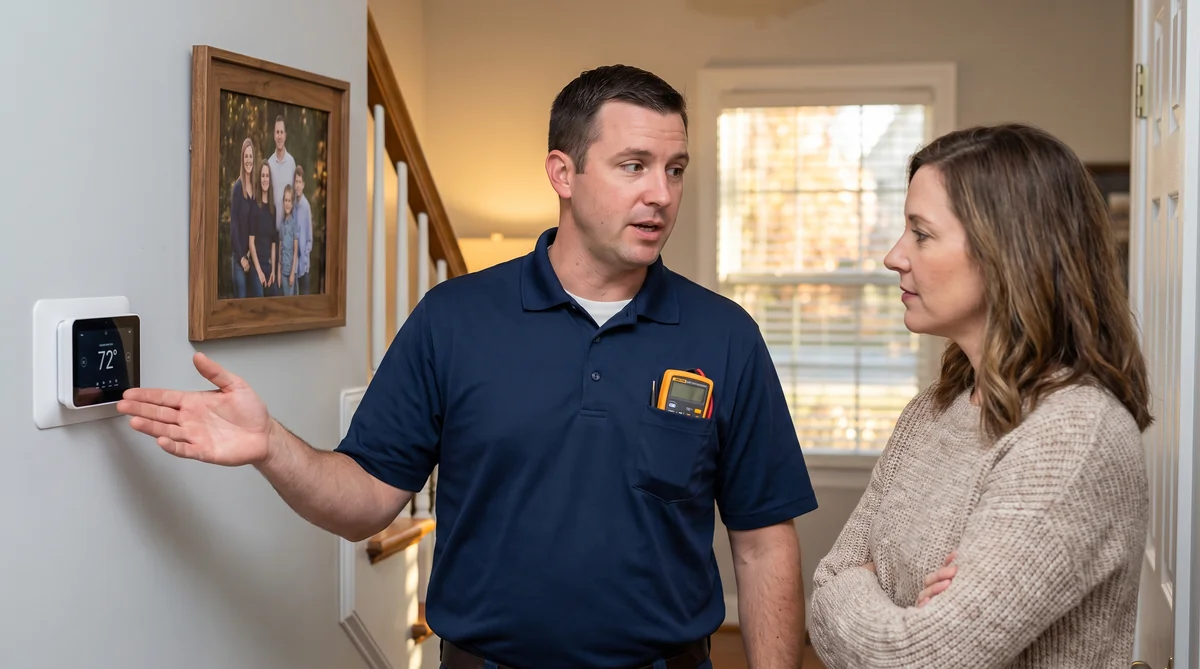
The wiring tell is simple. Google’s Nest support documentation says that “Single stage systems will only have one wire for heating (in the W or W1 connector) and one wire for cooling (in the Y or Y1 connector).” Multistage systems, it continues, “will have more than one heating or cooling wire. For example, systems with 3-stage conventional heat will have wires in the W1, W2, and W3 connectors.”
Which matters because of the cable already in your wall. A house wired in the 1990s for a single-stage furnace and a single-stage air conditioner very often has 5-conductor thermostat wire, and every one of those five conductors is already spoken for by R, C, W, Y and G. There is no spare for W2. Pulling new thermostat cable from the furnace to the hallway is usually a 45-minute job and occasionally an unpleasant one, and it belongs in the quote rather than appearing as a change order on installation day.
There is a second control question worth asking while the installer is standing there. A two-stage furnace paired with a communicating thermostat from the same brand will often stage more intelligently than the same furnace driven by a generic two-stage stat, because the control can see outdoor temperature and supply air temperature rather than just a call for heat. That capability usually carries its own price, and it is frequently bundled into the two-stage quote without being named. Ask what the thermostat line item actually is.
If you are shopping for the control at the same time, our comparison of Nest, ecobee and Honeywell thermostats covers which models handle multistage heat well. And if your system is a heat pump with gas backup, the staging conversation changes again, which we cover on the dual fuel systems page.
Sizing Matters More Than Staging, and North Carolina Law Agrees
A correctly sized single-stage furnace will outperform an oversized two-stage furnace, every time.
Goodman states the requirement plainly: “Your installation technician should confirm the size or BTUs required by performing a Manual J load calculation. This calculation evaluates the heating needs of your entire home by assessing square footage, number and location of windows, insulation values, and more.”
In North Carolina that is not advice, it is code. Section M1401.3 of the North Carolina Residential Code requires that “heating and cooling equipment and appliances shall be sized in accordance with ACCA Manual S or other approved sizing methodologies based on building loads calculated in accordance with ACCA Manual J or other approved heating and cooling calculation methodologies.”
And then comes a detail that almost nobody writes about. The first numbered exception to that section applies when “the specified equipment or appliance utilizes multistage technology or variable refrigerant flow technology and the loads calculated in accordance with the approved heating and cooling calculation methodology are within the range of the manufacturer’s published capacities for that equipment or appliance.”
Read that carefully: a multistage furnace gets measurably more sizing latitude under the code than a single-stage one, because the calculated load only has to land somewhere inside the manufacturer’s published capacity range rather than being matched tightly by Manual S. That is a legitimate engineering argument for two-stage equipment, and it is the one argument I would actually accept from a salesperson. It is also an argument that only pays off if someone ran the Manual J in the first place.
HomeAdvisor’s rule of thumb, “about 30 to 60 BTUs per square foot,” puts a 2,000 square foot house somewhere between 60,000 and 120,000 BTU. That is a two-to-one span, which tells you precisely how useless a rule of thumb is for this decision. Ask for the load calculation. If a contractor will not produce one, the staging line on the quote is the least of the problems with it. Here is the short list we would hand a homeowner comparing two quotes side by side, in the order the items actually move money.
What Is the “$5,000 Rule,” and Should You Use It?
It is a folk formula, no manufacturer or agency publishes it, and it is a decent tiebreaker and a terrible decision rule.
Google surfaces this question right under the two-stage search, so it is worth answering. The rule goes: multiply the furnace’s age in years by the quoted repair cost. If the product is over $5,000, replace it. A 17-year-old furnace with a $400 repair gives 6,800, so replace. A 9-year-old furnace with a $400 repair gives 3,600, so repair.
I went looking for a primary source and could not find one at any manufacturer, at EPA, or in the federal rules. What manufacturers publish instead is the 50 percent rule, and Goodman states it while naming where it came from: “Consumer Reports suggests that if the cost to repair your current furnace is 50% of the cost of a new furnace, you should replace it.” Against HomeAdvisor’s $4,814 average, that line sits at about $2,407.
Neither rule says anything at all about staging, which is the point worth making here. The repair-versus-replace question and the single-versus-two-stage question are different decisions that happen to arrive on the same day. Settle the first one on safety and cost, and only then, if you are replacing, open the staging question. Running them together is how people end up buying a feature in a hurry, on a cold morning, with no heat in the house.
If you are already in that conversation, our walkthrough of when a furnace needs replacing and our page on furnace repair will both get you to a number faster than a formula will.
When We Recommend Two-Stage in a Raleigh Home, and When We Don’t
The deciding factor is almost never the fuel bill. It is the floor plan, the ductwork and how long you are staying.
After the arithmetic above, you might expect me to talk everyone out of it. I do not. Plenty of Triangle homes are genuinely better with a two-stage furnace, for reasons that have nothing to do with payback. Here is the honest split we use on quotes.
The pattern we see on Triangle quotes is that the houses that benefit most are the ones where air has a long way to travel and the thermostat is nowhere near the problem room. A bonus room over a garage is the classic case: it has exterior walls on five of its six sides, it sits at the end of the longest duct run in the house, and the hallway thermostat downstairs is satisfied long before that room is. A single-stage furnace will dump its full output, hit setpoint in the hallway in eight minutes and shut off, and the bonus room never catches up. A longer, gentler cycle is a real fix for that, not a marketing one.
That sixth row deserves a note. Carrier points out that longer run times give “more opportunities for air to pass through the home’s furnace filter,” though it is careful to add that “actual filtration performance depends on the filter, blower operation and overall HVAC system.” That is a real secondary benefit in pollen season, and it is a better reason to like two-stage equipment than any savings claim on this page.
If you want the same comparison on the cooling side, where the humidity argument is much stronger, we wrote that up separately in single-stage versus two-stage air conditioners. And if your system is a heat pump rather than a furnace, the staging conversation is different again; start with heat pumps versus central air.
What Changes in 2026, and Again in 2028
The federal tax credit is gone, and in December 2028 the efficiency floor jumps enough that staging becomes the only real choice left.
Start with the credit, because quotes are still being written against it. The IRS states that the Energy Efficient Home Improvement Credit “is allowed for qualifying property placed in service on or after Jan. 1, 2023, and before December 31, 2025.” A furnace installed in 2026 does not qualify. If a quote nets out a federal credit, send it back.
On the state side, Energy Saver North Carolina’s program-changes notice states that Department of Energy guidance “must be implemented by Sept. 1, 2026,” and that under it “Fuel Switching Projects are NOT allowed: Rebates will no longer be allowed for the replacement of gas or any other fossil fuel appliances through the HEAR rebates pathway.” A new gas furnace does not qualify for that pathway. We keep the current picture updated in our North Carolina HVAC rebates guide; check it before you assume anything on a quote.
Now the 2028 change, which almost nobody is talking about yet. 10 CFR 430.32(e)(1) sets the minimum AFUE for non-weatherized gas furnaces at 80.0 percent for units manufactured before December 18, 2028. Paragraph (iii) raises it to 95.0 percent for units manufactured on and after that date. In other words, the 80 percent furnace is on a clock, and after 2028 every new gas furnace is a condensing furnace.
That matters for this decision in a way that is easy to miss. Once the AFUE floor rises to 95, the efficiency spread across the whole market collapses to almost nothing. We can see how little room is already left by counting the certified models today.
Of the 3,704 certified natural-gas furnace models on EPA’s list as of October 2026, 1,425, or 38.5 percent, are rated at exactly 95.0 percent AFUE, the U.S. South minimum. Another 1,334 sit between 96.0 and 96.7, 875 between 97.0 and 97.5, and just 70 reach 98.0 or above. The entire certified field spans four AFUE points. And per ENERGY STAR’s published key product criteria, the criteria are only two: 95 percent AFUE or greater for U.S. South gas furnaces, 97 percent or greater for U.S. North, and air leakage of 2.0 percent or less. Staging is not a certification criterion at all.
So the direction of travel is clear. The efficiency question is being settled by regulation. What will still be a real choice in 2029 is how the furnace delivers that heat, which is the staging question, bought for comfort on its own merits rather than sold as a savings story.
One last piece of context on timing, since this is a seasonal question. We pulled the twelve-month search pattern for this topic while writing, and the shape of it explains why every Raleigh contractor’s phone rings about stages in the same six weeks.
The curve below is our own pull, summed across the eight keywords people actually use for this question.
Searches jump 87 percent from September to October, peak at 7,930 in January, and bottom out at 2,570 in June. People ask this question when the heat first comes on and again when the first gas bill arrives. Both are the worst possible moments to make a four-figure decision in a hurry, which is a good argument for settling it in September instead.
Frequently Asked Questions About Single-Stage and Two-Stage Furnaces
The Bottom Line for Raleigh Homeowners
A two-stage furnace is a good product that is usually sold with the wrong argument. The gas valve has two positions instead of one, it runs at roughly 60 to 65 percent most of the winter, and in a house with decent ductwork you will feel the difference. That is worth money to some people and not to others, and either answer is defensible.
What is not defensible is the savings pitch. Bryant will not publish a savings percentage. Carrier tells you not to assume one. EPA credits an entire certified-furnace upgrade in the U.S. South with $60 a year, which is under 9 percent of the $671 the average North Carolina gas household spends heating the house. Any number larger than that, attributed to a gas valve, is a sales figure.
Three things I would actually do before signing either quote. Ask for the Manual J load calculation, because North Carolina’s code requires the sizing to be based on one and a correctly sized single-stage furnace beats an oversized two-stage furnace every winter. Ask whether the price includes new thermostat wire, since the W2 terminal is useless without a conductor to reach it. And ask the installer to separate the venting and condensate work from the staging line, because on an 80 percent to condensing upgrade that is where the real money usually is.
If you want a straight read on a quote you already have, or help deciding between a gas furnace and an electric one, or a look at whether a heat pump makes more sense for your house than either, call us at (919) 673-7667. You can also schedule online, request an instant quote, or reach us through the contact page. We handle heating work across Raleigh, Cary, Apex, Garner, Durham, Wake Forest and the rest of the Triangle service area, and we are happy to tell you when the cheaper furnace is the right furnace.
Written by Frankie Asfari, owner of Icy Hot Heating & Air Conditioning in Raleigh, NC. NATE-certified, NC HVAC License #L.34356.