We get this question more than almost any other: “Is this quote fair?” Most Raleigh homeowners have no idea what AC repair should cost until they’re already sweating. A technician quotes $450, and you don’t know if that’s reasonable or a rip-off. Industry pricing data puts the average AC repair cost in Raleigh at $365, with a typical range of $279 to $403. But that average hides a lot of variation. A simple capacitor swap is on the low end, while a compressor replacement can cost several times the average. And if your system uses old R-22 refrigerant, even a basic recharge gets expensive fast because the refrigerant is no longer manufactured.
This guide breaks down every major AC repair cost in Raleigh for 2026: by component, by system age, by season, and by refrigerant type. By the end, you’ll know what’s fair, what’s a red flag, and when it makes more sense to replace than repair.
TL;DR: AC repair costs in Raleigh average $365, with a typical range of $279 to $403 (Homeyou, Mar 2026). Drain line clogs and capacitor replacements are the most common repairs. If a repair quote exceeds 50% of a new system’s cost, replacement is usually the smarter call (HomeAdvisor, Nov 2025). Schedule a service call before summer demand drives up wait times.
What Does AC Repair Cost in Raleigh, NC?
The average AC repair in Raleigh costs $365, with most homeowners paying between $279 and $403 (Homeyou, Mar 2026). Nationally, HomeAdvisor (Nov 2025) puts the average at $350 with a range of $130 to $2, 000. Raleigh tracks close to the national average, though summer demand can push prices toward the higher end.
Before any repair work begins, you’ll pay a diagnostic fee of $75 to $200. This covers the service visit, full system diagnosis, and a written repair estimate. Some companies apply the diagnostic fee toward the cost of any approved repair, so it’s worth asking upfront. Labor rates for HVAC work in the Triangle run $75 to $175 per hour (Fixr, Jan 2026).
Several factors drive the final number higher or lower: the specific component that failed, how old your system is, which refrigerant it uses, and whether you’re calling at 2 PM on a Tuesday or 10 PM on a July Saturday. We’ll cover all of those below.
AC Repair Costs by Type: The Full 2026 Breakdown
Drain line clogs are the single most common AC repair in Raleigh, and capacitor replacement runs a close second, according to Fixr (Jan 2026). Both are relatively affordable fixes when caught early. In our shop, we replace more capacitors in a single July than any other component all year.
On the affordable end, you’re looking at drain line clears, capacitor swaps, and contactor replacements. These are the repairs most Raleigh homeowners end up needing, and they’re usually under $500. On the expensive end, compressor and evaporator coil replacements can push $1, 500 to $2, 000 or more on an older system. Before you accept a compressor quote, check the signs of a bad AC compressor, because a capacitor or contactor produces the same no-start symptom for a fraction of the cost. At that price point, the repair-or-replace math gets important fast, which is why it pays to catch the cheap causes early. Running a system with a frozen evaporator coil is one of the fastest ways to turn a filter change into a compressor bill.
If you’re dealing with specific component issues, you can learn more about compressor repair, evaporator coil repair, and condenser repair on our service pages.
What Does the Diagnostic Fee Cover?
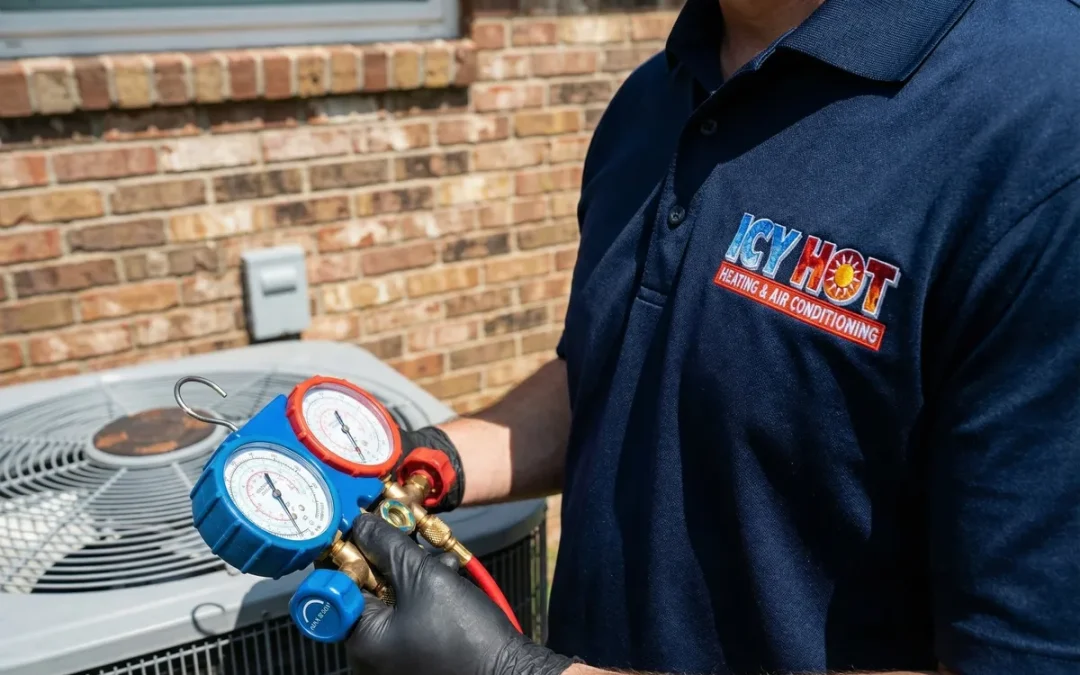
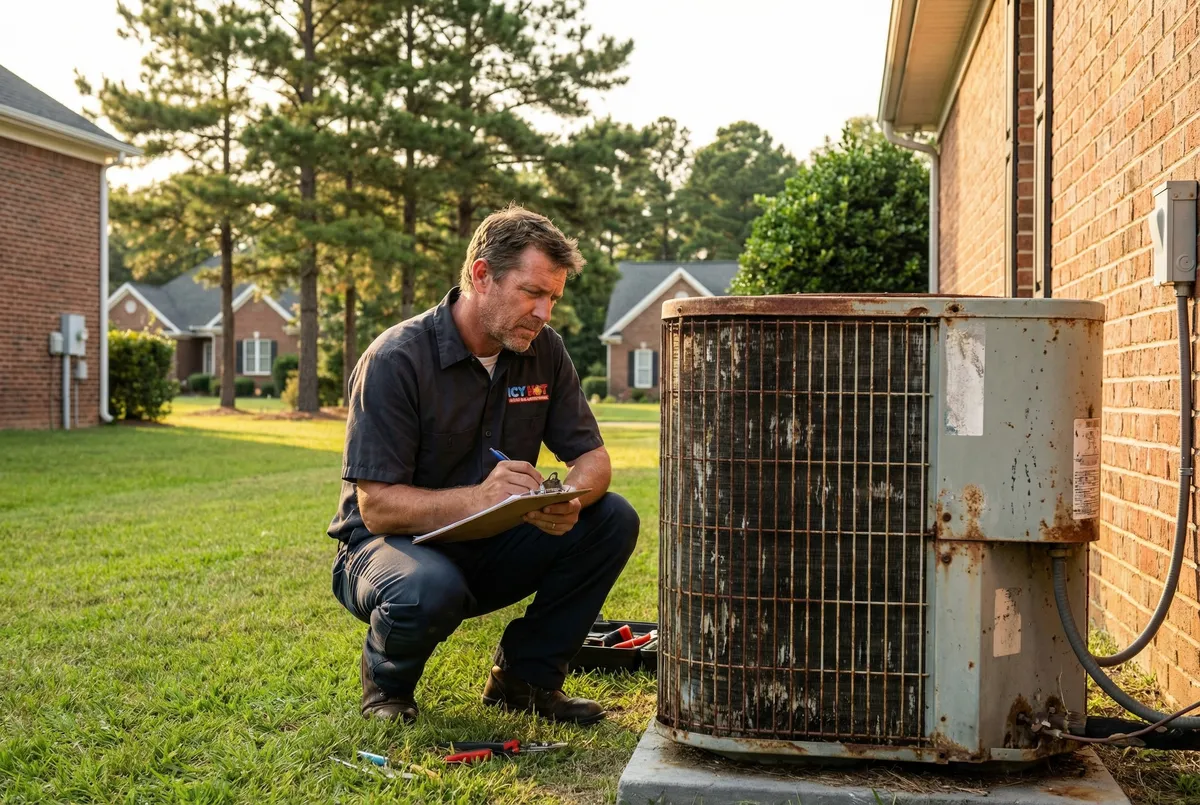
A diagnostic fee of $75 to $200 covers more than a technician showing up at your door. When one of our techs comes out, they’re checking refrigerant pressure, testing electrical components, inspecting the condenser and evaporator coils, verifying airflow, and tracking down the root cause. Then you get a written estimate before any wrench turns. No surprises.
Some companies apply the diagnostic fee toward the repair cost if you approve the work. That policy varies, so always confirm upfront when you call.
Calling after hours changes the math. After-hours and weekend diagnostic visits typically cost more because technicians are paid overtime. Some companies charge a flat after-hours premium; others charge the same diagnostic fee but add a separate emergency surcharge. For emergency AC service calls, expect the diagnostic fee to run toward the top of the $75 to $200 range or beyond.
How Does Refrigerant Type Affect Your AC Repair Bill?
I’ve had the refrigerant conversation with folks hundreds of times, and it still catches people off guard. Refrigerant type is one of the biggest hidden variables in AC repair pricing. The type your system uses depends almost entirely on when it was manufactured, and older refrigerants cost dramatically more per pound.
The short version: R-22 (Freon) costs significantly more per pound than newer refrigerants because it’s no longer manufactured. The EPA banned production under the Clean Air Act, and the remaining supply is all recovered or recycled. If your system uses R-22, it was built before 2010 and is at least 16 years old.
R-410A has been the standard since the mid-2000s and is still reasonably priced. The EPA banned it from new equipment manufactured after January 1, 2025, but systems already in the field can still use it. R-454B is the new standard required in all new AC equipment from 2025 onward, with significantly lower environmental impact.
The practical consequence: if your system runs on R-22 and needs a full recharge, the refrigerant cost alone can make the repair hard to justify on a system that’s already 16-plus years old. That cost equation almost always points toward replacement rather than repair.
For a deeper look at how refrigerant regulations are changing and what R-454B means for Raleigh homeowners, see our guide to R-454B refrigerant and the new A2L standards.
Does Your AC’s Age Drive Up the Repair Bill?
Age is the strongest predictor of AC repair frequency and cost. According to HomeAdvisor (Nov 2025), systems in their first five years average roughly $230 per year in repair costs. By years 16 to 18, that climbs to $700 or more per year. That’s triple the cost for a system that’s also running less efficiently and drawing more electricity for every hour it runs.
The U.S. Department of Energy (Dec 2024) estimates the average AC lifespan in hot-humid climates like North Carolina’s Southeast region at 18 years for a properly maintained unit. ENERGY STAR recommends replacing systems over 10 years old that need frequent repairs. That means if your system is pushing 15 years, statistically you’re in the back half of its life, and annual repair costs will keep climbing.
The years between 11 and 15 are often the trickiest. The system is old enough to need real repairs, but not old enough that replacement is automatic. That’s exactly when the 50% rule and the $5, 000 rule (covered in the next section) become most useful.
In our experience at Icy Hot, the systems most likely to fail catastrophically in July are the ones that had “minor” issues three summers in a row that never got fully addressed. A capacitor replaced one year, a refrigerant top-off the next, a contactor the year after. Each repair felt affordable on its own. But looking back, that homeowner spent $900 over three years on a 16-year-old system that ultimately needed full replacement anyway. Annual maintenance costs would have been less and would have flagged the bigger picture earlier.
Repair or Replace? How to Make the Call
Two rules of thumb help homeowners decide between AC repair service and AC replacement. The 50% rule, cited by HomeAdvisor (Nov 2025), says: if the repair cost exceeds 50% of what a new system would cost, replace. A new central AC system in Raleigh typically runs $4, 000 to $8, 000 installed, depending on efficiency tier and whether you choose a single-stage or two-stage compressor. That puts the repair threshold around $2, 000 to $4, 000. For a full breakdown of replacement pricing by system size, see our AC replacement cost guide.
The $5, 000 rule from ENERGY STAR is a quick formula: multiply your system’s age by the repair cost. If the result exceeds $5, 000, replace. So a 12-year-old system with a $450 repair quote: 12 × $450 = $5, 400. That math says replace. A 5-year-old system with a $500 repair: 5 × $500 = $2, 500. Repair it.
A few situations make replacement the clear answer even without running the numbers:
- Your system uses R-22 refrigerant. If it runs on R-22, it’s at least 16 years old and the refrigerant supply is only getting more expensive. Don’t sink another major repair into it.
- The compressor or evaporator coil has failed out of warranty. These are the most expensive repairs. If the equipment warranty has expired, replacement often pencils out better.
- You’ve had two or more major repairs in three years. That pattern usually continues. ENERGY STAR notes that systems over 10 years old consuming more energy than necessary should be evaluated for replacement, with new units saving up to 20% on cooling costs.
If replacement is on the horizon, get a free instant quote before committing to a major repair on an old system. Sometimes seeing the replacement number puts the repair cost in a very different light.
Why Summer AC Repairs Cost More in Raleigh
Our phone starts ringing off the hook the first week Raleigh hits 95 degrees. Summer isn’t just when your AC is most likely to fail. It’s when repairs cost the most. According to DOE and Trane (Feb 2026) data, roughly 30% of all annual AC repairs happen in June, July, and August: nearly a third of the year’s volume compressed into three months. July is consistently the single busiest month for AC service calls nationwide.
That volume creates two cost pressures. First, technician availability tightens. Companies book out days in advance during heat waves, and same-day service commands a premium. Second, after-hours calls spike. A system that fails at 8 PM on a Friday in August qualifies as an emergency, and emergency rates run 20% to 50% above standard rates, with total after-hours repair costs ranging from $300 to $1, 200 (Trane, Feb 2026). A repair that would be $350 on a Tuesday afternoon in April can easily run $600 on a Saturday night in July.
The best way to avoid summer pricing is to get ahead of it. An AC maintenance visit in March or April costs $75 to $200 and catches failing capacitors, low refrigerant, and dirty coils before they turn into a 9 PM emergency call in July. Our Comfort Club membership includes twice-annual tune-ups, priority scheduling, and discounts on any needed repairs.
How to Lower Your AC Repair Costs
Several practical steps can reduce what you spend on AC repairs over the life of your system. Fixr (Jan 2026) found that regular maintenance reduces the likelihood of major repair events significantly, with well-maintained systems averaging roughly 40% lower annual repair costs than unmaintained ones.
Sign Up for an Annual Maintenance Plan
A maintenance plan is the single highest-ROI step most homeowners can take. Twice-yearly tune-ups (spring and fall) catch small issues before they become expensive emergencies. They also establish a service relationship, which typically means priority scheduling when you do need a repair in peak season. The plan often pays for itself in the first repair it prevents.
Register Your Equipment Warranty
This one’s free money that people leave on the table constantly. Most major AC brands offer 10-year parts warranties, but only if you register the equipment within 60 to 90 days of installation. Miss that window and you default to a 5-year warranty. We’ve seen customers save over $1, 000 on a compressor replacement just because they registered their unit. Under warranty, the part is covered and you pay labor only: $600 to $1, 200 instead of $2, 300.
Understand the R-410A Transition
If your current system runs on R-410A and needs a refrigerant recharge, that’s still a reasonable repair. But know that R-410A equipment won’t be manufactured after 2025. When replacement time comes, you’ll be moving to R-454B equipment. Factor that transition into your long-term planning rather than making it a surprise.
Get a Thermostat Diagnostic Before Assuming Hardware Failure
At least once a week, we get called out for what someone thinks is a dead compressor, and it turns out to be the thermostat. A surprising number of AC “failures” are actually thermostat issues. Before agreeing to a compressor or control board replacement, make sure the technician has ruled out the thermostat. A $90 to $600 thermostat swap beats a $1, 500 compressor repair that doesn’t actually fix the problem.
Ready to get an accurate number for your situation? Get a free instant quote online, or book a technician for a full diagnostic. We’ve been servicing AC systems in Raleigh since 2008.
Frequently Asked Questions
The Bottom Line
AC repair costs in Raleigh average $365, and most repairs fall in the $279 to $403 range. But what you actually pay depends heavily on which component failed, how old your system is, which refrigerant it uses, and when you call. Drain line clogs and capacitor replacements are quick and affordable. Compressor and coil repairs on an aging, out-of-warranty system often make replacement the smarter financial move.
The clearest action you can take right now: if your system is 10 or more years old and hasn’t had professional maintenance this year, schedule a tune-up before the summer rush hits. A $100 to $200 maintenance visit that finds a $150 capacitor issue in April beats a $600 emergency call in July by a wide margin.
Icy Hot has been handling air conditioning repair in Raleigh since 2008. Call us at (919) 673-7667 or schedule a service call online. For heat waves and system failures after hours, our 24-hour AC repair service is available year-round throughout the Triangle.